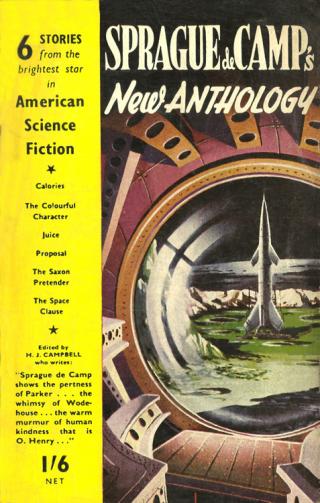
Sprague de Camp's New Anthology
- Автор: Де Камп Лайон Спрэг
- Год: 1953
- Язык: английский
- Год: Panther
- Жанр: Научная фантастика

Электронная книга - «Sprague de Camp's New Anthology». Краткое содержание книги:
The boy walked right up to the president's desk and handed a fistful of radiogram forms to Kalish, who said "Thank- you" in an absent-minded way, and peered at the forms. The boy murmured "Bienvenu, monsieur" and walked off.
Kalish swallowed as he read. The message was one long radio running over a half-dozen sheets. At last he laid down the radiogram and spoke into the microphone:
"The meeting will please come to order. The first item on to-day's agenda is the so-called Space Clause proposed by the delegation from the Andean Federation. It was planned to conclude arguments pro and contra this clause and vote on it this afternoon. However, news has just reached me which, if authenticated, has so great a bearing on the adoption of this clause that I think I should read it to you. It is a Reuter's dispatch from Darjeeling, India, and reads as follows:
"November fifth. An object described as a spaceship of extra-terrestrial origin landed yesterday in eastern Neping, near the Tibetan border in the vicinity of Kishanganj. First reports indicate that the beings who man the ship are green bipeds nine feet tall with tentacles for arms. Their intentions are said to be friendly.
"The arrival of a visitor from outer space is confirmed by a number of witnesses in Sikkim, over which the ship slowly passed while looking for a landing-place. In view of the enormous importance of this arrival, both as proving the long-surmised existence of intelligent extra-terrestrial life and as bearing upon the political organisation of the world to deal with the problems posed by this fact, the Government of Neping has waived its usual prohibition against entry of foreigners into the country to permit qualified experts and officials of the Indian Government to investigate the visitors. As Prime Minister Rajendrachandramohananah of Neping expressed it in a telephone call to Darjeeling, ' For the sake of God, sirs, let wise men be sent forthwith to cope with this appalling manifestation. We of Neping are not qualified to do so.'
"Pending the arrival of an official mission of the Indian Government to welcome the visitors in the name of the peoples of the earth, Richard Nugent, a retired American journalist living in Darjeeling, has crossed the border into Neping and struck out into the wild region where the ship is said to have come to earth ..."
Kalish finished the radiogram, took off his glasses, and rubbed his eyes with his finger-tips. Then he said:
"In view of the importance—"
Wilhelm Feuer, of the German delegation, was waving for attention. When recognised he said:
"This is all very impressive, Mr. President, but let us not by our emotions carried away be. To me it seems that the coincindence of such a landing, just when the so-called Space Clause is under consideration, is simply too perfect to be believed. At least we should await confirmation to be sure we are not the victims of a hoax."
"As I was about to say," continued Kalish, "in view of the importance of this development, the chair will entertain a motion to defer action on this clause until this time tomorrow."
The motion was made and carried, and for the rest of that session the Convention devoted itself to a long wrangle over tariffs.
When the meeting adjourned, the members swarmed around the newstand. By that time the newspapers bore not only the Reuters dispatch that Kalish had read, but a confirmatory Associated Press dispatch giving further information.
Richard Nugent, it seemed, had radioed that he had reached the space-ship and met the aliens, who had brought an elaborate equipage of linguistic apparatus, picture-books and the like, to enable them to get into communication with the Terrans. Further information was promised soon.
Mateo Marco Lope Aguirre Malaria glanced up from his newspaper with a smile of quiet triumph. It seemed to him that the other delegates were looking at each other with a new seriousness. When he had brought up the Space Clause, some had thought it ridiculous because there were no intelligent extra-terrestrials; others preferred to leave all non-essential controversies to the future, counting on amending the Constitution when and if civilised e.-t.'s were discovered. Now that the delegates were faced with extra-terrestrial reality, the petty national disputes that had stirred up such high words and hard feelings seemed small.
Next morning the papers carried still more information. By working furiously Nugent had gotten into communication with the aliens. He announced that they were from a planet of the small star Ross 154. There was a blurry radiophotograph which Nugent had transmitted with his portable set to Darjeeling and which had been re-transmitted around the world. It showed a bald man standing between two tall things that might have been a backward child's attempt to model a man in plasticene. The Indian party had already flown to Darjeeling and would take off the following day for the space ship in a helicopter with a television camera.
At that afternoon's session, Aguirre braced himself for argument. But none came. In fact one of his bitterest critics, Jacob Atta of Nigeria, rose to say that:
"While I have been opposed to this clause in the past, the events of the last twenty-four hours have changed my mind. Even if the space-ship should turn out to be a hoax, I now think it advisable to have this clause in the Constitution, just in case."
After a minor bicker over the meaning of the word "intercourse," the Convention adopted the Space Clause and went on to the rest of its business. There was little debate; everybody's mind was far away, in the rhinocerous-haunted wilds of Neping. In fact the President (Bretkun of Lithuania) managed to get compromise proposals on tariffs and immigration adopted that afternoon, leaving nothing to do but make laudatory speeches until the Drafting Committee finished polishing and homogenizing the final draft. The Sheikh of Aden made a speech in Arabic, followed by speeches from delegates of Afghanistan, Albania, and Algeria, and then the meeting adjourned.
Aguirre was relaxing in the bar when his glorious chief stalked in and strode up to him.
"Aguirre," said la Torre, "we leave tomorrow. Art thou ready?"
"Carajo! Why, chief?"
"I have received word that my enemies conspire against me, so I must get back to Andea at once."
"But you will miss the final ratification!"
"No; I have arranged it with Kalish and Carstairs-Brown. The Drafting Committee shall work all night and present the Constitution tomorrow morning to a special session. Then I will make my speech—Andea comes alphabetically after Algeria—and we shall rush to the airport as soon as I have finished. Get packed."
"Yes, yes, chief, of course."
And so it was done.
La Torre's airplane was over Venezuela when the radio broke the news that the arrival of the extraterrestrial space-ship had been a hoax after all, perpetrated by a group of journalists including Dagobert Heck and Richard Nugent. The announcer ended with a sardonic note:
"... the delegates to the World Government Constitutional Convention are having a hearty laugh over the departing speech made this morning by Senor Juan de la Torre Baroja, in which he boasted in extravagant terms of his authorship of the Space Clause and claimed sole credit for any benefits that might accrue to the earth hereafter as a result of communication with other civilized planets. However, inquiries at the Convention indicated that there, is no present intention of repealing the Space Clause, as this would require procedural complications, and since the clause is regarded as at worst a harmless piece of whimsy ..."
Aguirre became conscious of his chief's glittering black eyes. La Torre rasped:
"So! My dignity has been insulted! And who is responsible? Who put me up to backing that accursed Space Clause, saying that it would resound to the eternal fame and credit of the Andean Federation and its President, the people's choice, Juan Serafin de la Torre Baroja? Who led me astray and exposed me naked to the pitiless laughter of the world? Fool! Poltroon! Thou shalt see!"