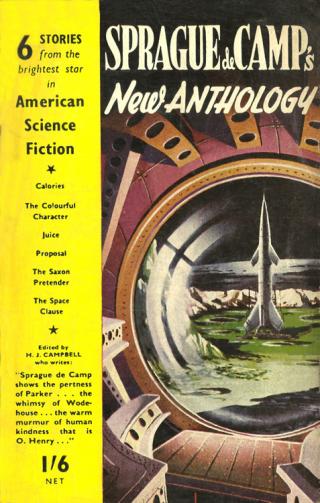
Sprague de Camp's New Anthology
- Автор: Де Камп Лайон Спрэг
- Год: 1953
- Язык: английский
- Год: Panther
- Жанр: Научная фантастика

Электронная книга - «Sprague de Camp's New Anthology». Краткое содержание книги:
Godwin sat in his bungalow telling his adventures to his friend Westbrook Wolff: "... and now Viggo Bruun is at Cal. Tech. finishing a new parachron, and he's promised me a job as a technician when my contract runs out. I may never be a real scientist, but I can twiddle knobs and hold a soldering-iron."
"How about our red-haired sun-bather?"
"Back at U.S.C.; her old man took a house in Glendale, and thinks I'm Santa Claus because I got him a bit-part in The Spider of Brazil. Anker Gram stood on his head trying to get us all back to Greenland so he wouldn't have to pay me damages for kidnapping me, but they wouldn't go. That reminds me ..." Godwin picked up the telephone and dialled. "Karen? Claude. Ja like to see the premier of Amazon Gold to-morrow night? Okay, I'll pick you up at twenty-hundred. See ya."
As Godwin hung up, Wolff looked at him with an amused expression, saying: "Don't tell me that after all the fighting and running you did to avoid marrying the dame you're going to do it anyway!"
"Not at all. I am dating Miss Hauch in the normal manner, and if on further acquaintance we decide we're made for each other and etcetera, who knows? Or again we may not. But nobody's gonna pressure us into it!"
The Space Clause
Dr. MATEO Marco Lope Aguirre Malaria, the eminent jurist, sat at a table in the bar of the Convention Quarters and wept into his rum.
These Quarters were those of the World Government Constitutional Convention, in a set of concrete chambers deep underground in the Rhone Valley. These accommodations had been hastily converted from the former Supreme Headquarters, United Civilised States, usually known as SHUCKS. The Convention was taking place in this armoured warren, first, because most of the earth's larger cities had taken hits in the war and were, therefore, short of housing—when they had any houses left at all; second, because the war was not quite over.
A journalist named Dagobert Heck sat down at the same table and asked: "Why do you weep, Dr. Aguirre?"
"My friend," said Aguirre, "I weep because we are off on the wrong track. Once again we fail to grasp opportunity by the forelock."
"Oh, I don't know," said Dagobert Heck. "Considering what the world has been through lately—most of its cities mashed flat and half a billion of its population blown to bits—I think we're doing better than we had any right to expect. We're getting a bigger improvement on the United Nations than the United Nations was on the League of Nations. The new World Government will have a directly elected legislature, the right to tax, and the world's only armed force. Ten years ago we'd have said that was Utopian moonshine. Why then so sad?"
"Because these narrow-minded so-called statesmen cannot look beyond the petty confines of their own planet!"
"Oh, you mean the Space Clause." Heck closed his eyes and recited the beginning of the controversial clause from memory: "'The Gerousia shall have the exclusive right to represent the peoples of the earth in relations with extra-terrestrial life-forms, should any such forms be discovered to exist; to limit, regulate, and forbid intercourse between the peoples of the earth and such life-forms; and to limit, regulate, and forbid movement of persons and things between the earth and other heavenly bodies ...' Oh, well, it's probably not vital. We've been to the moon and found nothing but a few viruses, and conditions don't look promising for life on the other planets, either."
"Exactly what that fool Carstairs-Brown said!" Aguirre mimicked the speech of the British delegate. " 'Really, you know, wouldn't Her Majesty's Government look a bit silly getting all set to welcome the Martians, and having it transpire there aren't any?' They forget that this is not the only sun in the universe."
Heck nodded sympathetically. Aguirre went on:
"And others, I think, hope to defeat the clause so that they can carry on nationalistic and imperialistic policies, if not on the earth, then off it somewhere."
"Look here, are you sure the fact that you're the author of this clause hasn't prejudiced you?"
"Sir, I have no prejudices!" Aguirre lowered his voice. "Save perhaps a slight one in favour of living."
"What do you mean?"
"You know my glorious chief?"
Heck nodded. Aguirre's chief was Juan Serafin de la Torre Baroja, President of the Andean Federation, a new political entity that had taken the place, amid the general uproar of World War III, of several of the nations of western South America. Not satisfied with making himself president for life of Andea, la Torre had appointed himself head of the Andean delegation to the Convention so as to have a personal finger in the new constitutional pie.
"Well," said Aguirre, "he is, as you know, a man of the utmost sense of personal, dignity. I—ah—sold him on this Space Clause, as you would express it, with the result that he has placed the Andean delegation squarely behind it and made speeches on its behalf. Now if the clause is not adopted he will feel that his honour has been insulted". And since he cannot take his feelings out on Carstairs-Brown and the other sceptics, he will vent them on me"
"What'll he do? Can you?"
"If that were all! Did you not hear how he had fourteen political opponents shot without trial before taking off for this Convention?"
"I probably did. So he's the guy who calls himself the great democratic liberator?"
"Oh, but he is! Think of all the things that he has done for the masses—free parades, extra holidays to hear his speeches, and all the rest! But these people were criticising him in public. Naturally he could not tolerate such insults to his dignity, or the people would have doubted his virility and thrown him out. After all, one must make oneself respected. But that^, alas^ will not save my neck."
"Too bad," said Dagobert Heck. "You Andeans have certainly done all you could to put the clause across. Short of having a space-ship land with a load of little green men with tentacles ... Hey!" Heck frowned into his drink. "That gives me an idea. There's an old friend of mine in India named Dick Nugent, used to work with me on the World-Telegram-Sun, but he retired a few years ago to become a yogi. Maybe ... Say, when does this clause come up for a final vote?"
"To-morrow, if the meeting goes according to schedule."
Heck consulted his watch. "Excuse me. I think I can just make it."
"Make what?" asked Aguirre. But Dagobert Heck had gone.
Myron Kalish, the American Secretary of State, took his turn as president of the Convention the following noon. His bland exterior concealed a battalion of worries that would have floored a lesser man, the chief being that after all his toil and travail the Senate of the United States would insert a long, sharp knife into his back by refusing to ratify the new Constitution. Already senators from the Middle West were talking ominously about "giving away the rights that our boys fought and died for at Valley Forge, Antietam, Chateau-Thierry, Midway and Teheran ..."
Nevertheless, Kalish prepared to call the meeting to order. With luck the Steering Committee should be able to wind up the thing in three more days. Most of the terms and clauses of the document had already been agreed upon.. There remained only the controversial questions of what power, if any, the World Government should have over tariffs and immigration, and this silly Space Clause in which Juan de la Torre seemed so inexplicably interested. Kalish thought such a provision absurb, but did not wish to offend La Torre, who, despite his domestic sins, had brought the Andean Federation into the war on the side of the United States.
Kalish was opening his mouth to speak, when the sight of a messenger-boy hurrying down an aisle stopped him. It must be pretty urgent or the guards would never have let the boy through during the actual session.