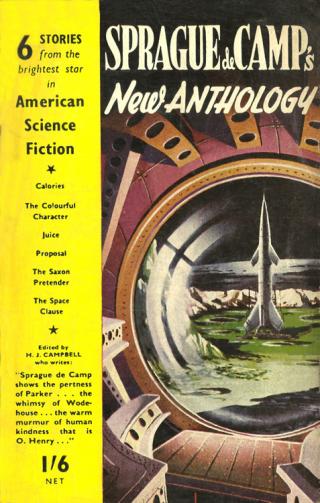
Sprague de Camp's New Anthology
- Автор: Де Камп Лайон Спрэг
- Год: 1953
- Язык: английский
- Год: Panther
- Жанр: Научная фантастика

Электронная книга - «Sprague de Camp's New Anthology». Краткое содержание книги:
"Why all the cops?" asked Godwin. "Even if this machine works—I mean, in spite of the fact that it works, I don't see why the secrecy."
Bruun said: "It is Anker Gram's doing. He has all sorts of profound political plans connected with the parachron. Besides, he thinks some criminal might wish to destroy the machine lest it be used to view his crimes in the past. This machine should eliminate crime and clear up a lot of mysteries like the Aarestrup fraud."
The elder Bruun led them into a laboratory room littered with the usual clutter of wires, tubing, electric cables, glassware, stands, clamps, meters, old copies of technical magazines, and ash-trays made of discarded scientific apparatus. In the middle of the room, on a massive concrete bench, stood the parachron: a thing somewhat like a television set without its cabinet, but much larger. Besides the viewing screen facing the door, the machine bore on top a gadget with a parabolic reflector, something like a small radar antenna. Viggo Bruun continued:
"We think that is all foolishness. This is science. We should take it around the world to solve the great historical problems, and not waste time in political manoeuvres and tracking down petty pickpockets."
"If you had to track them down," said Otto Malling, "you would not take such a yolly attitude about them."
"Perhaps not, my friend," said Bruun. "But if this works that way a lot of you fellows will be out of jobs, because a crew with a parachron can visit the scene of every crime and get all the evidence to convict right there."
"If the lawyers don't have the machine outlawed because it makes it too hard for their clients to make an honest living by robbery," said Malling.
Bruun turned back to Godwin. "Some day, maybe, we can take the parachron down between Latitudes thirty and forty North and really find out something about history. Meanwhile, Anker Gram says no, and he is the boss."
"You mean," said Godwin, "you gotta lug the machine around to the places where the things actually happened? You can't just sit here in Greenland and twiddle knobs and see the Battle of Waterloo?"
"That is right. You cannot. Actually, the magneto-gravitic matrix precesses about three degrees to the West per century, so the impressions of the Battle of Waterloo would be—let me see—" (he glanced at a wall-map) "—about where the south-west tip of England is now."
Bruun sighed, a faraway look in his eyes. "If I can only live long enough to get it down to the latitude of Alexandria and photograph the lost books in the Library ..."
"How ja get the pics Gram says prove I'm descended from that King Harold?"
"We flew the parachron in one of the whaling helicopters down to the middle of the Atlantic, between fifty and fifty-five North and fifty and fifty-five West. The whole life-history of King Harold and his immediate descendants is there. It is quite a job, because if you start shooting on a stormy day the wind makes the helicopter—how would you say—wobble about, so the pictures wobble, too."
"Look, Dr. Bruun, I'm no scientist, just a dumb actor, but I know a little about probability, and it sure doesn't stack up that I should be the guy to get—uh—involved with the Princess Karen, and at the same time be the eldest whatsit descendant of this old king. That's too much like drawing two pat royal flushes in a row."
Bruun smiled faintly. "You cannot argue with facts, my friend. Would you like to see the parachron in operation?"
"You bet!"
Bruun turned to the machine. "Karl, put that quintode tube back in. You see, Mr. Godwin, you can't see much right here, except the neighbourhood of Bergen about the year 420 A.D., or the Oslo region about 320. And they are not very impressive."
Karl Bruun replaced the tube that had been taken out of the machine, then pushed a wall-switch, whereupon the windows became opaque and the room dark except for the faint glow of vacuum-tubes inside the jungle of rods and wires and condensers. Viggo Bruun twirled knobs until a ghostly light appeared on the viewing-screen, then a blizzard of flickers and flashes like a television set out of tune.
The image cleared. Godwin found himself looking at a rugged landscape with a body of water in the distance.
"Bergen Fjord," said the older Bruun.
As the scientist turned more knobs, the antenna on top revolved, and the image on the screen swept around in a panorama. The image was black and white, surprising to Godwin, who had been brought up on colour in photography, cinematography and television.
Bruun said: "We are about the tenth of June, 421 A.D. As I remember, there is a man who goes close by here ..." The image jerked as he made an adjustment. "There he is! Take a good look."
A man was walking across the view. Though Godwin could not judge his size well without familiar objects to compare him with, he got the impression of a short man. He was dark and shaggy, clad in rough woollens: a kind of kilt wrapped around him under the armpits and reaching to his knees, and a shawl over his shoulders. He bore a bag on his back and gripped a staff in his free hand. As Godwin watched, the man passed out of sight.
"Very few people in Norway and Sweden at that time," said Brunn. "You have to hunt hard to find one. Mostly they were a miserable lot of Lapp-like folk living along the shores and digging clams. The big migration of Nordics from Jutland had not yet started."
"How far back can you. go? To the age of the dinosaurs?"
"Oh, my, no! In theory you can go back twelve thousand years, the time required for the matrix to precess clear around the earth. In practice, the image gets fuzzy when you try to go back more than five thousand. There is one nice view a little older than that ..."
The scene shifted, and Godwin was looking at a huge herd of bison drifting through snow-covered woodland.
"That is near modern Upsala," said Bruun. "If we go on back and eastward all we see is Russian and Siberian forest—hundreds of years and thousands of miles of it."
Godwin asked: "How about those movies of my ancestors? Got any here?"
"Yes."
Viggo Bruun spoke in Danish to his son. The parachron was switched off. There were clicks and whirrings in the dark, and a motion-picture image sprang into life on one concrete wall.
"This," said Viggo Bruun, "is the first reel of the Harold of Wessex series. That is King Harold marrying Aldyth. It wobbles a little because of the wind the day we photographed it."
The scene—black-and-white like the direct view, and badly lighted—showed a man and a woman in early-mediaeval costume standing before a man in ecclesiastical garb. The first man was a tall, broad-shouldered, clean-shaven fellow with a crown on his square-cut blond hair.
"Those are Earls Edwin and Morcar, who made all the trouble," said Bruun. "The little fellow at the right of the scene ..."
"Say," said Godwin, "that Harold guy looked all right. He'd have made a good actor."
"Quite a heroic character, but you ought to see the other Harold he fought against, King Harold Sigurdson of Norway. There was a legendary character in real life! Now the wedding is over and they are going in to the wedding-feast ..."
As the film ground on, Godwin remarked: "It just occurs to me this'll put the costume-movie out of business. You could dub in the sound. Who'll pay to see an actor playing Lincoln when he can see Lincoln himself? Say, this damn thing doesn't give a guy any privacy at all!"
"That is right. With the parachron you can really find out who is descended from whom." After a further pause, Bruun said: "Here are a few sequences of the Battle of Hastings, to give continuity."
Looking at the confused and dust-obscured scene, Godwin said: "We could put on a better battle in Hollywood. Look at those extras just standing around! Half of 'em aren't earning their pay."