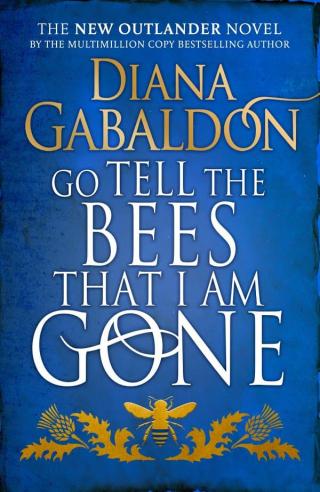
Go Tell the Bees That I Am Gone
- Автор: Гэблдон Диана
- Серия: Outlander #9
- Год: 2021
- Язык: английский
- Год: Delacorte Press
- ISBN: 978-1-473-51900-8
- Жанр: Исторические приключения

Электронная книга - «Go Tell the Bees That I Am Gone». Краткое содержание книги:
The past may seem the safest place to be . . . but it is the most dangerous time to be alive. . . .
Jamie Fraser and Claire Randall were torn apart by the Jacobite Rising in 1746, and it took them twenty years to find each other again. Now the American Revolution threatens to do the same. It is 1779 and Claire and Jamie are at last reunited with their daughter, Brianna, her husband, Roger, and their children on Fraser’s Ridge. Having the family together is a dream the Frasers had thought impossible. Yet even in the North Carolina backcountry, the effects of war are being felt. Tensions in the Colonies are great and local feelings run hot enough to boil Hell’s teakettle. Jamie knows loyalties among his tenants are split and it won’t be long until the war is on his doorstep. Brianna and Roger have their own worry: that the dangers that provoked their escape from the twentieth century might catch up to them. Sometimes they question whether risking the perils of the 1700s—among them disease, starvation, and an impending war—was indeed the safer choice for their family. Not so far away, young William Ransom is still coming to terms with the discovery of his true father’s identity—and thus his own—and Lord John Grey has reconciliations to make, and dangers to meet . . . on his son’s behalf, and his own. Meanwhile, the Revolutionary War creeps ever closer to Fraser’s Ridge. And with the family finally together, Jamie and Claire have more at stake than ever before.
Bibles, of course, but only a large one with an embossed leather cover and gilded pages, and a devotional-sized Book of Psalms beside it with a green leather cover, bright as a tiny parrot. He instantly revised his original opinion of the bookshop’s quality and likely custom, an opinion borne out by the neat array of novels in English, German, and French—including the French translation of Robinson Crusoe, intended for children, from which he’d been taught French at the age of ten or so. He smiled, momentarily distracted by the warmth of memory—and then glanced up from the display of books to see Amaranthus hovering behind it, no more than her pale face visible through the glass, as though she’d been beheaded.
The shock was so great that he gaped stupidly at her for a moment, but he observed that while not gaping stupidly, she appeared at least to be equally taken aback at sight of him. He drew himself up and fixed her with a stare meant to convey that it was no use her running out of the back door and down the alley, because he was undoubtedly faster than she was and would hunt her down like a fleeing tortoise.
She correctly interpreted this look and her changeable eyes—black, in the dimness of the shop—narrowed dangerously.
“Try me,” he said. Out loud, to the startlement of an elderly lady who had stopped beside him to peruse the bookshop’s wares.
“I beg your pardon, ma’am,” he said, bowing. “Will you have the goodness to excuse me?”
Not waiting for an answer, he pushed open the shop’s door and went in. Not surprisingly, Amaranthus was gone. He glanced hastily round the room, which—like every bookshop he’d ever entered—had piles of books stacked on every possible horizontal surface. The place smelled wonderfully of ink and paper and leather, but just this minute he hadn’t time to enjoy it.
A gnome stepped out from behind the piled desk, leaning on an ebony cane. It was only his height that was gnomish, William saw; he was slender but upright, with a full head of gray hair, thick and worn short, and a darkly tanned, deeply lined face whose lines were fixed in determination.
“Stay away from my daughter,” the gnome said, taking a double-handed grip on his cane. “Or I shall …” His eyes narrowed, and William saw just where Amaranthus had got both eyes and expression. Mr. Cowden—for surely this must be he—looked thoughtfully at William’s feet, then allowed his gaze to pass upward to his face—this a foot or so above his own.
“Or I shall break your knee,” Cowden said, deftly reversing his grip so as to hold the cane in the manner of a cricket bat and adopting the stance of one intending to smash the ball into the next county. So decided was his manner that William took a step backward.
Torn between annoyance and amusement, he bowed briefly.
“Your servant, sir. I am … William Ransom.” He’d been about to introduce himself as the Earl of Ellesmere, he realized. He also realized just how much deference that title might be worth, as he wasn’t getting any on the strength of his patronym.
“So?” inquired the gnome, not altering his posture in the slightest degree.
“I’ve come to deliver a message to your daughter, sir. From His Grace, the Duke of Pardloe.”
“Pah,” said Cowden.
“Did you say ‘Pah’?” William inquired, incredulous.
“I did, and I propose to go on saying it until you remove yourself from my premises.”
“I decline to leave until I’ve spoken with … um … well, whatever the bloody hell she’s calling herself these days. The Viscountess Grey? Mrs. General Bleeker? Or has she gone all the way back to Miss Cowden?”
Mr. Cowden’s cane swiped within an inch of William’s knee, missing only because William’s reflexes had carried him backward by a yard. Before the man could swing again, William bent and snatched the cane from his hand. He resisted the urge to break it—it was a fine piece, with a heavy bronze head in the shape of a raven—and instead placed it on the top of the nearest bookshelf, well out of Cowden’s reach.
“Now … why do you not wish me to speak to your daughter?” he asked, keeping his tone as reasonable as possible.
“Because she doesn’t wish to speak to you,” Mr. Cowden replied, his tone slightly less reasonable than William’s, but not enraged, either. “She said so.”
“Ah.”
The lack of aggression in William’s reply seemed to calm the bookseller slightly. His hair had risen like the crest of a cockatoo, and he made an attempt to smooth it with the palm of his hand. William coughed.
“If she won’t talk to me at present, perhaps I could leave her a note?” he suggested, gesturing toward an inkwell on the desk.
“Hm.” Cowden seemed dubious. “I doubt she’d read it.”
“I’ll lay you five to one she does.”
Mr. Cowden’s tongue poked into the side of his cheek, considering.
“Shillings?” he inquired.
“Guineas.”
“Done.” He moved behind the desk, drew out a sheet of paper, and handed William a slender glass pen with a swirling thread of dark blue running up its stem. “Don’t press too hard,” he advised. “It’s Murano glass and pretty strong, but it is glass, and you’re a ham-handed fellow. In terms of size,” he amended. “I don’t impugn your dexterity, necessarily.”
William nodded, and dipped the pen gently. Presumably one used it like a quill … one did, and it wrote beautifully, smooth as silk and holding its ink very well. No blots, either.
He wrote briefly, What are you afraid of? Whatever it is, it isn’t me. Your most humble and obedient Servant, William, then sanded the sheet and waved it gently to make sure it was dry. He didn’t see any sealing wax, but his father had shown him some years ago how to fold a letter like a Chinese puzzle, in a way that would make it nearly impossible to open and refold the same way. He pressed the creases with his thumbnail, to make sure they would show, should the letter be opened before reaching its intended recipient.
The bookseller accepted the folded square and raised a thick gray brow.
“Tell her I’ll come back tomorrow at three o’clock, without manacles,” William said, and bowed. “Your servant, sir.”
“Never have daughters,” Mr. Cowden advised him, tucking the note into a breast pocket. “They don’t listen worth a damn.”
WILLIAM SPENT A wakeful night, between bedbugs, inquisitive moths who seemed intent upon exploring his nostrils, despite these orifices lacking any light whatsoever, and his thoughts, which were undefined but active.
“You go into a situation with an expectation,” his uncle Hal had told him once, during a discussion of military tactics. “You should know what you want to happen, even if what you want is no more than your own survival. That expectation will dictate your actions.”
“Since,” his father had neatly interposed, “you might do something different, if you only wanted to get out alive, than you would if your primary desire was to keep a majority of your troops alive. And something else again, if what you wanted was to defeat an opposing commander and damn the cost.”
William scratched his middle, meditating.
Well, so … what do I want to happen?
On the face of it, he’d already achieved the stated purpose of his expedition, that being to discover where Amaranthus was and her circumstances and general well-being. Well, fine. She was with her father, which is where she’d said she was going, and was plainly neither ill nor injured, judging by the speed with which she’d left the premises.