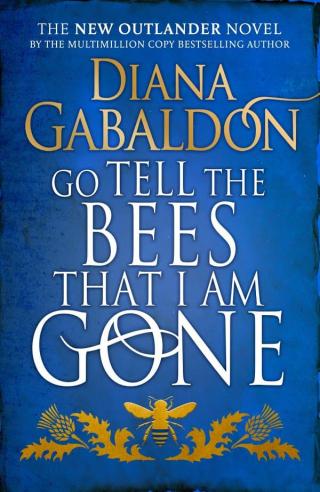
Go Tell the Bees That I Am Gone
- Автор: Гэблдон Диана
- Серия: Outlander #9
- Год: 2021
- Язык: английский
- Год: Delacorte Press
- ISBN: 978-1-473-51900-8
- Жанр: Исторические приключения

Электронная книга - «Go Tell the Bees That I Am Gone». Краткое содержание книги:
The past may seem the safest place to be . . . but it is the most dangerous time to be alive. . . .
Jamie Fraser and Claire Randall were torn apart by the Jacobite Rising in 1746, and it took them twenty years to find each other again. Now the American Revolution threatens to do the same. It is 1779 and Claire and Jamie are at last reunited with their daughter, Brianna, her husband, Roger, and their children on Fraser’s Ridge. Having the family together is a dream the Frasers had thought impossible. Yet even in the North Carolina backcountry, the effects of war are being felt. Tensions in the Colonies are great and local feelings run hot enough to boil Hell’s teakettle. Jamie knows loyalties among his tenants are split and it won’t be long until the war is on his doorstep. Brianna and Roger have their own worry: that the dangers that provoked their escape from the twentieth century might catch up to them. Sometimes they question whether risking the perils of the 1700s—among them disease, starvation, and an impending war—was indeed the safer choice for their family. Not so far away, young William Ransom is still coming to terms with the discovery of his true father’s identity—and thus his own—and Lord John Grey has reconciliations to make, and dangers to meet . . . on his son’s behalf, and his own. Meanwhile, the Revolutionary War creeps ever closer to Fraser’s Ridge. And with the family finally together, Jamie and Claire have more at stake than ever before.
She stopped, something tickling at her brain, and looked closer. Could anyone actually have ears that noticeably off-kilter? Big ears were one thing, but displaced ears … Perhaps if the man had had an accident that severed one ear and a surgeon had sewed it back on awry … The notion made her smile, despite her uneasiness, but another thought was pushing up behind the first, triggered by the thought of surgery. Plastic surgery.
She looked again, closer, at that very ordinary face, lacking most of the normal lines of expression. Alarm was flooding through her, even before her mind had dotted the I’s and crossed the T’s.
She felt suddenly ill and sat down abruptly, eyes closed. She hadn’t eaten lunch and now felt nauseated on an empty stomach. Common with morning sickness, her mother had said—but this wasn’t morning sickness. She opened her eyes and looked again.
And this time she breathed cold air smelling of pine and heather and burning rubber and hot metal and the acrid ghost of gunpowder. Remembered the hail-like sound of shotgun pellets pattering through gorse and heather. And the warm, greasy feel of an old wool cap in her hand, pulled off the head of a man whose face she hadn’t quite seen, as he tried to kidnap Jem and Mandy from the dark dooryard of Lallybroch. But now she saw him plain and saw through his disguise. Both of them.
Someone will come.
She leaned over and threw up.
ROGER WAS SITTING under a tree on the creek bank, theoretically writing a sermon about the nature of the Holy Trinity but in actuality hypnotized by the clear brown water gurgling past, letting random quotes about streams and water and eternity roll round inside his skull like rocks being dragged downstream, clacking into each other as they went.
“Time is but the stream I go a-fishing in,” he murmured, trying it out. He wasn’t worried about plagiarizing words that hadn’t been written yet. Besides, Davy Caldwell had assured him that quotation was the backbone of many good sermons—and a good place to start, if you found yourself without a thought in your head.
“Which is the case, roughly nine times out of ten,” Davy had said, reaching for a mug of beer. “And the tenth time, ye should write your brilliantly original thought down and put it aside and read it through next day, to be sure ye’re not talking out your arse.”
“I always thought Ralph Waldo Emerson was talking out his ass, but surely you aren’t going to say that in your next sermon, are you?”
“What?” He looked up from his notebook to see Bree making her careful way down the bank, and his heart lifted at the sight of her. She looked pregnant.
“If you live to be a hundred, I want to live to be a hundred minus one day, so I never have to live without you,” he said.
“What?” she said, startled. “Who said that?”
“Should I be hurt that you didn’t think it was me?” he said, laughing. “It’s A. A. Milne. From Winnie-the-Pooh, if you can believe it.”
“At this point,” she said, and sat down, sighing heavily, “I’ll believe anything. Look at this.”
She handed him an odd-looking drawing of a man’s head, the sheet showing the marks of having been folded.
“My brother sent it to me,” she said, and smiled, despite her apparent uneasiness. “He’s right, it does feel strange to say it. ‘Brother,’ I mean.”
“What is it? Or rather, who?” He could see what it was; a quick sketch of a man’s head, done in heavy graphite pencil. He frowned at it. “And what’s wrong with him?”
“Well, there’s a pair of good questions.” She took a deep breath and settled herself. “That’s a drawing of a man named Ezekiel Richardson. William says he’s a turncoat—started with the British, switched to the Continentals. He’s also some kind of skunk, who’s tried to do William harm of various kinds, but hasn’t yet succeeded. Does he look familiar to you?”
Roger glanced up at her, puzzled.
“No. Why should he?” He returned his gaze to the paper and slowly traced the outline of the face. “His ears aren’t quite straight, but I suppose William doesn’t have quite your artistic talent.”
She shook her head.
“No. Not that. Try imagining him with longer, curly, sandy-colored hair, light eyebrows, and a sunburn.”
Now slightly alarmed and wondering why, Roger frowned at the portrait of a man with slicked-back dark hair, level dark brows, and small eyes that gave away nothing.
“He certainly hasn’t got much expression …”
“Think bad plastic surgery,” she suggested, and there was a split second of incomprehension before it hit him. His mouth opened, and his throat closed, hard, and for an instant he was hanging, falling through a foot of air and ending with a heart-stopping jerk.
“Jesus,” he croaked, when his throat finally let go its death grip. “A time traveler? You really think so?”
“I know so,” she said flatly. “Do you remember, when we lived at Lallybroch, a guy named Michael Callahan—he went by ‘Mike’—who was an archaeologist who worked on Orkney? He came to look at the Iron Age fort on the hill above the—our—graveyard.” He saw her throat swell as she swallowed, hard. “Maybe he wasn’t looking at the fort. Maybe he was looking at the graves—and us.”
He looked from her tight lips to the drawing, back again.
“I’m not saying you’re wrong,” he said carefully. “But—”
“But I saw him again,” she said, and he saw that she was clutching the fabric of her skirt, bunched in both hands. “At the shoot-out at the O.K. Corral.”
A surge of searing-hot vomit hit the back of his throat, and he forced it down. She saw his face and let go the bunched fabric to take his hand in both hers, holding hard.
“I wouldn’t have thought of it at all—but looking at the ears, and suddenly it just came to me that the only thing I could think of that would make someone’s ears be like that would be if they’d had some kind of surgery that didn’t quite come out the way it was supposed to … and the way his face is so blank—and just all of a sudden I remembered that night. He—he tried to get into the van where the kids and I—I grabbed the woolly hat off his head, and yanked out some of his hair with it, and I caught just a glimpse of his face—and then I didn’t think about it again, because we were trying to get away and then I got the kids to California, and … But just now.” She swallowed again, and he saw that the paleness of her face had given way to a flush of rage. “It’s him. I know it’s him.”
“Holy buggery,” he said, staring back at the expressionless face, trying to match it to Callahan’s mobile, always smiling face. But everything was beginning to fall into place, like dominoes paving a path to hell.
“He knew Rob Cameron,” he said. “And Cameron read the book. He knew what we were.”
“Rob couldn’t travel,” she said. “But maybe Mike Callahan can. And he knew we’d recognize his real face.”
134
F. Cowden, Bookseller
IT WAS NOT OUT of the ordinary, seen from the street. Not one of the fashionable streets, but not an alley, either. The building was red brick, like most of Philadelphia, with fresh white-painted brick facings on the windows and doorway. William paused for a moment to give himself countenance and wipe the sweat from his face, while pretending to examine the books displayed in the window.