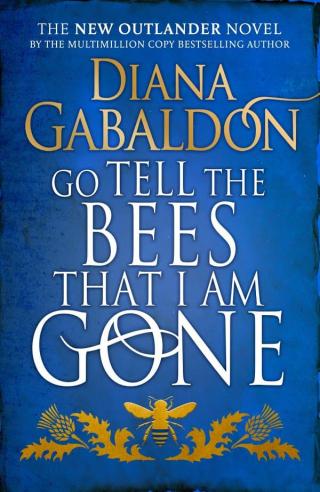
Go Tell the Bees That I Am Gone
- Автор: Гэблдон Диана
- Серия: Outlander #9
- Год: 2021
- Язык: английский
- Год: Delacorte Press
- ISBN: 978-1-473-51900-8
- Жанр: Исторические приключения

Электронная книга - «Go Tell the Bees That I Am Gone». Краткое содержание книги:
The past may seem the safest place to be . . . but it is the most dangerous time to be alive. . . .
Jamie Fraser and Claire Randall were torn apart by the Jacobite Rising in 1746, and it took them twenty years to find each other again. Now the American Revolution threatens to do the same. It is 1779 and Claire and Jamie are at last reunited with their daughter, Brianna, her husband, Roger, and their children on Fraser’s Ridge. Having the family together is a dream the Frasers had thought impossible. Yet even in the North Carolina backcountry, the effects of war are being felt. Tensions in the Colonies are great and local feelings run hot enough to boil Hell’s teakettle. Jamie knows loyalties among his tenants are split and it won’t be long until the war is on his doorstep. Brianna and Roger have their own worry: that the dangers that provoked their escape from the twentieth century might catch up to them. Sometimes they question whether risking the perils of the 1700s—among them disease, starvation, and an impending war—was indeed the safer choice for their family. Not so far away, young William Ransom is still coming to terms with the discovery of his true father’s identity—and thus his own—and Lord John Grey has reconciliations to make, and dangers to meet . . . on his son’s behalf, and his own. Meanwhile, the Revolutionary War creeps ever closer to Fraser’s Ridge. And with the family finally together, Jamie and Claire have more at stake than ever before.
Bobby nodded, pulled down his hat, and set off uphill, leaning perilously back in his saddle, reins clutched to his chest. Jamie grimaced, but waved reassuringly when Bobby looked back over his shoulder. He only needed to stay on the horse as far as the house.
“Even if he falls off and breaks his neck,” he muttered to himself, reining round, “they can follow our track this far. If it doesna pour.” He looked upward, into a dizzying swirl of black clouds, and saw the flash of silent lightning. He counted ten before the roll of distant thunder reached him.
“Trobhat!” he said to Phin, and they set off downhill, following the black hoofprints still showing clear.
THE MOUNTED BAND was moving briskly, but not fleeing. And while there were sprinkles of rain on his face, the storm had not yet broken. Jamie kept well back, always with an ear behind him for his own men coming.
And come they did, to his unspoken but vast relief. He heard them and reined uphill to meet them out of earshot of the troops he was following—he supposed they must be regular British troops, for Ulysses wouldn’t go through the mummery of pretending to be a British soldier if he weren’t one. If they were, though, he’d have to go canny. He wasn’t wanting a physical fight; his infant militia weren’t up to taking on trained soldiers yet.
The back of his mind had been keeping its peace to this point, but now it took the opportunity of his relaxed vigilance to ask him just what the devil he did want.
He wanted to get Ulysses alone, with a dirk in his hand and five minutes to use it, but failing that, he wanted to catch up to the man and go through his saddlebags, both for the damned letter—why had he not been quick enough to stop the man taking it?—and for the original grant, should Ulysses be carrying it. Which meant cutting him out of his own companions and sequestering him somewhere, briefly. He would have given the rest of the fingers on his right hand to have Young Ian with him now, but he didn’t dare wait.
He crossed himself, with a quick prayer to St. Michael, and threaded his horse carefully through a clump of spruce. Emerging on the far side, he saw the flash of a horse’s flank and heard the jingle of harness.
“Trobhad a seo! Over here!” It wasn’t raining yet, but the air still held that strange, muffled quality and he felt as though he’d shouted through a pillow.
They heard him, though, and within a minute or two, they were on their way.
“Who is it we’re after, sir?” asked Anson McHugh, politely. The eldest of Tom McHugh’s sons, he’d come with his father and a younger brother, as well as the Lindsay brothers and a few others who lived close enough to get the summons in time.
“A band of black British soldiers,” Jamie told him.
“Black soldiers?” Anson asked, looking puzzled. “Is there such a thing, then?”
“There is,” Jamie assured him dryly. “Lord Dunmore—ye ken Lord Dunmore? Oh, ye don’t. Nay matter—he started it some years back by getting into a moil wi’ the Virginians he was meant to be governing. They wouldna do as he said, so he put out word that any slave who chose to join the army would be freed. And fed, clothed, and paid,” he added, thinking that this was more than most Continental soldiers could expect.
Anson nodded, his long young face serious. All the McHughs were serious, save their mother, Adeline—and God knew the woman needed a sense of humor, wi’ seven bairns, all boys.
“Is it treason we’re going to commit, then?” Anson asked. A faint gleam of excitement came into his eyes at the thought.
“Very likely,” Jamie said, and suppressed an inappropriate smile at the thought. He’d had a flash of memory: a contentious conversation between himself and John Grey, on a road in Ireland. Grey, annoyed by Jamie’s refusal to tell him what he knew about Tobias Quinn’s aims, had said, “I suppose it is frivolous to point out that assisting the King’s enemies—even by inaction—is treason.”
To which he had himself replied evenly, “It is not frivolous to point out that I am a convicted traitor. Are there judicial degrees of that crime? Is it additive? Because when they tried me, all they said was ‘treason’ before putting a rope around my neck.”
He was surprised to find that the inappropriate smile had crept onto his face despite the current urgent situation—and the fraught circumstances of the memory. A shout from Gillebride MacMillan made him turn sharply from Anson and kick his horse into the highest pace he could sustain on a slippery blanket of wet pine needles.
Panting with the hurry, they reached Gillebride, who silently pointed the way with his chin.
The soldiers had stopped by a small creek to water the horses; that was luck. He could see Ulysses standing on the near bank, leaning against a bare willow’s trunk, the drooping, leafless branches falling in a sort of cage about him.
Taking that as a good omen, Jamie gathered his men and made his aims known. He let Anson McHugh shout, “One … two … three!” and on that signal, the group split like a dropped egg, Gillebride and the McHughs going for the left flank, as it were, with himself and the Lindsays riding straight into the creek to split the group, and himself meaning to seize upon Ulysses—Kenny Lindsay to back him up, if needed.
“Make sure o’ the horses!” he shouted, leaning toward Kenny. “I dinna ken which one belongs to our man. It’s the saddlebags I want!”
“Aye, Mac Dubh,” Lindsay said, grinning, and Jamie let out a Highland whoop that made Phineas—unused to such a thing—swerve madly, ears laid back.
The black soldiers sprang up at once to defend themselves, but most of them were dismounted, and their horses hadn’t liked the screech any more than Phineas did. Ulysses had started from his willow tree like a water rat flushed by a fox, and dived for his tethered horse.
Jamie pulled his own horse up into a slithering stop amid a shower of wet leaves and flung himself off. He ran through the creek edge, ignoring rocks and the cold water that splashed his legs, and threw himself at Ulysses just as the man was getting his left foot into the stirrup. His blood was up and he dragged Ulysses away from the horse, shoved him, then punched him in the belly.
“Saddlebags!” he bellowed over his shoulder, and caught a glimpse of Kenny sliding off his own horse, preparing to make a run for the bags. The glimpse took his attention off his own business for a split second and Ulysses hit him hard on the ear and pushed him backward into the creek. The cold water surging up through his clothes was as much a shock as the startling pain in his ear, but he got enough breath back to roll over and scramble clumsily to his feet. There was the boom of a pistol shot at close range; Kenny had fired at Ulysses, but missed, and one of Ulysses’s men dived at Kenny from behind and took his legs out from under him.
The erstwhile butler had got halfway into the saddle. He booted his horse and shot straight into the creek toward Jamie, who leapt to the side, then fell again as a slippery stone rolled under his foot. The horse clipped him in the hip with a hind foot as he tried to rise and knocked him sprawling.
He was too infuriated even to curse coherently. His left eye was watering profusely and he dashed his sleeve over it—to no effect, the sleeve being sodden.
The Lindsays had taken off in pursuit of Ulysses and the small group of his nearby soldiers—the McHughs had chased their own game away from the creek, up into a tangled growth of alders and hemlocks; he could hear shouts and the occasional ring of swords and gun barrels clashing.
He didn’t want any killing, and had said so, but the young McHughs might not remember that in the heat of their first real fight. And Ulysses’s soldiers were likely not under any such proscription. His own horse was still standing where he’d left it, mirabile dictu. Phineas wasn’t at all pleased to see his owner still moving, and when he clambered into the saddle sopping wet, the horse tried to bite him in the leg. He snapped the rein smartly across Phin’s nose, pulled the horse’s head round, and turned back uphill, heading for the sounds of affray.