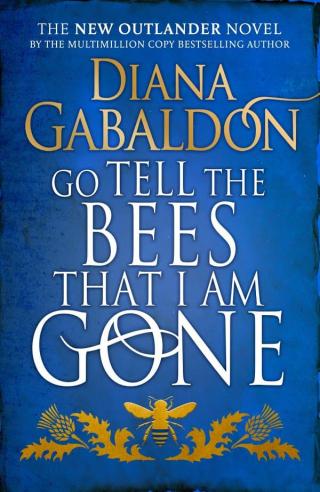
Go Tell the Bees That I Am Gone
- Автор: Гэблдон Диана
- Серия: Outlander #9
- Год: 2021
- Язык: английский
- Год: Delacorte Press
- ISBN: 978-1-473-51900-8
- Жанр: Исторические приключения

Электронная книга - «Go Tell the Bees That I Am Gone». Краткое содержание книги:
The past may seem the safest place to be . . . but it is the most dangerous time to be alive. . . .
Jamie Fraser and Claire Randall were torn apart by the Jacobite Rising in 1746, and it took them twenty years to find each other again. Now the American Revolution threatens to do the same. It is 1779 and Claire and Jamie are at last reunited with their daughter, Brianna, her husband, Roger, and their children on Fraser’s Ridge. Having the family together is a dream the Frasers had thought impossible. Yet even in the North Carolina backcountry, the effects of war are being felt. Tensions in the Colonies are great and local feelings run hot enough to boil Hell’s teakettle. Jamie knows loyalties among his tenants are split and it won’t be long until the war is on his doorstep. Brianna and Roger have their own worry: that the dangers that provoked their escape from the twentieth century might catch up to them. Sometimes they question whether risking the perils of the 1700s—among them disease, starvation, and an impending war—was indeed the safer choice for their family. Not so far away, young William Ransom is still coming to terms with the discovery of his true father’s identity—and thus his own—and Lord John Grey has reconciliations to make, and dangers to meet . . . on his son’s behalf, and his own. Meanwhile, the Revolutionary War creeps ever closer to Fraser’s Ridge. And with the family finally together, Jamie and Claire have more at stake than ever before.
“Not surprising,” Ulysses replied, not at all discomposed. He took a sip of the whisky, paused to let it spread through his mouth, and shook his head with a small “mm” of approval. “I joined Lord Dunmore’s company in ’74. You’ll know his lordship, of course.”
Jamie stiffened slightly.
“I do,” he said politely. “Though I’ve not had the pleasure of his acquaintance since the days before Culloden.”
“What?” I said. “I don’t recall a Lord Dunmore.”
“Well, he hadna got the title then.” Jamie glanced back at me and smiled a little, a rueful sharing of the memory of those fraught days. “But ye kent him, too, Sassenach—John Murray, he was then; just a lad, a page to Charles Stuart.”
“Oh. Yes.” I did recall him, just barely—a homely boy with receding chin, a large nose, and red hair that stuck out in tufts. “So now he’s Lord Dunmore …?”
“Yes. Of late, governor of the Colony of Virginia,” Ulysses said. “And more recently, commander of a major force against the Shawnee Indians in Ohio. A successful venture in which I was privileged to take part.” He did smile then, and I felt a small qualm in the pit of my stomach at the look of it. Indian wars were a messy business.
“Aye,” Jamie said, dismissively. “But surely the army has nay business of that kind wi’ the Cherokee. Though perhaps ye’ve come wi’ their allowance of powder and bullets from the government?”
“I have no army business with the Cherokee, no,” Ulysses replied politely. “In fact, I think of retiring from the army soon. Perhaps I shall follow your example, Mr. Fraser, and set up for a landlord. But for the moment, sir, my business is with you—though this visit is a personal one, rather than an official call. As yet.”
“A personal visit,” Jamie repeated, and leaned back a little in his chair, tilting his head. “And what might your personal business be with me?”
“Your aunt,” Ulysses said, and leaned forward, eyes fixed on Jamie’s face. “Does she still live?”
I was taken aback but at the same time realized that I wasn’t really surprised at all. Neither was Jamie, who didn’t change his expression but took a long, slow breath before replying.
“She does,” he said. “Though I canna tell ye a great deal more than that.”
Ulysses’s expression had certainly changed. His face was vivid, charged with urgency. “You can tell me where she is.”
I couldn’t always tell what Jamie was thinking, but in this instance, I was reasonably sure we were thinking the same thing.
Jocasta had married one of Jamie’s friends, Duncan Innes—while still carrying on her long-term affair with Ulysses, as we learned much later. In the chaotic aftermath of events at River Run and the subsequent dramatic revelations, Ulysses had fled, Jocasta had sold River Run, and she and Duncan had moved to Nova Scotia, and thence to a small farm on St. John’s Island.
I knew that the British army offered freedom to slaves who would join their ranks, and obviously that was the path Ulysses had chosen with Lord Dunmore. Jocasta had secretly manumitted him years before, but officially recognized freedom was a much safer path, especially in North Carolina, where a slave freed by his or her master must leave the colony within ten days or be subject to recapture and sale.
So now he was a free man, by the goodwill of the British government. Completely and permanently free—so long as he wasn’t captured by Americans with other ideas. While that knowledge made me happy for him, I had a great many reservations.
Behind the bland mask of servitude, this man had lived for twenty years as the unknown master of River Run, and had killed without compunction. He had, very plainly, loved Jocasta Cameron passionately—and she, him. And now he had come looking for her again … Very romantic. And very unsettling. I recalled vividly the skeletal remains of Daniel Rawlings, sprawled on the floor of the mausoleum at River Run, and a ripple of gooseflesh ran up my back.
I glanced quickly at Jamie, who carefully didn’t look at me. He sighed, rubbed a hand over his face, then dropped it, meeting Ulysses’s eyes.
“I havena heard from my aunt anytime these five years past,” he said. “And I’ve heard little more about her save that she is still alive. And well. Or at least she was when I heard it from my cousin Hamish, when I met him at Saratoga. That will be three years past. And that’s the last I’ve heard.”
All of that was mostly true. On the other hand, we did know a bit more than that, as Jocasta now and then wrote to her old friend, Farquard Campbell, who lived in Cross Creek. But I could see why Jamie didn’t mean to set Captain Ulysses Stevens on a dangerous path toward an unwarned and literally unarmed—the poor man had only one—Duncan Innes.
Ulysses looked hard into Jamie’s eyes for a long minute; I could hear the ticking of Jenny’s tiny silver watch on the shelf behind me; she’d left it when she’d come down to lend a hand with combing and carding several fleeces the week before. At last, Ulysses gave a small grunt, which might have been either amusement or disgust, and sat back.
“I thought it might be like that,” he said mildly.
“Aye. I’m sorry not to have a better answer for ye, Captain.” Jamie pushed back his chair and made to rise, but Ulysses raised a pink-palmed hand to stop him.
“Not so fast, Mr. Fraser—or no, I beg your pardon; it’s General Fraser now, is it not?”
“No, it’s not,” Jamie replied shortly. “I resigned my commission in the Continental army and I’ve no connection with it anymore.”
Ulysses nodded, urbane as always. “Of course, forgive me. But there are some things harder to renounce than a commission, are there not?”
“If ye’ve more to say,” Jamie said, an edge in his voice, “say it, then go wi’ God. There’s nothing for ye here.”
Ulysses’s smile showed a missing pre-molar on one side, and a gray dead tooth beside it. “I do apologize, Mr. Fraser, but I think you’ll find you’re mistaken. I do have business here. With you.”
I let my breath out, then lost it altogether when he reached into his coat and produced a very official-looking document, sealed with red wax. Red wax, in my experience, was usually a bad sign.
“Read that, sir, if you will,” Ulysses said, and unfolding it, placed it carefully on the desk in front of Jamie.
Jamie raised his brows and looked at Ulysses for a moment, but then picked up the letter with a shrug and popped the seal off with the tip of the skinning knife he used as a letter opener. His spectacles were sitting on the desk, and he put them on with deliberate slowness, smoothing out the creases in the letter.
I could hear voices in the house; the girls had come back from the springhouse with the cheese for supper and the crock of butter we’d need for tomorrow’s baking. I caught a whiff of raspberries as Fanny’s footsteps passed the door, and the soft clank of her tin bucket, brushing the wall as she turned to call to Agnes. We’d make a fresh pie, then … if the berries survived a kitchen full of hungry boys …
Jamie said something very terrible in Gaelic, took off his spectacles, and gave Ulysses a look meant to set his wig on fire. I plunged a hand into my pocket for my own spectacles and took the letter from him.
It was sent from one Lord George Germain, secretary of state for the American Department. I’d heard quite a bit about Lord George Germain; John Grey had worked under him briefly as a diplomat and held a low opinion of the man. But that didn’t matter just now.
What did matter was that it had come to the attention of Lord George Germain, secretary of state, et cetera, that one James Fraser (known erstwhile in Scotland as Lord Brok Turch, a convicted and pardoned Jacobite) had, in the Year of Our Lord 1767, fraudulently obtained a grant of land in the Colony of North Carolina, by misrepresenting and disguising to Governor William Tryon his identity as a Catholic, such persons being prohibited by law from holding such grants.