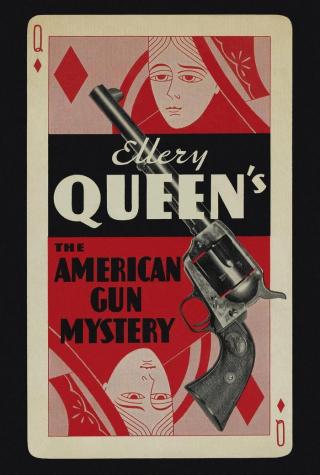
The American Gun Mystery (Death At the Rodeo)
- Автор: Куин (Квин) Эллери
- Серия: Ellery Queen #6
- Год: 1933
- Язык: английский
- Год: Frederick A. Stokes Company
- Жанр: Классические детективы

Электронная книга - «The American Gun Mystery (Death At the Rodeo)». Краткое содержание книги:
Ellery reached for it eagerly. “Uuuump!” said the Lieutenant with a grin. “Wait ’til I pull the teeth out of my pet. Fellow like you’s liable to plug me in the kishkes.” He pulled out the magazine, dumped the six cartridges into his hand, and removed the seventh cartridge from the firing chamber. Then he replaced the magazine and handed the weapon to Ellery.
“Ah,” said Ellery, and hefted the pistol cautiously. It felt a little heavier than he had expected it to, but it was still feather-light in comparison with the official revolvers he had been accustomed to seeing and, on occasion, handling. It snuggled in his palm very cosily. “I wonder why,” he muttered half to himself, “our man used this in preference to a bigger and more effective weapon?”
Unexpectedly, the Major chuckled. “More effective? I say, Mr. Queen, you don’t realize what that little jigger you’re holding is capable of. You could shoot right through a two-inch board with this thing at a very respectable distance!”
“Let alone soft human flesh,” muttered Ellery. “So that’s it. Not effectiveness. Then convenience. Small...” He returned the pistol to the police expert and gazed raptly at his pince-nez. “Well!” He returned the glasses to his nose. “One question more before we dig into this bag. How long would it take to empty the magazine, firing at top speed?”
“I’ve done it in two and a half seconds, and it was a rusty old stop-watch at that,” boomed Lieutenant Knowles.
“Two and a half seconds!” Ellery whistled, and momentarily grew thoughtful again. “Then we find the trail of our old friend the expert marksman again. One shot sufficed, eh... Very well, gentlemen. Let’s see what Santa Claus has brought us.”
He squatted on the floor and began tossing revolvers out of the bag. The Lieutenant and the Major watched him in silence. And when the bag was empty Ellery looked up at them, and they looked down at him, and none of the three said a word for some minutes.
Then simultaneously they looked at the floor. Ellery had separated automatics from revolvers. And in the pile of revolvers there were forty-four long-barreled weapons, and in the “pile” of automatics there was no pile at all, for only one weapon lay there — a lonely little exhibit. Ellery scanned the tag attached to the trigger-guard. It read: Ted Lyons.
Still in silence he scrabbled through the pile of cartridges. And he found no .25 calibre automatic bullets at all.
“Well, well,” he said softly as he rose. “Not much grist in the mill. Apparently our friend the mongering newspaperman was the only occupant of the arena proper who carried a weapon capable of having fired the bullet which killed Horne. I suppose there’s nothing to do but test Lyon’s automatic.”
Ellery strolled about, humming a mournful tune, as Lieutenant Knowles, assisted by Major Kirby, prepared to test the single suspect weapon. The Lieutenant busied himself setting up a peculiar-looking target of unknown substance on the firing-range; then he and the Major retired to a far corner of the room, conferring earnestly as Knowles examined the seven cartridges in Ted Lyons’s pistol.
“Not blanks.” Then the Lieutenant said: “I’m a rotten shot, Major. Want to pot that target?”
“Don’t mind,” replied Kirby, and taking up a position some twenty feet from the target pointed the small weapon and almost negligently squeezed the trigger. A continuous, deafening report raised by the echoes in the little laboratory made Ellery jump. By the time Ellery came to his senses the little man was smiling, some acrid-smelling smoke was drifting off, and the target looked like Swiss cheese.
“Nice work, Major,” said Knowles admiringly. “Sprayed ’em in a circle, eh? That will give us a number of specimens. Let’s get busy.”
He strode back from the target, juggling half a dozen spent bullets which were swathed in black greasy coats. He looked at them keenly when he got to the table. “Let’s test these babies.”
He removed his coat, waved Ellery into a chair, and then occupied himself with a very simple business. There was a familiar instrument on the work-table which had some curiously unfamiliar features. It seemed to be an unusual type of microscope.
“Companion ’scope,” he explained. “Got a double comparison eye-piece, as you can see. You know this dingus, Major?”
Kirby nodded. “Quite well. I used one for some time in the army, and I’ve one at home for my own amusement.”
Ellery watched the two men anxiously. The blood-coated bullet Lieutenant Knowles bathed in a solution, and then rubbed gently dry. It emerged quite clean; it was leaden in color. He studied it under the microscope for some time; and then he raised his head and motioned Major Kirby to the eye-piece.
“Beautiful markings!” exclaimed the Major, looking up. “It certainly won’t be any trouble matching those marks to a comparison specimen, Lieutenant!”
“Maybe not. Now let’s see how these bullets you just fired stack up,” said Knowles briskly; and he busied himself again with the microscope. The fatal bullet remained where it was; but the six shot into the target a few moments before succeeded each other in slow order. There was much to-do with screws and careful turnings of the new specimens; both men conferred frequently, and the Major checked each of the Lieutenant’s findings. And at the end they nodded with solemn certainty, and Knowles turned to Ellery with an air of finality.
“There’s nothing certain but death and taxes, they say! Well, here’s one thing sure, Mr. Queen — the bullet that killed your man didn’t come from this fellow Lyons’s automatic. Don’t even have to use the universal molecular. The marks haven’t anything in common.”
Ellery digested this for a moment, then got to his feet and began to pace the floor. “Hmm. Nice to find one example of fixation in a wavering world. By the way, I suppose you’re both absolutely sure?”
“No question about it, Mr. Queen,” said Major Kirby earnestly. “When we can arrive at a conclusion at all, you may be sure it’s the right one. This matter of checking fired bullets is now pretty much of an exact science. You see, all modern arms are rifled — I suppose you know what that means. The inside of the barrel is — well, you might almost describe it as etched spirally. The .25 automatic’s barrel has six grooves and six lands in a left-hand twist — it sounds complicated, but it’s really very simple. There’s a spiral, or twist, which runs from end to end of the barrel inside, cut into the metal; the depressions made by the cutting are called the grooves, the raised spirals of metal left by the cutting are called the lands. Six of each, as I say. Now there are always minute differences in lands which are visible under the microscope. Naturally, when the bullet on firing passes through the barrel, it spins through the grooves, and the marks of the lands are left on the bullet...”
“I see. And by putting two bullets under the microscope you can see if the markings are similar or dissimilar?”
“That’s right,” said the Lieutenant. “You focus the two specimens until they merge into one — or seem to; you see the left side of each slap against the other; then it’s easy to see if all the markings match, or if they don’t.”
“And these don’t?”
“And these don’t.”
Whatever Ellery in the helplessness of the moment was about to say was choked back by an unexpected interruption. A tall, burly individual hurried into the laboratory, carrying a small bag.
“Ah, Ritter!” said Ellery eagerly. “More guns?”
The detective dumped the bag on the work-table. “From the Inspector, Mr. Queen. Sent ’em down with me — on the run. Found ’em, he said to tell you, on people from the audience.”