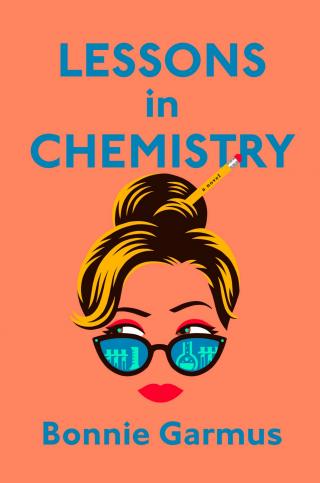
Lessons in Chemistry
- Автор: Garmus Bonnie
- Год: 2022
- Язык: английский
- Год: Doubleday Canada
- Жанр: Современная русская и зарубежная проза

Электронная книга - «Lessons in Chemistry». Краткое содержание книги:
“Pregnancy is a normal condition. It is not disgraceful. It is how every human being starts.”
“How dare you,” he said, his voice rising. “A woman telling me what pregnancy is. Who do you think you are?”
She seemed surprised by the question. “A woman,” she said.
“Miss Zott,” Miss Frask stated, “our code of conduct does not allow for this sort of thing and you know it. You need to sign this paper, and then you need to clean out your desk. We have standards.”
But Elizabeth didn’t flinch. “I’m confused,” she said. “You’re firing me on the basis of being pregnant and unwed. What about the man?”
“What man? You mean Evans?” Donatti asked.
“Any man. When a woman gets pregnant outside of marriage, does the man who made her pregnant get fired, too?”
“What? What are you talking about?”
“Would you have fired Calvin, for instance?”
“Of course not!”
“If not, then, technically, you have no grounds to fire me.”
Donatti looked confused. What? “Of course, I do,” he stumbled. “Of course, I do! You’re the woman! You’re the one who got knocked up!”
“That’s generally how it works. But you do realize that a pregnancy requires a man’s sperm.”
“Miss Zott, I’m warning you. Watch your language.”
“You’re saying that if an unmarried man makes an unmarried woman pregnant, there is no consequence for him. His life goes on. Business as usual.”
“This is not our fault,” Frask interrupted. “You were trying to trap Evans into marriage. It’s obvious.”
“What I know,” she said, pushing a stray hair away from her forehead, “is that Calvin and I did not want to have children. I also know that we took every precaution to ensure that outcome. This pregnancy is a failure of contraception, not morality. It’s also none of your business.”
“You’ve made it our business!” Donatti suddenly shouted. “And in case you weren’t aware, there is a surefire way not to get pregnant and it starts with an ‘A’! We have rules, Miss Zott! Rules!”
“Not on this you don’t,” Elizabeth said calmly. “I’ve read the employee manual front to back.”
“It’s an unwritten rule!”
“And thus not legally binding.”
Donatti glowered at her. “Evans would be very, very ashamed of you.”
“No,” Elizabeth said simply, her voice empty but calm. “He would not.”
The room fell silent. It was the way she kept disagreeing — without embarrassment, without melodrama — as if she would have the last say, as if she knew she’d win in the end. This is exactly the kind of attitude her coworkers had complained of. And the way she implied that hers and Calvin’s relationship was at some higher level — as if it had been crafted from nondissolvable material that survived everything, even his death. Annoying.
As Elizabeth waited for them to come to their senses, she laid her hands flat on the table. Losing a loved one has a way of revealing a too-simple truth: that time, as people often claimed but never heeded, really was precious. She had work to do; it was all she had left. And yet here she sat with self-appointed guardians of moral conduct, smug judges who lacked judgment, one of whom seemed unclear on the process of conception and one who went along because she, like so many other women, assumed that downgrading someone of her own sex would somehow lift her in the estimation of her male superiors. Worse, these illogical conversations were all taking place in a building devoted to science.
“Are we done here?” she said, rising.
Donatti blanched. That was it. Zott needed to go right now and take her bastard baby, cutting-edge research, and death-defying romantic relationship with her. As for her rich investor, they’d deal with him later.
“Sign it,” he demanded, as Frask tossed Elizabeth a pen. “We want you out of the building no later than noon. Salary ends Friday. You’re not allowed to speak to anyone regarding the reasons for your dismissal.”
“Health benefits also end Friday,” Frask chirped, tapping her nail against her ever-present clipboard. “Tick tock.”
“I hope this might teach you to start being accountable for your outrageous behavior,” Donatti added as he held out his hand for the signed termination notice. “And stop blaming others. Like Evans,” he continued, “after he forced us to fund you. After he stood in front of Hastings management and threatened to leave if we didn’t.”
Elizabeth looked as if she’d been slapped. “Calvin did what?”
“You know very well,” Donatti said, opening the door.
“Out by noon,” Frask repeated as she tucked her clipboard under her arm.
“References could be a problem,” he added, stepping out into the hall.
“Coattails,” Frask whispered.
Chapter 14
Grief
The thing Six-Thirty hated most about going to the cemetery was the way it took him past the place where Calvin had died. He’d once heard someone say it was important to be reminded of one’s failures, but he didn’t know why. Failures, by their very nature, had a way of being unforgettable.
As he neared the cemetery, he kept an eye out for the enemy groundskeeper. Seeing no one, he pressed himself under the back gate and scooted through the rows, nabbing a clutch of fresh daffodils from one tombstone before laying it here:
Calvin Evans
1927–1955
Brilliant chemist, rower, friend, lover.
Your days are numbered.
The tombstone was supposed to have read, “Your days are numbered. Use them to throw open the windows of your soul to the sun,” a quote from Marcus Aurelius, but the tombstone was small and the engraver had made the first part too big and had run out of room.
Six-Thirty stared at the words. He knew they were words because Elizabeth was trying to teach him words. Not commands. Words.
—
“How many words does science tell us dogs can learn?” she’d asked Calvin one evening.
“About fifty,” Calvin said, not looking up from his book.
“Fifty?” she’d said, scrunching her lips together. “Well, that’s wrong.”
“Maybe a hundred,” he said, still engrossed in his book.
“A hundred?” she’d answered just as incredulously. “How can that be? He already knows a hundred.”
Calvin looked up. “Excuse me?”
“I’m wondering,” she said. “Is it possible to teach a dog a human language? I mean the whole thing. English for example.”
“No.”
“Why?”
“Well,” Calvin said, slowly, realizing that this might be one of those things she simply didn’t accept — there were so many of those things. “Because interspecies communication is limited by brain size.” He closed his book. “How do you know he knows a hundred words?”
“He knows one hundred and three,” she said, consulting her notebook. “I’m keeping track.”
“And you’ve taught him these words.”
“I’m using the receptive learning technique — object identification. Like a child, he’s automatically more receptive to memorizing objects he’s interested in.”
“And he’s interested in—”
“Food.” She got up from the table and started gathering books. “But I’m sure he has lots of other interests.”
Calvin looked back at her in disbelief.
—
So that’s how their word quest had started: he and Elizabeth on the floor, flipping through big children’s books.
“Sun,” she’d instructed, pointing at a picture. “Child,” she’d read in turn, pointing at a little girl named Gretel eating a candied house shutter. That a child would eat a shutter did not surprise Six-Thirty. In the park, children ate everything. This included whatever they could find up their nose.