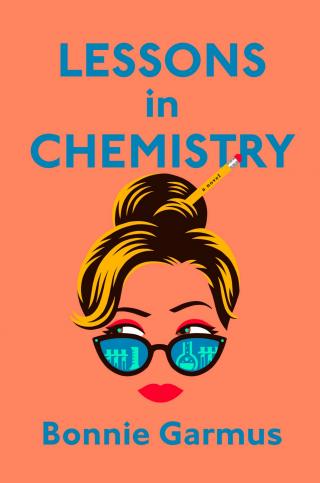
Lessons in Chemistry
- Автор: Garmus Bonnie
- Год: 2022
- Язык: английский
- Год: Doubleday Canada
- Жанр: Современная русская и зарубежная проза

Электронная книга - «Lessons in Chemistry». Краткое содержание книги:
“No, he’s our dog,” she managed. “My dog.”
“I see,” she said. “But from now on, he’ll need to stay at home.”
From the corner, Six-Thirty lifted his head.
“I can’t be here without him,” Elizabeth said. “I just can’t.”
Frask blinked as if the room was too bright, and then from out of nowhere produced a clipboard on which she made a few notes. “Of course,” she said without looking up, “I like dogs, too,” although she didn’t, “but as I said, we made allowances for Mr. Evans. He was quite important to us. But at some point,” she said as she put one hand back on Elizabeth’s shoulder and started patting again, “you have to realize, the coattails only go so far.”
Elizabeth’s expression changed. “Coattails?”
Frask looked up at her from the clipboard, trying to seem professional. “I think we know.”
“I never rode his coattails.”
“I never said you did,” Frask said with mock surprise. Then she lowered her voice as if confiding a secret. “Can I just say something?” She took a short breath in. “There will be other men, Miss Zott. Maybe not as famous or as influential as Mr. Evans, but men all the same. I studied psychology— I know about these things. You chose Evans, he was famous, he was single, maybe he could help your career, who could blame you? But it didn’t work. And now he’s gone and you’re sad—of course you’re sad. But look on the bright side: you’re free again. And there are lots of nice men, good-looking men. One of them is sure to put a ring on your finger.”
She paused, remembering ugly Evans just before she pictured pretty Zott back in the dating pool, men teeming about her like frothy bubbles in a bathtub. “And once you find one,” she said, “maybe a lawyer,” she specified, “then you can stop all this science nonsense and go home and have lots of babies.”
“That’s not what I want.”
Frask straightened up. “Well, aren’t we the little renegade,” she said. She hated Zott, she really did.
“There’s just one more thing then,” she continued, tapping her pen against the board, “and that is your bereavement leave. Hastings has awarded you three extra days. That’s five days total. Unheard of for a non — family member — very, very generous, Miss Zott — and again an indication of how important Mr. Evans was to us. This is why I want to assure you that you can and should go home and stay there. With the dog. You have my permission.”
Elizabeth wasn’t sure if it was the cruelty of Frask’s words or the foreign feel of the small, cold ring she’d buried in her fist just before Frask walked in, but before she could stop herself, she turned to retch into the sink.
“Normal,” Frask said as she darted across the room to collect a wad of paper towels. “You’re still in shock.” But as she placed a second towel on Elizabeth’s forehead, she adjusted her cat-eye glasses and took a much closer look. “Oh,” she sighed judgmentally, drawing her head back. “Oh. I see.”
“What?” Elizabeth murmured.
“Come on, now,” Frask said disapprovingly. “What did you expect?” And then she tsked just loud enough to make Zott understand she knew. But when Zott didn’t acknowledge that she knew she knew, Frask wondered if there was an outside chance Zott actually didn’t know. That’s how it was with some scientists. They believe in science right up until it happens to them.
“Oh, I almost forgot,” Frask said, withdrawing a newspaper from under the crook of her arm. “I wanted to make sure you’d seen this. It’s a nice photo, don’t you think?” And there it was, the article from the reporter who’d attended the funeral. “The Brilliance He Buried,” claimed the headline, followed by a story that implied that Evans’s difficult personality may have kept him from reaching his full scientific potential. And to prove that point, just to the right was a photo of Elizabeth and Six-Thirty standing in front of his coffin, with the caption “Actually, Love Isn’t Blind,” accompanied by a short summary of how even his girlfriend said she barely knew him.
“What a horrible thing to write,” Elizabeth whispered, clutching her stomach.
“You’re not going to be sick again, are you?” Frask scolded as she held out more paper towels. “I know you’re a chemist, Miss Zott, but surely you expected this. Surely you’ve studied biology.”
Elizabeth looked up, her face gray, her eyes empty, and for one tiny moment Frask found herself almost feeling sorry for this woman and her ugly dog and the vomit and all the problems that were to come. Despite her brains and beauty and her incredibly slutty approach to men, Zott wasn’t any better off than the rest of them.
“Expected what?” Elizabeth said. “What are you getting at?”
“Biology!” Frask roared as she tapped her pen against Elizabeth’s stomach. “Zott, please! We’re women! You know very well Evans left you something!”
And Elizabeth, eyes suddenly wide with recognition, was sick all over again.
Chapter 13
Idiots
Hastings Research Institute management had a big problem. With their star scientist dead, and a newspaper article implying that his lousy personality had kept him from accomplishing anything worthwhile, Hastings’s benefactors — the army, the navy, several pharmaceutical companies, a few private investors, and a handful of foundations — were already making noises about “reexamining Hastings’s existing projects” and “rethinking future grants.” That’s how it is with research — it’s at the mercy of those who pay for it.
Which is why Hastings management was determined to lay this ridiculous story to rest. Evans had been making good progress, hadn’t he? His office was overflowing with notebooks and strange little equations written in an indecipherable script and punctuated by exclamation marks and thick underlines like the kind one makes when one is on the brink of something. In fact, he was scheduled to present a paper on his progress in Geneva in just another month. Or would have if he hadn’t been backed over by a police car because he insisted on running outdoors in the rain instead of indoors in ballet slippers like everybody else.
Scientists. They just had to be different.
That was also part of the problem. Most of the Hastings scientists weren’t different — or at least not different enough. They were normal, average, at best slightly above average. Not stupid, but not genius either. They were the kind of people who make up the majority of every company — normal people who do normal work, and who occasionally get promoted into management with uninspiring results. People who weren’t going to change the world, but neither were they accidentally going to blow it up.
No, management had to rely on its innovators, and with Evans gone, that left a very small pool of true talent. Not all of them were in lofty positions like Calvin’s; in fact, a few of them probably didn’t realize they were regarded as true innovators. But Hastings management knew it was from them that nearly every big idea and breakthrough came.
The only real issue with these people, besides the occasional hygiene challenge, was that they always seemed to embrace failure as a positive outcome. “I have not failed,” they’d endlessly quote Edison, “I’ve just found ten thousand ways that won’t work.” Which may be an acceptable thing to say in science but is absolutely the wrong thing to say to a roomful of investors looking for an immediate, high-ticket, chronic treatment for cancer. God save them from actual cures. Much harder to make money off someone who doesn’t have a problem anymore. For that reason, Hastings did whatever it could to keep these people away from the press, unless it was the scientific press, which was fine because no one read that. But now? Dead Evans was on page eleven of the LA Times, and there next to his coffin? Zott and the damn dog.