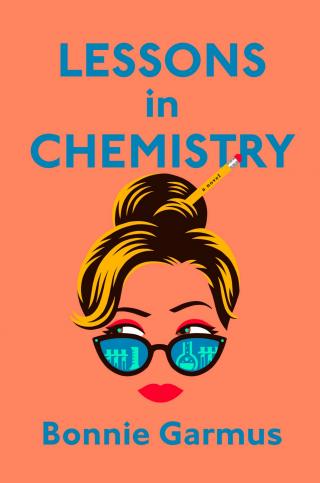
Lessons in Chemistry
- Автор: Garmus Bonnie
- Год: 2022
- Язык: английский
- Год: Doubleday Canada
- Жанр: Современная русская и зарубежная проза

Электронная книга - «Lessons in Chemistry». Краткое содержание книги:
“That’s what I said,” he replied soothingly, reaching for her elbow again. “You didn’t know him very long.”
“Don’t touch me.” She wrested her elbow from his grip and with Six-Thirty at her side made her way across the uneven lawn, expertly avoiding stone angels and exhausted flowers as only one with twenty-twenty vision can do and, embracing the loneliness of the front row, selected a chair directly opposite his long, black box.
—
What followed was the usual refrain: the sad looks, the dirty shovel, the boring verse, the preposterous prayers. But when the first clods of dirt hit the coffin, Elizabeth interrupted the minister’s final tribute by announcing, “I need to walk.” And then she turned, and with Six-Thirty, walked away.
It was a long walk home: six miles, in heels, in black, just the two of them. And it was curious: both the route, which took them through as many bad sections as good, and the contrast, a colorless woman and injured dog planted against the conflict of an early spring. Everywhere they walked, even in the drabbest of neighborhoods, blooms poked their way up between sidewalk cracks and flower beds, shouting and boasting and calling attention to themselves, mingling their scents in hopes of creating complex perfumes. And there they were in the thick of it, the only living dead things.
The funeral car followed her for the first mile or so, the driver pleading for her to get in, informing her she’d last no more than fifteen minutes in those heels, reminding her that she’d already paid for the ride, and apologizing that while he wasn’t able to take the dog, he was certain someone from another car would. But she was as deaf to his pleas as she had been blind to the reporter’s nosiness, and eventually he and everyone else gave up and Elizabeth and Six-Thirty did the only thing that made sense: they just kept walking.
—
The following day, not able to be in her home, and with nowhere else to go, they went back to work.
This was a problem for her coworkers. They had already exhausted their full complement of things to say. I’m so sorry. If there’s ever anything you need. What a tragedy. I’m sure he didn’t suffer. I’m there for you. He’s in God’s hands now. So they avoided her.
“Take all the time you need,” Donatti had said to her at the funeral, putting his hand on her shoulder while at the same time noting with surprise that black really wasn’t her color. “I’m there for you.” But when he saw her sitting on her stool in the lab in a daze, he avoided her, too. Later, after it was clear that everyone was only going to “be there” for her as long as she was “not there,” she took Donatti’s advice and went away.
The only place left to go was Calvin’s lab.
“This might kill me,” she whispered to Six-Thirty as they stood in front of Calvin’s door. The dog pressed his head into her thigh, begging her to go no farther, but she opened the door anyway, and they both stepped through. The scent of cleaning fluid hit them like a locomotive.
Humans were strange, Six-Thirty thought, the way they constantly battled dirt in their aboveground world, but after death willingly entombed themselves in it. At the funeral, he couldn’t believe the amount of dirt needed to cover Calvin’s coffin, and when he saw the size of the shovel, he’d wondered if he should offer the help of his back legs to fill the hole. And now dirt was again the issue, but in the wrong direction. Every last trace of Calvin had been scrubbed away. He watched as she stood in the middle of the room, her face blank with shock.
—
His notebooks were gone. Boxed up and already stored while Hastings management waited nervously to see if a next-of-kin type might come forward and try to claim them. It went without saying that she, who knew and understood his research better than anyone, and whose kinship with him far surpassed the meaning of “kin,” would not qualify.
There was only one thing left; a crate where they’d tossed his personal effects: a snapshot of her, some Frank Sinatra records, a few throat lozenges, a tennis ball, dog treats, and at the very bottom, his lunch box — which she realized, with a heavy heart, probably still contained the sandwich she’d made him nine days before.
But when she opened it, her heart nearly stopped. Inside was a small blue box. And inside that, the biggest small diamond she had ever seen.
—
Just then, Miss Frask poked her head in. “There you are, Miss Zott,” she said, her rhinestone cat-eye glasses dangling like a sloppy noose from a chain around her neck. “I’m Miss Frask? From Personnel?” She paused. “I don’t mean to disturb you,” she said, pushing the door open a bit wider, “but—” Then she noticed Elizabeth going through the box. “Oh Miss Zott, you can’t do that. Those things were his personal belongings, and while I know and recognize the — well — unusual relationship you and Mr. Evans enjoyed, we have to — by law — just wait a teeny bit longer to see if someone else— a brother, a nephew, blood—might step forward to claim those things. You understand. It’s nothing against you or your personal — well, proclivities; I’m not making a moral judgment. But without some sort of document that says he actually meant to leave you his things, I’m afraid we have to follow the letter of the law. We have taken steps to secure his actual work. It’s already under lock and key.” She stopped short, giving Elizabeth the once-over. “Are you okay, Miss Zott? You look like you might faint.” And when Elizabeth slumped forward slightly, Miss Frask pushed the door all the way open and came in.
—
After that day in the cafeteria — when Eddie looked at Zott in a way he’d never once looked at her — Frask found Zott hateable.
“I was in the elevator today,” Eddie had swooned, “and Miss Zott got in. We rode four whole floors together.”
“Did you and she have a nice chat?” Frask said, her molars clenched. “Find out what her favorite color is?”
“No,” he said. “But I’ll definitely ask next time. Geez, she’s something else.”
Frask had gone on to hear about exactly how Zott was something else at least twice a week since then. With Eddie it was always Zott this and Zott that; he talked about her nonstop — but then, everyone did. Zott, Zott, Zott. She was so fucking sick of Zott.
—
“I’m sure I don’t have to tell you,” Frask said, placing a dimpled hand on Zott’s back, “that it’s too soon for you to be at work — especially here,” she said, tipping her head at the room that had once held Calvin. “It’s not good for you. You’re still in shock and you need your rest.” Her hand moved up and down in a clumsy pat. “Now I know what people are saying,” she said, implying her role as ground zero when it came to Hastings gossip, “and I know you know what people are saying,” she continued, fairly confident Elizabeth did not, “but in my opinion whether or not Mr. Evans was getting the milk for free doesn’t mean his untimely death hurts you any less. In fact, in my opinion, it is your milk and if you choose to spoil it, that is your right.”
There, she thought, satisfied. Now Zott knew what people were saying.
Elizabeth looked up at Frask, stunned. She supposed it took a certain type of skill to be able to say exactly the wrong thing at exactly the wrong time. Maybe that was a prerequisite for a position in Personnel— a certain clunky, cheerful cluelessness that gave one the ability to insult the bereaved.
“I’ve been trying to track you down for several reasons,” Frask was saying, “the first being the issue of Mr. Evans’s dog. Him,” she said, pointing a finger at Six-Thirty, who stared back grimly. “Unfortunately, he can’t be here any longer. You understand. Hastings Research Institute absolutely venerated Mr. Evans and, because of it, overindulged his quirky tendencies. But now that Mr. Evans has left us, I’m afraid the dog must leave as well. As I understand it, the dog was really his dog anyway.” She looked to Elizabeth for confirmation.