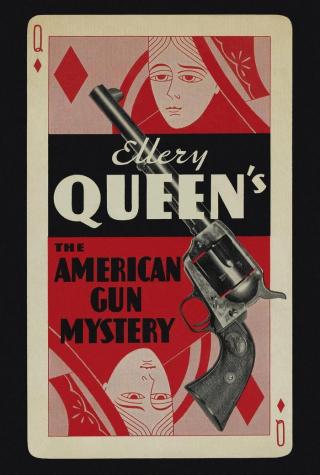
The American Gun Mystery (Death At the Rodeo)
- Автор: Куин (Квин) Эллери
- Серия: Ellery Queen #6
- Год: 1933
- Язык: английский
- Год: Frederick A. Stokes Company
- Жанр: Классические детективы

Электронная книга - «The American Gun Mystery (Death At the Rodeo)». Краткое содержание книги:
Ellery sprang to his feet. “Are you quite finished with this mumbo-jumbo?”
“Hell, no. I want to see—”
“You,” said Ellery firmly, “want to see none other than Major Kirby, god of the newsreel cameras.”
“Kirby? But what the deuce for?”
“It seems to me that what we require more than anything else at the moment is someone on intimate terms with firearms — if you can imagine such a situation.”
The Inspector granted. “You want a firearms expert, so you pick a movie man, hey? That’s logic.”
“The Major, I’ve been told,” said Ellery, “is not only a crack pistoleer but is also something of an authority on something or other — I deduced firearms. That on the admittedly dubious word of Tony Mars — which you would recall if you’d thought about Kirby’s visit to the box before the fracas. Well, send for him, and we’ll find out soon enough how dependable Mars’s information is.”
Sergeant Velie was duly dispatched for the Major.
“But what do you want an expert for?” frowned the Inspector.
Ellery sighed. “Father, dear father, what’s the matter with your wits tonight? We’ve a bullet, haven’t we?”
The Inspector was distinctly annoyed. “Sometimes, my son... Don’t you think I know enough about the mechanics of my own job to have an expert look over the bullet, and compare it with others? But what’s the rush? Why the dickens—”
“Look here— We’ve got to examine those forty-five shooting-irons immediately — not just some time, but at once, dad!”
“What forty-five guns?”
“Well, I suppose there are forty-five of them,” said Ellery impatiently. “I noticed that the group of riders following Horne seemed consistently to be wearing single holsters which means a revolver per rider. That’s forty. Then there are Ted Lyons’s three — the .25 automatic and the two .45’s from the rodeo armory which he appropriated. Forty-three. Wild Bill Grant’s and Horne’s own — forty-five. But why argue? Don’t you see, dad, we’ve got to know?”
The Inspector’s irritation vanished. “You’re right. And the sooner the better... Well, Hesse?”
One of his squad, a solid Scandinavian, charged in, his little red eyes excited. “Chief, there’s a riot upstairs! The boys got all they can do to hold those people! They want to go home.”
“So do I,” growled the Inspector. “You pass the word around, Hesse, to the uniformed men to use their billies, by God, if they have to. Not a single soul goes out of this place until he’s searched to the bone.”
Hesse’s eyes widened. “Search twenty thousand people?” he gasped.
“It’s a tall order, I know,” said the Inspector glumly. “But it looks as if we’ve got to do it. Now, Hesse, you tell Ritter...”
He walked out into the corridor with the detective, enumerating the commands “necessary to begin the task of searching to the skin the population of a small city. This was the good Inspector’s private meat; he began to look almost happy.
“Take all night,” said the Inspector when he returned, “and I s’pose I’ll be on the carpet tomorrow, but what the devil! Got to be done... Oh, come in, Major!”
Major Kirby, looking tired, nevertheless contrived also to look curious. He snapped a glance at Ellery.
“Still grinding?”
Kirby shook his head. “Stopped long ago. Good grief, when the home office finds out how much film we’ve used there’ll be war! Lucky I had plenty of stock with me. Well, sir, what can I do for you? Your Sergeant here tells me you wanted me especially.”
“Not I,” said the Inspector. “My son. Spill it, El.”
“It all depends,” said Ellery abruptly, “on you, Major. This evening we were informed that during the War you had achieved a reputation for being a crack pistol shot. Is that true?”
The Major’s small black eyes turned to small black stones. “And just what,” he said crisply, “do you mean by that?”
Ellery stared, and then burst into laughter. “Heavens, I’m not pumping you, man, as a murder suspect! I’m really interested for an entirely different reason. Is it true or isn’t it?”
Kirby’s expression wavered; then he smiled slightly. “I suppose it is. I won a few medals.”
“And I was also told that you’re something of a firearms expert. Is that true, too?”
“I’ve made a study of ballistics, Mr. Queen. More a hobby than a profession. I shouldn’t care to call myself an expert—”
“Thy modesty’s a candle to thy merit,” laughed Ellery. “How would you like to engage in a little experting for me?”
Major Kirby stroked his mustache nervously. “Happy to oblige, of course,” he murmured, “but I’ve a duty to my company, you know. That film we shot—”
“Nonsense! We’ll arrange all that. You’ve a lieutenant of some sort in your crew upstairs, haven’t you?”
“Yes. My chief cameraman will do. Name of Hall.”
“Excellent! Suppose—”
“I’ll have to talk to Hall first. We’ve made something of a scoop here tonight, Mr. Queen, with these pictures, and speed is our byword in this business.” He became thoughtful. “Tell you what. I’ll drop everything if you’ll let my men go at once. Film they’ve ground out will be developed, printed, cut, and assembled with sound for distribution to Broadway theaters by morning. Must get it out. It’s a go?”
“It’s a go,” said the Inspector unexpectedly, “but you and your men will have to go through the formality of a search, Major, before we release you.”
The Major cooled. “Is that necessary?”
“I should hope to tell you!”
Kirby shrugged. “Very well. Anything for some action. All right, Mr. Queen, I’m with you.”
The Inspector said genially to Sergeant Velie: “Thomas, there’s a special job for you. Go upstairs, search Major Kirby and his crew, and every bit of equipment.”
The Major seemed startled. “I say, now—”
“Just form, Major, just form,” said the Inspector affably. “Go on now, the two of you. I’ve work of my own.”
In twenty minutes the job was done. Sergeant Velie, than whom there was no more thorough disrespecter of persons on the metropolitan force, himself supervised a search which included Major Kirby’s slender body, Major Kirby’s natty clothes, Major Kirby’s resentful and jeering crew of cameramen and sound engineers, Major Kirby’s cameras, Major Kirby’s ohms and watts and rheostats (in a manner of speaking) — in a word, everything connected with Major Kirby and his unit, down to the last coil of cable, was picked over, scrutinized felt, pinched, pressed, eviscerated, anatomized, dismembered, and divellicated.
The result was a complete absence of discovery. There was nothing on that platform, nor anything on the persons of the men on the platform and the apparatus on the platform, which even remotely resembled an automatic. Whereupon, under special escort, the group of newsreel men was packed out of the building, armed with a hastily scribbled message from Major Kirby to the editor of his newsreel company.
The Major was the last to be pawed over. Found pure, he was passed directly out of the building by a side exit into Ellery’s arms. Ellery was waiting on the sidewalk with a huge police bag at his knee which contained forty-five pieces of assorted lethal hardware and some hundreds of cartridges.
The Inspector saw them off. “You’ll shoot whatever you find in the way of artillery down to us at Headquarters?” asked Ellery soberly.
“You bet.”
The old man stood gazing thoughtfully after their departing cab. Then he rather grimly went back into the Colosseum, to supervise the bodily search of twenty thousand persons.