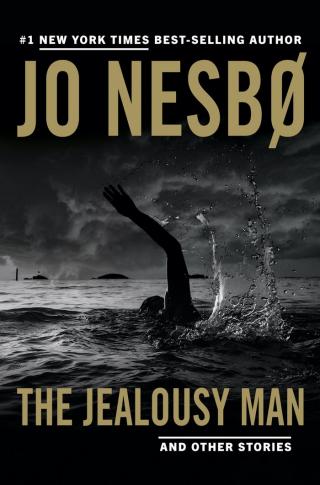
The Jealousy Man and Other Stories
- Автор: Несбё Ю
- Год: 2021
- Язык: английский
- Год: Alfred A. Knopf
- ISBN: 978-0-593-32100-3
- Переводчик: Robert Ferguson
- Жанр: Криминальные детективы

Электронная книга - «The Jealousy Man and Other Stories». Краткое содержание книги:
A detective with a nose for jealousy is on the trail of a man suspected of murdering his twin; a bereaved father must decide whether vengeance has a place in the new world order after a pandemic brings about the collapse of society; a garbage man fresh off a bender tries to piece together what happened the night before; a hired assassin matches wits against his greatest adversary in a dangerous game for survival; and an instantly electric connection between passengers on a flight to London may spell romance, or something more sinister.
With Nesbø’s characteristic gift for outstanding atmosphere and gut-wrenching revelations, The Jealousy Man confirms that he is at the peak of his abilities.
‘So what? Just as well is not the same as proof that it wasn’t Franz.’
‘Correct. I didn’t get my proof until I received the fingerprints that you, Franz, left on the glass you drank from during our conversation at the police station in Pothia. I compared them with the prints I had at home in Athens.’
‘Athens?’
‘To be precise, on a box on a shelf above my bed. On the stone you gave me at the hospital. Yes, paradox is Greek, and the paradox here is that even though twins have identical DNA profiles, their fingerprints are not identical.’
‘That’s not true. We compared fingerprints, and they are the same.’
‘Almost the same.’
‘We have the same DNA, so how is that possible?’
‘Because fingerprints are not decided one hundred per cent by genetics. They’re also affected by your surroundings in the womb. The position one foetus lies in in relation to the other. The difference in the length of the umbilical cord which, in turn, creates a difference in the bloodstream and the access to nourishment which, again, determines how quickly the fingers grow. By the time your fingerprints are fully formed, which is at some point between week thirteen and week nineteen of the pregnancy, small differences have arisen which are detectable on close examination. I gave them a close examination. And guess what? The fingerprints on the stone I got from you at the hospital when you were claiming to be Julian, and on the glass that you, Franz, drank from at the police station, were identical. In a nutshell, the two people were...’
‘...one and the same.’
‘Yes, Franz.’
Maybe it was just the onset of darkness, maybe just our always biased gaze that adjusts its bias on the basis of every new item of information received, but it seemed to me I could see Franz emerge in the person beneath me, see him throw away his mask and step out of the role he had been playing all these years.
‘And you are the only one who knows this?’ he said quietly.
‘That’s correct.’
From out at sea came the single, pained cry of a gull.
It really was true, the work I had done in reconstructing the crime and the identity switch had been done in isolation, and with no other tools but these fingerprints, my halting logic, and my vivid powers of imagination.
He killed Julian the night they drove to the hospital, probably while they were still quarrelling and in a moment of jealous rage. I presumed it was true that in an effort to get Franz to give up Helena, Julian claimed to have been in touch with her that same day, revealed that he was the twin brother and had tricked her, and that Helena nevertheless said that it was him, Julian, that she wanted. Julian lied to Franz; Helena didn’t know she had been with both twins until I told her. And yet Julian knew he was right, that she would prefer him, because when it came to capturing a woman’s heart he would always win out over his gloomy brother. I guessed that Franz, maddened by jealousy, pulled out the Luger and shot his brother there and then. And that in that same blind rage, with no thought for the consequences, sent that text message to Helena saying he had killed Julian, the one he thought she had promised herself to. But then Franz regained his composure. And it became clear to him that, if he played his cards right, Helena might still be his. He found a spot where he could drive all the way down to the sea, undressed the body and threw it into the sea. After that Franz drove back to Massouri, returned Julian’s clothes, phone and other personal items to the room, and reported him missing the following morning, saying he had gone out before daybreak for a swim. Even though it was credible that Julian had drowned, Franz knew that if we found out about their quarrel the previous evening, it might make us take a closer look at him, so he deleted the message he had sent to Helena. He also deleted the log that showed he had made eight attempts to call Victoria, who had seen him return home alone that night. Probably he wanted to talk to Victoria to explain it away, and to persuade her not to complicate matters by telling the police. But after talking to me at the police station in Pothia he realised that we could trace the log and the text messages through the phone company. He also learned that I had spoken with Helena, and while on his way to the rock face at Odysseus he had seen me talking to Victoria. Franz realised that the net was closing in on him.
And was desperate.
The only card he still held was that Julian’s body had not yet been found. And that he and Julian had the same DNA, so that if Julian’s body was found, it might be possible to fool us into believing it was Franz.
Franz Schmid’s only hope was to disappear, to cease to exist. So he staged his own suicide. Called me from the beach and announced it in such a way as to leave no doubt about it. Planted the idea that maybe Julian wasn’t dead, that he might yet be found in his ‘prison of love’. He had to express it like that to give himself time to get up to Palechora before we solved his riddle, but he probably hadn’t reckoned on my taking several days to do it. After his phone conversation with me he left his clothes and mobile phone in the car, walked barefoot out into the waves and threw away the Luger so that if we found it that would strengthen the likelihood of suicide. Climbed ashore again on the rocks and from there made his way to Palechora, it can’t have taken him much more than an hour. It was night, there was a storm, so he knew the chances of encountering anyone or at least anyone who would recognise him were minimal.
‘You had a woollen blanket with you but you must have had clothing and shoes to get up to Palechora,’ I said. ‘Where did you get rid of them?’
I could see Franz loosening his hold, saw the yellow-taped end slide up towards his hand.
‘In Chora,’ he said. ‘In a rubbish bin below the fortress walls. Along with the packaging for the emetic and the laxatives I took so that it would look as though I had been chained there for a long time before you found me. I made it up to the cellar, and then I shat and puked like a pig. I really thought it wouldn’t take you long to find me.’
‘You stayed in the cellar the whole time?’
‘During daylight hours yes, otherwise I risked being seen from Chora, or by tourists. But I went out at night to get some fresh air.’
‘And of course, you didn’t chain yourself to the wall until you knew that “rescue” wasn’t far away. The key to the handcuffs, where did you hide that?’
‘I swallowed it.’
‘And that was all you ate while you were there? No wonder you looked a good deal thinner.’
Franz Schmid laughed. ‘Four kilos. It shows, when you’re already thin to begin with. I got a bit desperate when I realised you weren’t taking the hint. I started shouting for help. And when I finally heard people walking out there, I had shouted myself hoarse and almost lost my voice.’
‘That’s why your voice was different,’ I said. ‘You had just shouted until you were hoarse.’
‘No one heard me,’ said Franz.
‘No one heard you,’ I repeated.
I took a deep breath. The climbing harness tightened, constricting the circulation, and my feet were already beginning to contract. I knew, of course, that he might have two reasons for confessing. One was that, come what may, he intended to let me drop into the abyss. The other, that it feels good to confess. To shift the burden over onto someone else. It’s the reason that confession is one of the church’s most popular attractions.
‘So you assumed the life of your own brother,’ I said.