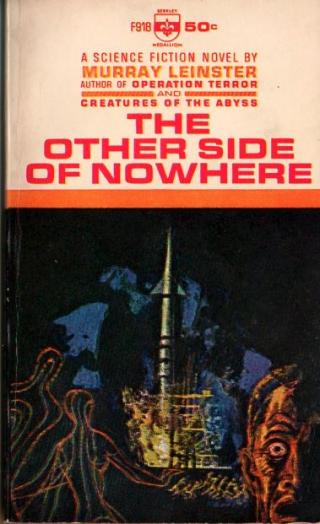
The Other Side of Nowhere
- Автор: Лейнстер Мюррей
- Год: 1964
- Язык: английский
- Год: Berkley Medallion
- Жанр: Научная фантастика

Электронная книга - «The Other Side of Nowhere». Краткое содержание книги:
For centuries space travelers had dreaded a place they called the Other Side of Nowhere — a place in the universe where up was down, where right was wrong, and where all direction was lost...
To save the RIM STAR Braden had to bring the ship to the place of nightmare, the Other Side of Nowhere...
Tracing circuits was a very tedious business; there was no clear connection with the situation in the ship. Men whose purpose was piracy and murder - plus atrocity if that became practical - controlled the ship. But in the heavy steel cell supposed never to be entered outside a spaceport, Braden and Hardy and Diane traced circuits, identified functions, and informed themselves about the methods used by specialists to certify that the Rim Star was spaceworthy. It seemed wildly irrelevant to the situation they were in.
Derr Carmody whimpered. She was ignored. Duckworth fretted, and Fortescue seemed to view the universe with a wry acknowledgment of his uselessness. But presently the three of them drew together and talked wistfully about the production of tape dramas. They were not qualified to think in detail about anything else. Soon they were planning epics and spectaculars and heart-interest narratives to be shown upon the screens of all the worlds if they could ever be able to produce them. Always, it was understood, the star part was tailored for Derr Carmody. Eventually she was battling jealously if a good scene or an effective line were assigned to another imaginary character in these imaginary productions.
But all this was after Braden made his first trip out of the drive-compartment. Conditions, already uncomfortable, became hair-raising because nothing happened.
The skipper, for example. He knew where Braden proposed to hide the passengers. He should have come there at least to consult about joint action when action became possible. But he did not come.
There was the question of food and water. Braden went out, on the second day, to obtain them and to see if he could find any sign of the skipper's survival.
When he went out, the ship was utterly silent. She drove on, but the mutineers could have been dead and the skipper with them, for all the signs of life there were. The temptation to make a search was extreme, but Braden resisted it. He took food from one of the space-boats. As he was carrying it back to enter the drive-cell, he heard a faint, faraway, irrational thump. Then he heard another. He swung ape-like along the intricate patterns of the strength-members and put his ear against the wall of No. 1 hold... Nothing... He clambered down to No. 2 hold. There was movement inside.
He listened, his ear against the hold-plates. The mutineers were shifting cargo. They would be hunting among packing-cases and crates for a certain unmarked box which held some millions of credits in interstellar currency. It had been stowed among crates of preserved food and hardware and bottled beverages for a labor-force canteen. It was simpler and safer to ship a really valuable item this way than under special guard. The mutineers were completely confident that the ship was in their possession. They were hunting for the money. When they found it, they would be rich. Meanwhile they were working leisurely. Confidence as great as this should mean that the skipper was dead. But, of course, they might believe that he'd gone with Braden and the passengers on the hopeless lifeboat trip that Braden had faked for their benefit.
Braden went back to the drive-compartment, back to the uncongenial task of unraveling the circuits leading through the test apparatus to the astrogation equipment and the drive. The mutineers obviously had a destination in mind where they could unload their loot - by space- boat, no doubt - and then abandon the Rim Star to her eternal career as a derelict. This destination must be somewhere along the Rim Star's legitimate course. Quite likely, a new trip- tape would be put into the astrogator control after the Rim Star broke out of overdrive at Handel's Planet itself. It would be convenient.
Braden felt a certain contempt for the crewmen, because they would take away only a fraction of the value they destroyed. If they were lucky, they might load into a lifeboat half of a tenth of a thousandth of the value of what they'd send drifting endlessly in emptiness. They believed they'd killed the ship's officers and passengers for such a reward. They were enraged because one of their number had been killed and others singed by blaster bolts. They would have exacted special vengeance for those things, if they could.
The details of the circuits gradually became clear. Braden and Diane and Hardy knew what wires carried the signal for overdrive and breakout; for compartment doors to close or open; for the image of bow and stem and side vision screens; for all the things the ship's equipment could be commanded to do.
But they lost track of time. Finally, they believed, they had the information needed for the action Braden intended, quite alone, to take. He said with satisfaction:
"Now we plan the business! We've got to work the thing out in detail and then rehearse it until we have it perfect..."
At that exact instant a voice boomed out of a speaker unit in the drive-room ceiling.
"Attention! Breakout coming! Prepare to come out of overdrive in five seconds. Five... four... three... two... one..."
The universe seemed to reel and their bodies and particularly their stomachs seemed to be trying to turn inside out. There was an instant of intolerable dizziness and the feeling of a precipitous fall...
"Turn on the test screens," snapped Braden. "Put everything on test to make sure! We should have been ready! Hurry!"
Diane threw one switch after another. The vision screens of the drive-room lighted, showing exactly what the screens in the control-room showed. A voice - a different voice - came out of the speaker. It was not from inside the ship.
"Checkpoint Carol," said the voice. It was metallic and loud. "Report. Report." There was a pause. "Checkpoint Carol. Report. Report."
The voice was strong. This was another Space Patrol checkpoint at another crossroads of space. The checkpoint robot here could not be more than a light-minute away - no more than ten or eleven million miles. It seemed - almost - that a human being was calling to the Rim Star, and that if the Rim Star appealed for help, it would be given. But the voice was that of a robot - a clumsy, unmanned complex of machinery within a hedgehog-like agglomeration of receiving antennas. It would record what the Rim Star broadcast to it, but it would not reply; it could not respond. It continued to repeat senselessly, "Checkpoint Carol, Report..."
There was a banded sun in the right-hand vision screen; it filled a respectable part of the firmament. There were millions upon millions of stars in view. There was a planet to port. There were hummings, and whirrings, and no less than two wabbling whines which were ship's logs being broadcast for the Patrol checkpoint robot to pick up and record. Ultimately they would be listened to by somebody in case there was anything notable about them. There never was.
The Rim Star's own high-speed broadcast of her log began. It came through on the test circuit in the drive-room as an unsteady, high-pitched droning noise.
Braden's lips compressed. The ship was out of overdrive in a checkpoint solar system. It would be possible to cut the drive from here, the drive-room. From here, too, he could broadcast an appeal for help - not to the checkpoint robot, of course, but to other ships also out of overdrive and in this same solar system. But it would be utterly futile.
It was conceivable that a ship might pick up such an appeal. It was even remotely - very remotely - possible that such a ship might take a bearing on the call and come to investigate. But it couldn't do a thing to help. In theory, perhaps a Patrol ship could match the speed of the Rim Star in space and conceivably clamp on to the bigger vessel. But it was by no means certain that even a Patrol ship could break into an air lock and fight its way inside, even if it was convinced that such a course was necessary. Nothing like it had ever happened in all the centuries of space travel.