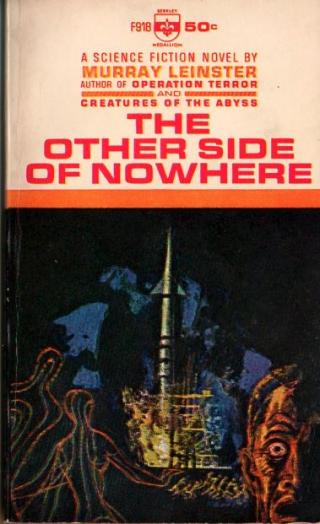
The Other Side of Nowhere
- Автор: Лейнстер Мюррей
- Год: 1964
- Язык: английский
- Год: Berkley Medallion
- Жанр: Научная фантастика

Электронная книга - «The Other Side of Nowhere». Краткое содержание книги:
For centuries space travelers had dreaded a place they called the Other Side of Nowhere — a place in the universe where up was down, where right was wrong, and where all direction was lost...
To save the RIM STAR Braden had to bring the ship to the place of nightmare, the Other Side of Nowhere...
Braden saw the complete impossibility of defending the passenger section. The mutineers had lost at least two heavy-duty weapons in the fire-fighting fog, but they had more. There would be no weapons in any of the spaceboats now, and the skipper had had powerful blast- rifles in the control-room cache. The crewmen would be extravagantly equipped for murder. They could melt through walls if necessary, to kill the passengers. And they should be on the way sternward now.
He was driven to desperate haste. Once he slipped and his hand jerked loose from what he was holding on to, and he fell. But the struts and girders were like tree limbs in their distribution. He fell no more than a dozen feet before he caught himself, though he felt as if his arms would be pulled from their sockets. Then he went on again.
He growled. He wished bitterly that the Rim Star were like those old-fashioned ships now relegated to minor runs between solar systems. Those ships' drives were considered engines and engineer-officers cobbled them, and swore that they were superior to the new-fangled automatics. Men felt greater loyalty to those ships and believed them better than any others in space. They would fight for them. Mutiny would be unthinkable.
But the Rim Star was a machine. Her drive-units were failure-proof. They were sealed in an armored compartment after inspection by specialists aground. The astrogation system was no less non-human. The Rim Star was a complex, soulless device which was wholly indifferent to the human beings aboard her. She drove on blindly.
Braden heard an ominous sound. A blaster - a hand weapon - made a snarling noise. It was nearby - higher, and closer to the bow, but certainly within a few hundred feet. It could be the skipper. He might have attacked the mutineers with a hand-blaster in an utterly hopeless attempt to kill them before they could kill him. A tumultuous uproar of heavy weapons answered. But it kept up too long to be simply a suicidal attack for the purpose of getting killed. There were blasts at odd intervals for several minutes. It could be that the skipper had sniped at them from a cracked-open corridor-plate and then retreated to the dimness in which Braden moved now. There were other blasts from heavy rifles, as if the mutineers were trigger- happy and expected further sniping.
Then there was heavy firing, and somehow it sounded final, as if the men who fired were certain that they had killed their enemy - the skipper. If so, everything was up to Braden.
Braden almost flung himself downward. The crewmen, though, would be marching down ramps and steps which successively circled the whole ship. They could move faster forward, but probably not downward as swiftly as Braden could.
He came to a catwalk which should be the right one. Breathing hard from his exertions, he made his way to the corridor-plate. As he opened it and stepped out, a pellet of blindingly white light flashed past him. He heard a blaster snarl.
"Stop!" he snapped.
He was within ten yards of the doorway to the passengers' quarters. Duckworth had been on guard. He saw Braden appear and fired. He missed. It was wise to miss with only a stage weapon. Braden went past him, angered.
"That shot tears it!" he snapped again, as he went in. "But shoot first if anybody comes!"
He was in the passengers' saloon. Diane had snatched up a hand-blaster. She gave a little gasp of relief at the sight of him. Fortescue had grabbed a stage rifle when he heard Duckworth shoot. Hardy faced the door grimly, a hand-blaster halfway drawn. Derr Carmody seemed to be half-fainting, her hand to her lips and her eyes filled with terror.
"Come along!" said Braden sharply. "Everybody up! The crew's on the way here. The skipper's killed one of them, but they're heavily armed and they're coming to kill you. Everybody up!"
He gave them no time to ask questions as he hurried them out. There were two spiral corridors from end to end of the ship. The mutineers would come along the corridor to the right, so he shepherded his charges to the left. There had to be two passageways, for safety's sake alone.
They passed the place where a stairway went down to the exit port. The exit was at the bottom of one of the giant fins on which the Rim Star stood upright in port. Braden had an idea and seized on it.
"Go on ahead," he commanded. "Right with you!"
He raced down the stairs. The personnel port, of course, was an air lock. Braden hauled open the inner door, jammed it against being closed, and held his pocket weapon within inches of the door that remained between himself and interstellar space. He held down the trigger, and swore at the smallness of the effect it made. Heavy-duty weapons had burned through the control-room door as if it were butter.
But presently - it seemed an agonizing length of time - a small place glowed red... cherry red... incandescent. And then the ship's air-pressure blew out the semi-liquid metal and screamed out through the small opening into the space beyond. It was not a large hole, of course - actually less than an inch in diameter. But air rushed out and Braden raced up the stairs again. He reflected dourly that this was the kind of trick the steward might think of. Smart. And safe. He didn't like it, but it was necessary.
He reached the top of the stairs and there was the mournful, mooing, dismal sound of the maximum-emergency signal. A monitor-panel somewhere had reported a drop of air-pressure here. Collision doors closed all over the ship, dividing it into innumerable airtight compartments.
"Quick!" snapped Braden. "Run!"
He drove them on. Derr Carmody stumbled on the stairs. He picked her up and ran with her. Already the air was thin. There was a considerable volume of air to escape from this compartment, but there was need for haste.
The corridor ahead was blocked by an automatically closed collision door. But there was an escape section, to be worked by hand. Braden opened it and rushed the others through. He panted out orders. Diane grasped what he meant and ran on ahead. Only Fortescue stayed behind.
"Anything I can do?" he asked uneasily.
"Get them to the next door. Fast!" commanded Braden.
Fortescue ran on ahead, disappearing around the curve of the corridor. Diane called. Braden punctured this door also with his blaster. It was a smaller hole than the one in the outside lock door. Air whistled through, ultimately to stream out free into space.
Braden caught up with the others. Again he opened the escape section and got them through.
"They can't follow us now," he said savagely. "I created an air leak. One compartment's empty of air and another is emptying its air into the first. But now we've got to move faster than ever. We can't go back the way we came, and they can head us off by way of the bow."
There was sweat on his forehead. He'd asked to be given the responsibility for the ship and the passengers, but it involved flight, hiding, trickery, instead of the violent action he preferred. He disapproved of himself as he rushed them onward. One closed-off section after another. Derr Carmody gasped that she had to rest... the stairs... the ramps. She had to rest.
"We haven't time!" Braden raged at her. "Keep going or be left behind!"
He knew he wouldn't do it, but the threat might keep her going. The corridor seemed interminable. Where there were no steps, there was ramp. It was a matter of climbing, climbing, climbing.
He drove them on. Their behavior could have been predicted. Just as a group of men, long isolated, form group-patterns of behavior that tacitly assign different roles to each man, so a group of men and women establish a pattern in a time of emergency. Here Braden was obviously the leader, and Diane was automatically his chief lieutenant. Fortescue was prepared to do loyally whatever he was told. Duckworth might be a third leader in case of need, and Hardy... Braden somehow left Derr Carmody to Hardy. In an emergency Hardy would always be the one man who saw details the others did not notice, and stolidly took care of the weakest. Who, of course, would be Derr Carmody.