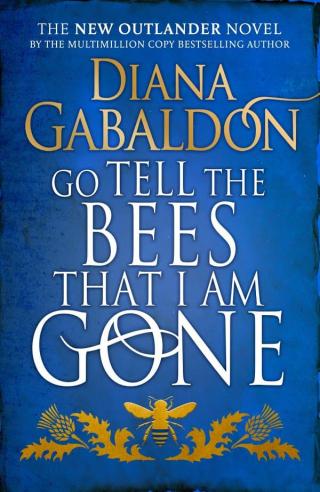
Go Tell the Bees That I Am Gone
- Автор: Гэблдон Диана
- Серия: Outlander #9
- Год: 2021
- Язык: английский
- Год: Delacorte Press
- ISBN: 978-1-473-51900-8
- Жанр: Исторические приключения

Электронная книга - «Go Tell the Bees That I Am Gone». Краткое содержание книги:
The past may seem the safest place to be . . . but it is the most dangerous time to be alive. . . .
Jamie Fraser and Claire Randall were torn apart by the Jacobite Rising in 1746, and it took them twenty years to find each other again. Now the American Revolution threatens to do the same. It is 1779 and Claire and Jamie are at last reunited with their daughter, Brianna, her husband, Roger, and their children on Fraser’s Ridge. Having the family together is a dream the Frasers had thought impossible. Yet even in the North Carolina backcountry, the effects of war are being felt. Tensions in the Colonies are great and local feelings run hot enough to boil Hell’s teakettle. Jamie knows loyalties among his tenants are split and it won’t be long until the war is on his doorstep. Brianna and Roger have their own worry: that the dangers that provoked their escape from the twentieth century might catch up to them. Sometimes they question whether risking the perils of the 1700s—among them disease, starvation, and an impending war—was indeed the safer choice for their family. Not so far away, young William Ransom is still coming to terms with the discovery of his true father’s identity—and thus his own—and Lord John Grey has reconciliations to make, and dangers to meet . . . on his son’s behalf, and his own. Meanwhile, the Revolutionary War creeps ever closer to Fraser’s Ridge. And with the family finally together, Jamie and Claire have more at stake than ever before.
Hiram Crombie had brought the beer tonight, it being his turn. Skinflint he might be—all the fisher-folk were, having lived in stark poverty all their lives—but he kent what was right, and the beer was good. Jamie wondered what was ado with wee Cyrus, but it didn’t look urgent ….
On the far side of the room, Cunningham was talking. About loyalty. About his service in the Royal Navy. About loyalty to the King.
Jamie slowly got his feet under him. All right, there was nothing that prevented men talking of politics or religion outside of Lodge, but this was not quite far enough outside, and everyone knew it. Silence spread from the men who surrounded Cunningham—Jamie took note of their faces—and a coldness ran through the room like spreading frost as the others began to listen and hear what was being said.
Then it stopped. Cunningham still stood, unmoving save for his eyes, which took note in turn of each face in the room. Jamie had been listening intently, not so much for Cunningham’s words but composing answers to them. Then Jamie rose to his feet. His own words fell away, and others rose in their place.
“I will say but one thing to ye all, a charaidean. And that is not my own, but a thing said by our forefathers, four hundred years ago.” A faint stir broke the sense of ice, and men shifted on their stools, drawing themselves up to hear. Glancing sideways, to see how matters lay.
It had been a long—a very long—time since he’d read the Declaration of Arbroath, but they weren’t words you’d forget.
“As long as but a hundred of us remain alive, never will we on any conditions be brought under English rule. It is in truth not for glory, nor riches, nor honours, that we are fighting …” He paused and looked Cunningham straight in the eyes. “… but for freedom—for that alone, which no honest man gives up but with life itself.”
He didn’t wait for the deep rumble of response but turned on his heel and went out the door, as quick as he could, and broke into a run as soon as he was outside, knife in hand.
There were three or four of them, waiting for him. But they’d thought he’d talk on, and he caught them staring, moon-faced in the light from the suddenly open door. He hit one in the jaw, shouldered another out of the way, and was into the wood before they could move. He heard the shouting and confusion as the men in the Meeting House all tried either to get out or to punch each other.
The moon wasn’t yet up and the woods were pitch-dark, but he’d chosen a large boulder near a huge spruce for his hiding place and had the pistol in his hand within moments. It was loaded and primed, but he didn’t cock it yet.
His heart was pounding in his ears as he slid through the brush—he daren’t run, in earshot of the Meeting House—but he thought he heard Cunningham’s quarterdeck roar. He was bellowing, “All hands!” and Jamie would have laughed, if he’d had breath.
His freedom—and probably his life—depended on two things now, and he had no control over either one. If Scotchee Cameron had got his note, and if he thought it was worth keeping the Cherokee from being involved in a fracas over the Line—that was one thing. The other was whether John Sevier had been able to find Partland and his men at Ninety-Six and stop them.
Hiram Crombie and the rest were keeping Cunningham and his men busy, from the sounds of it. But if either Cameron or Sevier had failed him, it was going to be a bloody night.
IT WAS WELL past midnight; I’d sent the girls and Bluebell up to bed two hours ago, and now exhaustion hung over the kitchen like a low veil of chimney smoke. We had exhausted everything: prayer, conversation, industry, food, milk, and chicory coffee. Elspeth didn’t drink alcohol recreationally, pious Christian that she was, and had refused more than the one medicinal cup of whisky tonight. While I longed to obliviate myself, I felt that I had to stay sober, had to be ready. For what, I didn’t want to think—thinking was another thing I had exhausted.
For a time, I had been conscious every moment of what might be happening at the Meeting House. Visualizing the Lodge meeting—or what I knew of it, for Jamie observed the Masonic vows of secrecy, and while he laughed with me over the apron and dagger, he said nothing about their rituals. Wondering where the crisis would come.
“Nothing will happen during the meeting, Sassenach,” he’d said, in an effort to be reassuring. “Cunningham’s an officer and a gentleman, and a Mason of the Thirty-third Degree. He takes an oath seriously.”
“Such men are dangerous,” I’d said, quoting Julius Caesar. I was striving for levity, but Jamie had just nodded soberly and taken the best of his pistols from its place above the mantelpiece.
But now my mind was blank, having room only for a formless dread. I’d stirred up the fire; I stared into the flames, my face hot and my hands cold as ice, lying useless in my lap.
“It’s raining.” Elspeth broke the silence, lifting her head at the sound of the spatter of raindrops against the closed shutters. We were sitting by the kitchen fire again, having left the surgery spick-and-span. Fresh bandages. Linen towels. Surgical instruments recleaned and sterilized, laid out on their own fresh towel on the counter. The brazier cleaned and filled with new hickory chips, a selection of cautery irons ready beside it. Without speaking a word to each other about what we were doing, we had prepared for sudden and dire emergency.
“So it is.” The silence fell again. The sound of the rain had rekindled my thoughts, though. Would it keep them inside the Meeting House?
Nonsense, Beauchamp, my mind replied. When has rain stopped a Highlander from doing anything whatever? Nor yet a naval office, I suppose …
“I’m sorry.” Elspeth spoke abruptly and I glanced at her, startled. Her hands were folded tight in her lap. Her face was pale and her lips pressed together, as though sorry she’d spoken.
“It’s not your fault,” I said automatically, and then more consciously, “Nor mine.”
Her lips relaxed a little at that.
“No,” she said, softly. She was silent for a bit, but I could see her throat working faintly, as though she was arguing with herself about something.
“What is it?” I said at last, very quietly. She looked at me, and I saw her stringy throat bob as she swallowed.
“Five years,” she blurted.
“What?”
She looked away, but then back, dark eyes fixed on mine with an odd look, apology mingled with something else—relief? Triumph?
“When Simon died—my grandson … two years ago …”
“Jesus H. Roosevelt Christ!” I said, and a lance of real fear stabbed me in the heart. Like everyone else present at the time, I’d been deeply moved by Charles Cunningham’s maiden sermon, and the story of his son’s death—and his last words. “I’ll see you again. In seven years.”
“What did you say?” Elspeth asked, incredulous. I flapped a hand at her in dismissal. If the captain believed his son’s word—and very plainly he did—then he must conclude that he was essentially immortal for the intervening years. Five years now.
“Holy Lord,” I said, finding a more acceptable interjection. There was an inch of buttermilk left in my cup, and I tossed it back as though it were bad whisky.
“That—I mean … it doesn’t mean that he will kill your husband,” Elspeth said, leaning forward anxiously. “Only that your husband will not kill him.”
“That must be a comfort to you.”