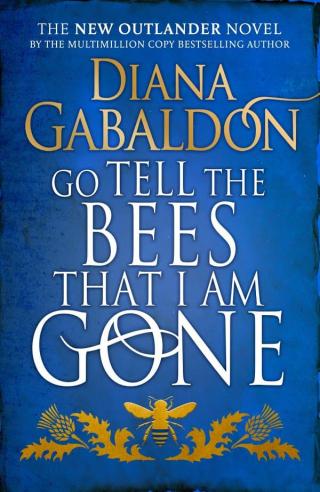
Go Tell the Bees That I Am Gone
- Автор: Гэблдон Диана
- Серия: Outlander #9
- Год: 2021
- Язык: английский
- Год: Delacorte Press
- ISBN: 978-1-473-51900-8
- Жанр: Исторические приключения

Электронная книга - «Go Tell the Bees That I Am Gone». Краткое содержание книги:
The past may seem the safest place to be . . . but it is the most dangerous time to be alive. . . .
Jamie Fraser and Claire Randall were torn apart by the Jacobite Rising in 1746, and it took them twenty years to find each other again. Now the American Revolution threatens to do the same. It is 1779 and Claire and Jamie are at last reunited with their daughter, Brianna, her husband, Roger, and their children on Fraser’s Ridge. Having the family together is a dream the Frasers had thought impossible. Yet even in the North Carolina backcountry, the effects of war are being felt. Tensions in the Colonies are great and local feelings run hot enough to boil Hell’s teakettle. Jamie knows loyalties among his tenants are split and it won’t be long until the war is on his doorstep. Brianna and Roger have their own worry: that the dangers that provoked their escape from the twentieth century might catch up to them. Sometimes they question whether risking the perils of the 1700s—among them disease, starvation, and an impending war—was indeed the safer choice for their family. Not so far away, young William Ransom is still coming to terms with the discovery of his true father’s identity—and thus his own—and Lord John Grey has reconciliations to make, and dangers to meet . . . on his son’s behalf, and his own. Meanwhile, the Revolutionary War creeps ever closer to Fraser’s Ridge. And with the family finally together, Jamie and Claire have more at stake than ever before.
A burning stick broke in the hearth with a sharp crack and sparks sprayed up in a tiny fountain. A few caught in the fire screen Bree had made, glowing red for an instant before dying. The cat twitched an ear, but remained unperturbed.
I felt, rather than heard, the front door closing: a muffled vibration through the bones of the house. Aaron Cloudtree was gone. I pulled my wrapper close and went downstairs, leaving Adso to mind the fire.
“DO YOU THINK this Scotchee can help?” I asked dubiously. Mr. Cloudtree had departed, full of whisky and pickle, with a sealed note—written in Gaelic and carefully unsigned, in case of interception or indiscretion—in his pocket, and we were sitting by the kitchen fire, sharing the rest of the whisky with the peace of the resting house around us. It was very late—perhaps two or three o’clock in the morning, judging from the deep, chilly stillness of the air outside—but neither of us wanted to go to bed.
“I dinna ken,” Jamie admitted. He rubbed both hands over his face, then shook his head, leaving his hair rumpled and flyaway, short hairs rising from his crown, red in the firelight. He yawned, blinked, and shook his head, more to dispel mental fog than to acknowledge onrushing sleep, I thought.
“It depends,” he said, after a meditative sip. “Where he is, who he can talk to. And whether he can still read the Gàidhlig,” he added, with a rueful smile. “If not, we’re nay worse off than before. If we’re lucky, he may be moved to find out who Cunningham’s been dealing with among the Cherokee, and maybe drop a word to the headman of that village.”
I nodded, dubious. The Cherokee territory was a vast country, with hundreds of villages. On the other hand, Jamie was well known there as the Indian agent before Scotchee, and I rather thought that while Charles Cunningham’s accomplices might be familiar with some of the Cherokee headmen, Cunningham himself almost certainly wasn’t. Alexander Duff and his son lived within a quarter mile of the Cunningham cabin; Donald MacGillies within a stone’s throw of the Duffs. Sandy Duff and Donald MacGillies were Ardsmuir men, wholly to be trusted, and I knew they had been keeping an eye on the comings and goings over the Treaty Line.
“What did you do with the rifles you took from Cunningham?” I asked, pouring another cup of hot milk and adding a drizzle of honey.
“Gave most of them to men I can trust. Speaking o’ that …” he said, and yawned again. “Oh, God … I’ll have to send word to the Overmountain men, though I canna reach them all in time. Sevier might come, though; he’s the closest, and a solid man. And he doesna much like Indians.”
108
Lodge Night
JAMIE COULDN’T EAT SUPPER, though he hadn’t eaten anything since the night before. His wame was closed as a knotted glove, and he didn’t feel hungry; the lack of food sharpened his bones and cleared his head. He felt calm but as though he was standing behind a sheet of glass, watching himself.
“Eh?” Claire had said something to him, and he hadn’t heard. He made a brief gesture of apology, and she narrowed her eyes at him—not in annoyance, in concern.
“It’s fine, Sassenach,” he assured her. “Cunningham doesna want me dead. The worst that can happen is that he takes me prisoner tonight.”
“What about what happens after that?” she demanded. She was wound tight as a new watch; he could see her wee gears spinning, and smiled. One of her eyebrows went up, and he leaned over and kissed it.
“Dinna fash, a nighean. After that, the captain has a choice, doesn’t he? Get me off the Ridge—and good luck to him if that’s his choice—or try to take me over the Line and through the Cherokee lands to get to Ferguson—wherever that poor bastard is now. And while Cunningham’s friends have friends among the Cherokee—so do I, and if Aaron Cloudtree either found Scotchee Cameron or spoke of the matter to anyone else—and I’d wager my best stockings that he did; ye can tell he’s a blabbermouth—the captain might have a good deal more trouble in taking me anywhere than he might think.”
“Oh, good,” she said, and the line between her brows eased a bit. “So after you start a small war over the Treaty Line, the captain will just have to kill you all by himself.”
Jamie shrugged. He hadn’t thought that far, but it didn’t matter.
“He can try.”
She didn’t look much less worried, but she smiled at him, despite herself. Seeing that made him want suddenly and urgently to have her, and it plainly showed on his face, for her smile deepened—though her sidewise glance at the door convinced him that she wasn’t going to let him bend her over the table and try to finish before wee Aggie came in.
“After Lodge, then,” he said, grinning at her.
She took a deep breath and nodded.
“After Lodge,” she said, trying to sound as certain as he did.
I WAS THUMBING through my Merck, roaming from pleural disorders and the use of thoracentesis to a gripping account of inflammation of the rectal mucosa, but while my cerebellum could be coaxed into a momentary distraction, my brain stem, spinal cord, and sacral nerves were having none of it. If I’d had a tail, it would have been pressed tight between my legs, and small jolts of something between electricity and nausea spurted unexpectedly through my abdomen.
The girls knew that something was afoot. They’d been silent as mice at supper, gazing as though hypnotized at Jamie. I’d been likewise hypnotized, watching him dress afterward.
I’d stayed to help clear the table, put away the remnants and orts from the meal, and smoor the fire in the kitchen hearth, and when I came up to our bedroom, I found him facing away from me, on the far side of the room. He didn’t turn round; I thought perhaps he hadn’t heard me come in. His face was reflected in the window he stood in front of, but I could see that he wasn’t looking at his reflection.
He wasn’t looking anywhere. His eyes were fixed and full of darkness, and his fingers moved swiftly, twitching buttons free, unwinding his neckcloth, loosening his breeches—all as though he were somewhere else, completely unaware of what his hands were doing. He was preparing to fight.
His plaid lay on the bed, along with a clean shirt and his leather jerkin. He turned, presumably to fetch it, and saw me. He looked blank, and then the life flowed back into him.
“Ye look as though ye’ve seen a ghost, Sassenach,” he said, in a voice that was almost normal. “I ken I’ve aged a bit, but surely it’s none sae bad as all that?”
“You’d scare the Devil himself,” I said. I wasn’t joking, and he knew it.
“I know,” he said simply. “I was remembering how it was, just before the charge. At Drumossie. Folk were shouting and I could see the gunna mòr across the field, but it didna mean anything. I was shedding my clothes, because there was nothing left but draw my sword and run across the moor. I kent I’d never make it to the other side, and I didna care.”
I couldn’t speak. Neither did he, but went quietly about the business of washing, of putting on his clean sark and his belted plaid, and when he got to his feet, he smiled at me, though his eyes still held memories.
“Dinna fash, Sassenach. Cunningham wants to hand me over to Patrick Ferguson and take the credit. It’s his best chance to make his name among the Loyalist forces.”
I nodded obediently, knowing as well as he did that the motive for starting a fight often had nothing to do with how things turned out.
He started for the door, then stopped, waiting for me. I came slowly to him, touched him. He hadn’t put on his coat yet, and his arm was solid and warm through the cloth of his shirt.