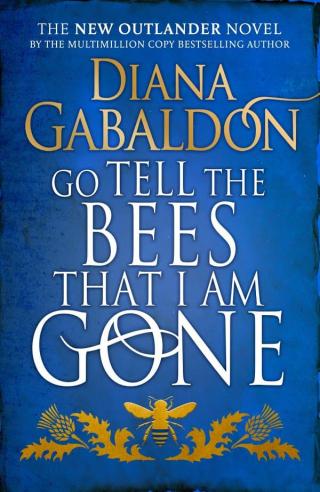
Go Tell the Bees That I Am Gone
- Автор: Гэблдон Диана
- Серия: Outlander #9
- Год: 2021
- Язык: английский
- Год: Delacorte Press
- ISBN: 978-1-473-51900-8
- Жанр: Исторические приключения

Электронная книга - «Go Tell the Bees That I Am Gone». Краткое содержание книги:
The past may seem the safest place to be . . . but it is the most dangerous time to be alive. . . .
Jamie Fraser and Claire Randall were torn apart by the Jacobite Rising in 1746, and it took them twenty years to find each other again. Now the American Revolution threatens to do the same. It is 1779 and Claire and Jamie are at last reunited with their daughter, Brianna, her husband, Roger, and their children on Fraser’s Ridge. Having the family together is a dream the Frasers had thought impossible. Yet even in the North Carolina backcountry, the effects of war are being felt. Tensions in the Colonies are great and local feelings run hot enough to boil Hell’s teakettle. Jamie knows loyalties among his tenants are split and it won’t be long until the war is on his doorstep. Brianna and Roger have their own worry: that the dangers that provoked their escape from the twentieth century might catch up to them. Sometimes they question whether risking the perils of the 1700s—among them disease, starvation, and an impending war—was indeed the safer choice for their family. Not so far away, young William Ransom is still coming to terms with the discovery of his true father’s identity—and thus his own—and Lord John Grey has reconciliations to make, and dangers to meet . . . on his son’s behalf, and his own. Meanwhile, the Revolutionary War creeps ever closer to Fraser’s Ridge. And with the family finally together, Jamie and Claire have more at stake than ever before.
“You little bas—” she began, and then pressed her lips together, cutting off the word.
“Bastard,” he finished for her. “Yes, I am. Go home.” And turning his back on her, he reached down a hand to the boy and lifted him ’til he could get a foot on the stirrup and scramble up behind.
“Où allons-nous?” he asked briefly, and the boy pointed behind them, toward the river.
A large feminine hand grabbed his horse’s bridle. The horse snorted and shook his head in protest, but she held on.
“Has anyone ever told you that being reckless will get you killed?” she asked, imitating his polite tone. “Not that I care that much, but you’ll likely get this kid, as well as John Cinnamon, killed too.”
“Kid?” was all he could think of saying, for the collision of words trying to get out of his mouth.
“Child, boy, lad, him!” she snapped, jerking her chin toward the little drummer behind him.
“Quel est le problème de cette femme?” the boy demanded indignantly.
“Dieu seul sait, je ne sais pas,” William said briefly over his shoulder. God knows, I don’t.
“Will you bloody let go?” he said to his sister.
“In a minute, yes,” Brianna said, fixing him with a dark-blue glare. “Listen to me.”
He rolled his eyes but gave her a short, sharp nod and a glare in return. She sat back in her saddle a bit but didn’t let go.
“Good,” she said. “I walked up and down that shore nearly every day, before the Americans showed up, and my k—my children poked into every cranny in those bluffs. There are only four places that could possibly be called caves, and only one of them is deep enough that somebody Cinnamon’s size could have a hope of hiding in.”
She paused for breath and wiped her free hand under her nose, eyeing him to see if he was paying attention.
“I hear you,” he said testily. “And?”
“And that one isn’t a cave at all. It’s the end of a tunnel.”
The flush of temper left him abruptly.
“Where’s the other end?”
She smiled slightly and let go of the bridle.
“See? You may be reckless, but I knew you weren’t stupid. The other end is in the cellar of a tavern on Broad Street. They call it the Pirates’ House, and so far as I know from the talk in town, there’s a good reason for that. But if I were you—”
He snorted briefly and gathered up his reins. The end of the alley was clear now, emptied of wagon, mourners, and small shrouded bodies.
“You are my sister, madam,” he said, and with no more than an instant’s hesitation, added, “and I’m glad of that. But you’re not my mother. In fact, I’m not stupid, and neither is John Cinnamon.” He paused for an instant, then added, “Thank you, though.”
“Good luck,” she said simply, and sat watching as he turned and rode away.
BRIANNA DIDN’T LEAVE the alley at once. She watched William ride out, back stiff with determination, the boy clinging to his waist. From the looks of it, the child had never sat on a horse before, was terrified, and was damned if he’d admit it. Between him and William, she thought John Cinnamon might have chosen worse, in terms of allies. She quivered with the urge to follow William, not to let him go alone, but he was—damn him!—right. She couldn’t risk something happening to her, not with Jem and Mandy …
She gathered her reins and clicked her tongue; more people were coming through the square, toward the church. Soberly dressed, walking close together. This church had no bell, but one was ringing, tolling, somewhere across the city. More funerals, she thought, and her heart squeezed tight in her chest. Slowly, she rode out among the mourners and turned up Abercorn Street.
How many people can you worry about at once? she wondered. Jem, Mandy, Roger, Fanny, her parents, now William and John Cinnamon … She was still shaken by the dead children and their mother; this, on top of a night spent in the marshes with Casimir Pulaski, made her feel as though her skin were about to peel off. A sudden memory of her last sight of the general surged into her mind, and a high, completely unhinged giggle escaped her. Just as suddenly, bile rose in her throat and her stomach turned over. “Oh, God.”
She fought down the surge of nausea, but saw that people were staring at her and realized that, in addition to laughing like a loon, she was still clutching her tricorne in one hand, her hair blowing loose, and her legs scratched and mosquito-bitten, bare from knees to absurdly elaborate shoe tops—she’d taken off her wet stockings the night before and forgotten to find them in the morning. Suddenly embarrassed by the sidelong glances and whispers, she straightened up defiantly, shoulders back. A big hand clutched the bare calf of her leg, and she yelped and swatted whoever it was with her hat, making the horse shy violently.
Who it was was Roger, who shied violently, too.
“Christ!”
“Shi— I mean S-word!” she said, grappling her horse back under control. “What did you do that for?”
“I called, but ye didn’t hear me.” He slapped the horse companionably on the withers and reached up a hand to her. He looked tired, and his eyes were creased with worry. “Come down and tell me what the devil’s been happening. Did ye go to the American camp? I shouldn’t have asked ye to— God, ye look like death.”
Her hands were actually shaking, and in fact, she realized, she felt rather like death. When her feet touched the ground, she nearly fell into his arms, hugging him, and began to live again.
98
Minerva Joy
LORD JOHN RETURNED FROM a visit to the local hospital, where the British wounded—along with those Savannah inhabitants injured by flying splinters or house fires—were being treated, to find his brother sitting at his desk in the study, looking as though he’d been struck by lightning.
“Hal?” John said, alarmed. “What’s happened?”
Hal’s mouth opened, but only a small wheezing noise came out. There was an opened letter on the desk, looking as though it had traveled some distance through rain and mud, and possibly been trampled by a horse along the way. Hal pushed this wordlessly toward him, and he picked it up.
Friend Pardloe,
I write in torment of mind and spirit, which is increased by the knowledge that I must oblige thee now to share it. Forgive me.
Dorothea gave birth to a healthy girl, whom we named Minerva Joy. She was born within the precincts of the prison at Stony Point, as I was confined there and I would not trust Dorothea’s welfare to the local midwife, whose competence I doubted.
Mina (as we called her) thrived and bloomed, as did her mother. There was an outbreak of fever within the prison, though, and fearing for their health, I sent them into the town, where they took refuge with a Quaker family. Alas, no more than a week after their departure, I received a note from the husband of this family, with the dreadful news that two members of his own family had fallen ill with a bloody flux, and that my own dear ones showed signs of the same disease.
I sought leave at once to go to treat my family, and was (reluctantly) granted a temporary parole for the purpose. (The prison’s commander, valuing my services to the sick, did not wish me gone for long.)
I was in time to hold my daughter through the final hours of her life. I thank God for that gift, and for the gift that she was to her parents.