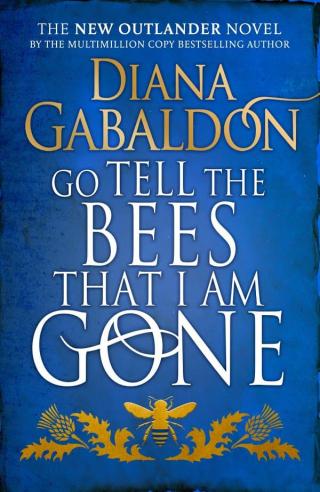
Go Tell the Bees That I Am Gone
- Автор: Гэблдон Диана
- Серия: Outlander #9
- Год: 2021
- Язык: английский
- Год: Delacorte Press
- ISBN: 978-1-473-51900-8
- Жанр: Исторические приключения

Электронная книга - «Go Tell the Bees That I Am Gone». Краткое содержание книги:
The past may seem the safest place to be . . . but it is the most dangerous time to be alive. . . .
Jamie Fraser and Claire Randall were torn apart by the Jacobite Rising in 1746, and it took them twenty years to find each other again. Now the American Revolution threatens to do the same. It is 1779 and Claire and Jamie are at last reunited with their daughter, Brianna, her husband, Roger, and their children on Fraser’s Ridge. Having the family together is a dream the Frasers had thought impossible. Yet even in the North Carolina backcountry, the effects of war are being felt. Tensions in the Colonies are great and local feelings run hot enough to boil Hell’s teakettle. Jamie knows loyalties among his tenants are split and it won’t be long until the war is on his doorstep. Brianna and Roger have their own worry: that the dangers that provoked their escape from the twentieth century might catch up to them. Sometimes they question whether risking the perils of the 1700s—among them disease, starvation, and an impending war—was indeed the safer choice for their family. Not so far away, young William Ransom is still coming to terms with the discovery of his true father’s identity—and thus his own—and Lord John Grey has reconciliations to make, and dangers to meet . . . on his son’s behalf, and his own. Meanwhile, the Revolutionary War creeps ever closer to Fraser’s Ridge. And with the family finally together, Jamie and Claire have more at stake than ever before.
“William said that he—or rather you—wanted a portrait made,” she said, changing to what seemed safer ground. “I’d be very happy to do that. Er … is it meant for some lucky lady?”
That surprised him, and he laughed, a low, warm sound.
“No, I don’t have a woman. I mean to send it to my father,” he said.
“Your father? Where is he?” The clouds had shredded and the light of a setting moon showed her his broad face, soft-eyed now, and thoughtful. He would be wonderful to paint.
“London,” he said, surprising her. He saw that he had surprised her and ducked his head, abashed.
“I am a bastard, of course,” he said, with a tone of apology. “My father was a British soldier; he got me on an Indian woman in Canada.”
“I … see.” There didn’t seem anything else she could say, and he gave her a small, shy smile.
“Yes. I thought—for many years, I thought that Lord John was my father. It was him who took me when my mother died—I was an infant—and gave me to the holy fathers at the mission in Gareon. He sent money for my keeping, you see.”
“That … seems very like him,” she said, though in fact she would never have thought of him doing such a thing.
“He is a kind man. Very kind,” he added firmly. “William brought me to Savannah to talk to him—William thought Lord John to be my father, too—and it was his lordship who told me the truth. My real father abandoned me; such things are common.”
His voice was matter-of-fact; probably such things were common.
“That doesn’t mean it’s right,” she said, angry at the unknown father.
He shrugged.
“But Lord John told me his name, and a direction. I know how to—to send the picture to him.”
“You want a portrait for a man who abandoned you? But—why?” She spoke cautiously. This young man was patently a realist; did he really think that a portrait of his half-breed child, now grown, would move the sort of selfish, coldhearted oaf who—
“I don’t think he will acknowledge me,” he assured her. “I don’t want him to. I don’t want money or anything he might value. But he has one thing that I want, and I hope that if he sees my face, he will give it to me.”
“What on earth is that?”
Even the dripping from the trees had ceased by now. The night was so still that she could hear him swallow.
“I want to know my name,” he said, so low she scarcely heard him. “I want to know the name my mother called me. He’s the only one who knows that.”
Her throat was too tight to speak. She stepped toward him and put her arms around him, holding him as his mother might have, had she lived to see him grown.
“I promise you,” she whispered when she could speak. “Your face will break his heart.”
He patted her back, very gently, and stepped back.
“You’re very kind,” he said. “You should sleep now.”
97
An Excellent Question
JOHN CINNAMON TACTFULLY LEFT William and Brianna soon after they had made their way back through the debris of the abatis line into the city, saying that he had business at the riverfront and would see William later at Lord John’s house.
“I like your friend a lot,” Brianna said, watching Cinnamon’s broad back disappear into the dappled sunlight of a square whose name she didn’t know.
“So do I. I only hope—” William checked himself, but his sister turned to him, a sympathetic expression on her face.
“Me, too,” she said. “You mean London, and this Matthew Stubbs?”
“Malcolm, but yes.”
“What sort of man is he?” she asked curiously. “Have you met him?”
“Yes, twice that I recall. Once at Ascot and once at one of my f—one of Lord John’s clubs.” He glanced at her to see whether she’d noticed, but of course she had.
“It’s okay—all right, I mean—to call Lord John your father,” she said, the expression of sympathy transferring itself to him. “Da wouldn’t mind.”
Blood rose in his cheeks, but he was saved from saying what he thought about Jamie Fraser’s preferences in the matter by Brianna’s instantly returning to the subject of Malcolm Stubbs.
“So, what’s he like, this Stubbs?”
He couldn’t help a smile at the suspicious tone of “this Stubbs.”
“To look at, very aptly named. Short and thick—with hair just like Cinnamon’s, though it’s a sort of a sandy blond. It may be gray by now, though,” he added. “He always wears a wig in public.”
She lifted her brows at him—thick brows, for a woman, and red to boot, but very expressive.
“I don’t know,” he said honestly, in response to the brows’ question. “There’s the one thing that might help. Pa—Papa, I mean,” he said, giving her a brief glare that dared her to comment, “told me that he has a black wife. Stubbs has, I mean,” he amended. “Not Papa.”
She blinked.
“In London?”
She sounded so shocked that he laughed.
“Why should the place make a difference? I imagine she’d be just as surprising here”—he waved a hand at the stately, shattered houses surrounding St. James Square—“if not more so.”
“Hm!” she said. Then, curiously, “Did he free her from slavery, and then marry her?”
“She wasn’t a slave,” William said, somewhat surprised. “My father said that he—he and Stubbs both, he meant—had met her in Cuba. Stubbs’s first wife had just died of some sort of fever, and he brought this woman—Inocencia, that’s her name, I knew it was some sort of Spanish virtue—brought her back to London with him and married her. Anyway,” he said, bringing the conversation back to its point, “I’m sure that Papa said Stubbs had children by this woman.”
“You mean he wouldn’t necessarily turn his back on John Cinnamon because of being …” She waved a hand, indicating Cinnamon’s noticeable Indian-ness.
“Yes.” William felt doubtful, despite the firmness of his answer. Having children of an unusual hue would cause comment, but wasn’t necessarily a scandalous thing, provided they were legitimate, which the junior Stubbses certainly were. Having an enormous and very obviously extra-legal adult Indian turn up and claim parentage might well be a horse of a different color. And he found that he very much wanted John Cinnamon not to be hurt.
Brianna made a clicking noise, and her horse moved obligingly out of the shade of the live oaks and into Jones Street. There were a large number of people out, William saw; overnight, the sense of fearful oppression had lifted with the siege, and while the smell of burning still tinged the air and broken tree limbs were scattered everywhere, people had to eat and business must be done. The normal tide of daily life was coming in apace.
“Will you go with him? To London?” Brianna asked over her shoulder. She nudged her horse with both heels, reining him out of the way of an oncoming wagon filled with barrels and sweetly smelling of beer.
“London?” William repeated. “I don’t know.” He didn’t, and let so much uncertainty show in his voice that his sister pulled up a bit to wait for him, then nodded toward a lane that ran behind the Baptist church, indicating that he should follow her.
“It’s not my business,” she said, as they passed into the cold shadow of the church, “but—what are you planning to do? I mean, now the siege is lifted, I suppose you can go anywhere you want …”
Excellent question.
“I don’t know,” he said honestly. “Truly, I don’t.”
She nodded.