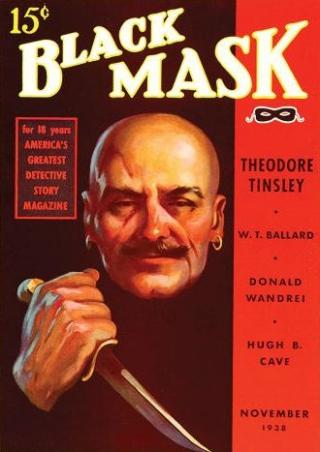
Black Mask (Vol. 21, No. 8 — November, 1938)
- Автор: Баллард Уиллис Тодхантер, Cave Hugh B.
- Год: 1938
- Язык: английский
- Год: Pro-Distributors Publishing
- Жанр: Другие детективы

Электронная книга - «Black Mask (Vol. 21, No. 8 — November, 1938)». Краткое содержание книги:
Holden’s eyes flew wide open then. Blood was throbbing in his temples; he twisted his hands and cried out:
“I didn’t know it was her bag! I hardly saw it. I shot him, yes. I got the things out of his safe, money, and that confession. But I didn’t know it was her bag.”
“It’s possible,” said Paradine. “I believe you. You did care about Molly, in your way... How long did you work for Tiemann before he ordered you to work in with Hanifin?”
Holden looked at the question mark on the floor; moved his foot a little further from it; said:
“Three years. Years of doing what he told me to... But I wanted to go straight after — after we were married.”
“Wanted to.” Paradine’s voice was chilled with contempt. “If a man wants to, he does. He may have to fight for it, and go hungry, but if he wants to be straight, he is straight. There’s a rotten spot in you, and it spread, that’s all.”
“Save the lecture,” said Holden. “I know when I’m through.”
Paradine’s face softened. “There’s a decent out for you if you want it.”
“I want it,” Holden said. “You’ll have to give me that. I know what you mean.”
“Yes; you know what I mean. Man, you were wild, to think you could be another Tiemann. Even if you’d won out at the start and made Salter come to heel a while, being boss would have finished you. I wasn’t certain about that part of it. I wasn’t sure that’s what it was — your hankering to be the big shot. I brought you here in order to prove it. And Salter proved it nicely, to my satisfaction. Molly isn’t here, Pete. Salter hasn’t had her here since Ferenczi got her out. She’s with me.”
“With you!” Holden started to rise, but Paradine waved the gun and Holden dropped back.
“She’s all right,” said Paradine. “She will be all right; she’s got courage. She could even stand it to live through the days of your trial. Watching the State put you to death would be... well, she’s still in love with you. She might believe you weren’t guilty. She might have that thought to live with, after you’d been tried on the front page and then burnt.” Paradine picked up Holden’s gun in his left hand, by the barrel. “You killed Ed Hanifin, Pete? You’re admitting that?”
“Yes.” A sigh curiously like relief followed the simple word.
“With this gun?” said Paradine.
“Yes.”
“Used this one on Tiemann too?”
“Yes.”
“There’s a glass in my pocket. Came from the Bar and Grill. Traces of beer in it. Traces of poison in the beer, aren’t there? That’s what the police chemist will find, isn’t it, Pete?”
Pete Holden set his teeth; groaned through them: “Yes. Rat poison.”
“Sure you want the out, Pete? It’s up to you.”
“I want it.”
Paradine glanced at the chambers of Holden’s gun; said: “There’s another death in it,” and tossed it across the question mark.
Holden caught it by the grip. His livid face squeezed up like a crying baby’s. He said:
“There isn’t a damned bit of evidence.”
Holden’s gun blazed — outward.
Paradine felt a blow under his ribs; felt his right forefinger tighten, but scarcely heard the explosion that followed. The blow had spun him halfway around, and there were wide scarlet wheels spinning away from his eyes toward black distance. His mind cleared before his eyes did, laboriously but sanely tracing the course of that bullet. It had struck near the hip-bone on the left, and ranged upward, until a rib stopped it at the back. The spinning wheels changed to zigzag lines, showing the course of that bullet, and then they disappeared, and Paradine saw the room again, and saw Pete Holden dead, on the other side of the question mark, with a neat bullet hole between his eyes. Paradine said carefully out loud:
“I am not going to fall down. Plenty of evidence, Pete. Especially now.” Paradine pressed his left hand to his side; it seemed to ease the pain that was sending white fire up and down his back; he holstered his gun; said, “Poor devil. Poor devil.” He walked to the door, turned the key, said again: “I am not going to fall down.”
Blasts of cold air outside the house made Paradine more light-headed. The pain was like something walking beside him, clear of his body. The wound was not bleeding much; Paradine kept his left hand pressed on it, outside his overcoat; walked two blocks before he found a taxi and climbed in and gave the address of his apartment. He tried to ease himself down on the seat, but the car’s jerking start threw him backward and he said, almost shouting:
“I can do it if little Ferenczi could!”
“Huh?” said the driver, braking and turning half-around. Paradine leaned forward; gabbled:
“Drive fast. I’m drunk. What I want is speed. The reason is that I am rather—”
“Drunk,” said the driver, and threw in the clutch. Outside Paradine’s apartment the cabbie gave the big man his arm, helping him to the lobby, remarking: “Sure. I know how it is, buddy.”
Paradine dug up a five-dollar bill; said:
“Hope you have nine children, and every one of them a fine, upstanding man like—”
“Go to bed,” said the driver. “Thanks.”
Paradine reached the third floor in the self-service elevator. But outside the door of his apartment his knees buckled and gave way. He reached up with his key and struggled with the lock a while; said:
“Ferenczi—”
The door opened. Paradine scrambled inside on hands and knees, shoved it shut behind him. The telephone was in the foyer. Paradine rested both arms on the telephone table, trying to rise. The apartment was dark and silent. But, of course, Molly must be still asleep. Paradine got a grip on the telephone and pulled it down.
Now the pain was a thing that hung somewhere between him and the ceiling, jeering at him because his fingers were furry and had trouble with the telephone dial. Paradine laughed; heard himself do it. After a time there was a tired, peevish voice on the phone. Paradine said:
“Still awake, Shapiro?”
“You!”
“Shapiro, listen.” Paradine’s voice was low, but steady enough. It told everything. Everything except the fact that Paradine expected to die. Paradine knew Shapiro was not the only one listening at the precinct station telephone; knew that even before he hung up there would be a squad car cutting across the city to the water-front to find out if he spoke the truth. Paradine wound up:
“Come here yourself, Shapiro. I’ve got evidence, with me.”
“Coming,” Shapiro said, hostile, weary and suspicious.
“Bring a surgeon with you.”
“A surgeon? You’re—”
Paradine hung up the receiver sharply; called:
“Molly? Molly?”
There was light; Molly’s face somewhere above him; between him and the pain. Paradine wanted to tell her something important, but heard himself say only: “I’m sorry about that talcum powder.” Then he fainted, and the lapse of consciousness made it seem that Molly s face melted into Captain Shapiro’s...
Shapiro was real. He was there, kneeling beside Paradine on the floor of the foyer. Paradine reached complete clarity for a while, and saw the other faces — Molly’s, Lieutenant Leeds’, Dr. Meier’s.
“Molly,” Paradine said, “go away. I want to talk to this square-headed ape. Leeds, take her out back and give her some black coffee. She’s had sleeping drops... Listen, Shapiro, can you fix it so she won’t know? So she can think he went out clean? Why not pile it on Salter? Give the papers that. He could have been guilty.”