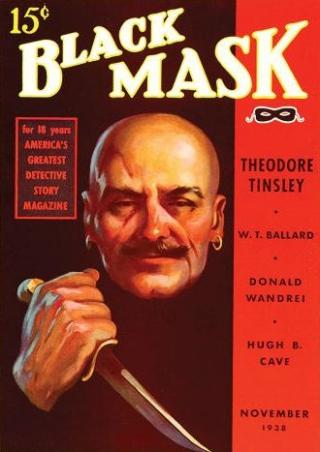
Black Mask (Vol. 21, No. 8 — November, 1938)
- Автор: Баллард Уиллис Тодхантер, Cave Hugh B.
- Год: 1938
- Язык: английский
- Год: Pro-Distributors Publishing
- Жанр: Другие детективы

Электронная книга - «Black Mask (Vol. 21, No. 8 — November, 1938)». Краткое содержание книги:
“Never mind that sandwich after all,” said Paradine. “Look, Pete, sorry I had to put you through it, after all the rat trouble you’ve been having around here, but I had to find out something. I wasn’t sure about you. Maybe I’m not quite sure, even yet; but I’m going to take a chance.” Paradine reached across the bar and dropped his hand on Holden’s shoulder; the shoulder winced slightly, and stiffened, but Paradine kept his hand there.
“Look here, Pete, Salter’s got your wife. Up at his hide-out. I’m going there. I’m going to blast hell out of that pack of rats. I think you’re going to help. Instead of heeling around for the cops, Pete, I’m in bad with them. So bad it’s a wonder I’m not locked up. It looks to me as if you’d kind of stood around and let the Hanifins fight alone. But maybe I’m wrong. If you’ve got what it takes, you’ll come along and help me get Molly. Salter hasn’t got that confession, but he’s got your wife. He thinks she has the confession, you see. He wants it. His methods aren’t very nice, I’m told.”
Pete Holden had gone chalk-white. “If I could believe you—”
Paradine jammed his hand down into his overcoat pocket. “Of course, if you want to sit and count your fingers while another man pulls your wife out of hell—”
“I’m coming with you,” Pete Holden said. He ripped off his apron and ran to the back, flinging on his coat, turning off the restaurant lights. When he came front to lock the door, Paradine was looking across the street. He said:
“Right, son. We go out the back way.”
They slipped through the service alley at the rear of the Bar and Grill; nevertheless, in the subway Paradine saw the slope-shouldered man on the platform, and a square bulk in blue uniform lounged near him. Paradine slung his arm back of Pete’s shoulders affectionately and said:
“I’m tired of cops. Next station, follow my lead. Maybe it’ll work.”
The train snarled into Fourteenth Street. Paradine bolted from his seat and plunged through the door, Holden behind him. The police shadows stepped off the train without haste. Just before the door slid shut, Paradine and Holden were back inside the car; it ground past the slope-shouldered man, and through the glass Paradine gave the officers a smile of dazzling sweetness.
Salter’s house near the water-front was a blind thing, hiding secrets behind tightly shuttered windows that had no light behind them. It was next door to an all-night coffee shop, and the counterman moved, as Paradine and Holden went by, and walked unhurriedly toward the back of his shop. Paradine saw that, and thought that Holden saw it too. But Holden turned directly into an alley without a word. Paradine murmured: “You seem to know the way.”
“I’ve been here before. So what? That guy in the shop saw us. The only way into the house except by the front door is through that shop.”
“Got a gun?”
“Yes. Have you?”
“Yes; I have a gun. Let’s go.”
Holden walked down into the alley, Paradine a pace or two behind. He sensed rather than saw that Holden had stopped again. Then Holden gasped, staggered backward into Paradine, righted himself and snarled. Paradine heard a swish in the air and flung up his arm, catching a savage blow on it, apparently from a blackjack. Paradine grabbed the arm that held the thing, and threw his weight backward, tugging.
The dimly visible man with the sapper lost his balance; his feet scrambled loosely on the gravel of the alley, and his left side crashed into the wall of the building. Paradine sent his right fist where he expected to find the point of a jaw, and found it. There was the thick sound of a body falling helplessly. Paradine struck a match and knelt for a second. The man was out cold. He was the coffee shop attendant.
Further down the alley, Holden was struggling with someone. A tiny glow came from the rear exit of the coffee shop, and Paradine saw the two straining figures stumble through that light. Holden had a man by the throat and was stepping backward, dragging him; Holden’s voice was saying, “You guessed wrong, fella.”
The man Holden held dropped with a small choking sound and lay still. Holden came toward the light brushing his hands together; saw Paradine and said: “Heels!”
The alley opened into the kitchen of the coffee shop, and this kitchen was empty. One dirty wall was a half-inch out of true, showing itself to be a door slightly ajar; beyond it there was darkness. Holden stood at one side of it, reached out and shoved it gently with his foot.
Paradine was just behind Holden, and Paradine’s hand was on his holster. They cat-footed through the secret door.
From some uncertain direction there was the sound of a low monotone. The light from the kitchen touched the steps of a staircase. The treads did not creak. A door, with a dim light behind it, was at the head of the stairs.
Holden put his ear at the crack. He shaped words! “If she isn’t here, Paradine—”
“If she isn’t here it’s my fault,” said Paradine, and Holden might make what he could of that.
Behind that door the monotone said:
“You think we’re washed up. Maybe. If you hadn’t sent the boys out after that fat ape because you thought the girl with him looked like the Hanifin broad, we’d be sitting pretty. Mueller in the hospital is liable to squeal. You can thank yourself for that, Marsh. And if anything happens, you’re the goat. I can see to that. If the cops get you, you’ll be the head of the mob — that’s what they’ll hear, and you’ll get the whole works. The Ferenczi killing will come right home to you where it belongs, and up you go to the hot squat. But my nose is clean.”
A dry, nasal voice, the same monotone that had said, earlier that night, “Watch it, Ferenczi!” when Ferenczi was already past watching anything, said, “But, Salter, it was your orders. You wanted Ferenczi gunned out. Suppose I was trigger man, it was your orders.”
“I’ll enjoy watching you try to tell that to the cops. No, Marsh, if the cops come down on us, you’re for it. I’m telling you so that you won’t get wrong ideas. I saw you shoot Ferenczi, and I can get witnesses to prove I was there reading a newspaper when it happened.” Salter laughed. “You can’t say I wanted Ferenczi gunned out. Seemed like he wanted himself gunned out. He was asking for it. All the other boys were loyal. Hey, Belling? That right? All loyal as hell, weren’t you?”
A third voice answered in a thin toady’s whine. Salter went on:
“Uh-huh. Poor Ferenczi was the only one that was damn fool enough to throw in with—”
Pete Holden kicked the door open; stepped through with a gun out in his right hand and said:
“Reach, boys! Up! All the way up!”
Paradine eased his bulk through the doorway and kicked the door shut behind him; his Colt drooped from his hand, not pointing anywhere in particular; he remarked:
“Better satisfy him, gentlemen. Peter’s riding high tonight.”
Salter got up slowly, both thin hands in sight. The man’s even, reptilian calm chilled Paradine. The other two in the room stayed in their chairs, frozen. A wide-shouldered, slab-faced man with drooping cheeks; that was Beef Marsh. Marsh was right, in his blind way; you couldn’t say he’d killed Ferenczi. He’d only pulled the trigger. The other man cringed, his narrow little face gone gray. Belling, Salter had called him; but his name didn’t matter. The city’s mean streets spawned his like by the hundreds.
Salter said almost gently: “Well, young man?”
“Where is she?” Holden said.
Salter glanced quickly at Beef Marsh, and then allowed a grin to curl up his lips. He said: “Why, he’s looking for a woman. Take a walk, buddy. Somebody gave you the wrong address.”