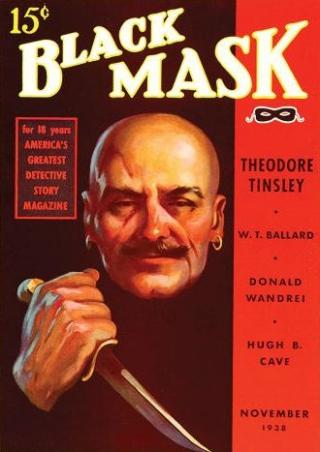
Black Mask (Vol. 21, No. 8 — November, 1938)
- Автор: Баллард Уиллис Тодхантер, Cave Hugh B.
- Год: 1938
- Язык: английский
- Год: Pro-Distributors Publishing
- Жанр: Другие детективы

Электронная книга - «Black Mask (Vol. 21, No. 8 — November, 1938)». Краткое содержание книги:
“You’re asking for it,” Holden said, and his voice cracked. “I can shoot you first and find her afterward. Where is she?”
Salter gave Marsh another quick look. Paradine saw what it meant. The only light burning in the room was a bridge lamp near the chair where Salter had been sitting. A section of the cord was exposed, and that section was within reach of Marsh’s long leg. Paradine pointed his gun at Marsh’s slightly moving foot and said:
“Don’t believe I would, Beef.”
“Where is she?” Pete Holden said.
Salter shrugged. “She’s not here.” For the first time Salter’s moving slanted eyes acknowledged Paradine’s existence. “I can tell you where she is, maybe, in return for — let’s say, services rendered.”
Paradine’s grip on his gun tightened. Salter was walking straight toward Holden’s gun, hands above his shoulders, and there was still a grin curling his lip. A foot or so from the point of the gun he stopped, and his right hand came down and out in slow motion, toward Holden, the fingers cupped.
“Molly’s in a tough spot,” Salter said, “so I hear. You can get her out of it all right, I guess. She’s still all in one piece, so far as I know. You can get her out, in return for — well, let’s quit stalling, Pete. Hand it over... The gun don’t mean a thing. You’re still crazy about that broad, so I’ve got you where I want you. Hand it over. You know what I mean.”
Angry blood mottled Holden’s face. “Where is she?”
“Why, he’s like one of these trained birds. Can’t say only just one thing. You’re funny, Pete. You don’t know how funny you are.”
It had looked like a grandstand play, when Salter walked up to the gun, grinning at it. It was more than that. Paradine realized too late that Salter had put himself in front of Marsh. The slab-faced man stabbed out his foot, yanking the cord free from the wall-socket and throwing the room into blackness.
Death shouted through orange flame.
Dropping flat, Paradine rolled his body till it wedged against the door. He braced up on his left elbow, his gun gripped in his right but not shooting in the darkness.
There was enough shooting without Paradine’s help.
Gunfire flared from the corner of the room where Belling had been cowering. That shot was answered from somewhere near Paradine; Holden’s gun, perhaps. Belling’s scream was thin and high. Light stumbling footsteps reached the door, and a weight fell across Paradine’s legs. There was choking and gasping, audible under the noise that another gun was making now.
Paradine slipped his gun to his left, reached down and gripped the thing lying across his legs and flung it away. It was Belling, limp, unresisting. Paradine’s hand was stickily wet.
Holden was on the other side of the room now. Paradine heard him shout thickly, over and over: “You’re asking for it! You’re asking for it!”
Paradine reached up, feeling for the doorkey; found it, turned it, and dropped it in his pocket. He got slowly to his feet; moved crouching across the room, a step at a time, toward the wall-socket.
There was no more shooting now. Holden said from an uncertain direction in a drawn, wavering voice:
“You asked for it...”
There wasn’t any answer.
Paradine put down his left hand, feeling about on the floor. Someone was breathing hard, sobbing. The room stunk; gun-smoke and the sweetish reek of fresh blood. Paradine’s fingers found the light cord, the plug and then the socket.
The lamp had been knocked over, but a metal shade had saved its bulb. Light washed up from the floor, leaving two dead open-eyed faces in shadow, and a third face that was waiting for death.
Beef Marsh had not gone far from his chair. He lay beside it, his long body curled in a question mark, and the dot of the question mark was a red smear, showing the place where Belling had evidently risen once, after Paradine flung him away and before he tumbled in a heap across Salter’s legs to finish dying.
Salter sat braced against the wall, both hands pressed white on the floor. He was bleeding, but his eyes were still alive, fixed on Holden, who stood in the middle of the room swaying, breathing painfully, his gun drooping. Salter’s wound was somewhere in the middle of his chest, and there were flecks of foamy blood on his lips; he spoke, like a phonograph running down:
“You won’t get anywhere with it, Pete. You’re just funny. It’s a wonder Ferenczi didn’t know how damn funny you are. Tiemann knew. Tiemann knew even when...”
Pete Holden was walking toward the dying man. Paradine moved toward him quickly. Not quickly enough. The gun in Holden’s hand roared, kicking up.
Salter jerked convulsively, quivered and fell over flat.
Paradine grabbed Holden from behind, seizing both arms and holding them out at the side. Holden stiffened and strained away, but could not break the grip. Paradine’s hand wormed down Holden’s right arm till it reached the wrist, then squeezed with all the sudden power of trained muscles, paralyzing Holden’s clasp on the gun, which clattered on the floor. Paradine kicked it away, but still kept his grip on Holden’s arms and said:
“It’s all over. Understand that?”
Holden said, “Molly—”
“You haven’t the right to think much about Molly,” Paradine said, “except for one thing. You can make it a little easier for her, if you want to. You can have an out. I’ll give you that.”
Pete suddenly wrenched at the restraining hands. It was no good; the pale corded hands were expecting it. Holden threw himself this way and that, blindly, an animal in a trap. Paradine drew the man’s hands together so that his own right could hold both wrists. Paradine’s left hand moved under Holden’s coat, found the inner pocket empty and slid down.
Under Holden’s vest there was the faint rustle of paper. Paradine ripped open vest and shirt, caught the edge of the paper clasped to Holden’s undershirt and drew it out. A single sheet, covered with fine, tight handwriting and signed with Salter’s name.
Paradine freed Holden’s wrists and sent him staggering toward the armchair across the smeared question mark that had been Beef Marsh. Before Holden could push himself up out of the chair, Paradine’s gun covered his heart. Paradine said:
“No more shooting. I said it was all over. This paper proves you killed Tiemann. I knew that, but I had to prove it to myself.”
The bleak light from the floor poured along the high-lights of Holden’s defeated face. He sank back in the chair, staring vacantly.
“You got this confession of Salter’s when you killed Tiemann. Man, you were a fool to think you could make Salter talk turkey the way Tiemann could. It took an old hand like Tiemann to manage a cold fish like Salter. Salter was right. Ferenczi was another damn fool for throwing in with you. But I think I know why he did.”
Holden said nothing. Paradine went on:
“Ferenczi threw in with you because he loved your wife. Not the way Tiemann did. Really loved her, I guess. He saved her life and it cost him his. He got her away from this place when Salter had her here and was planning to pull her apart. Ferenczi joined with you for Molly’s sake only, and not because he thought there was any chance you could fill Tiemann’s shoes the way you planned to.”
Paradine waited. Holden had gone limp, and shut his eyes. Holden said nothing.
“And when Ferenczi wrote out that address you wiped it away. Because you already knew it. You’d been there, about three hours before. I think Ed Hanifin learned that you were in the racket up to your neck. He went for you with both hands; and you shot him to death,”
Holden let out a shaken breath.
“Maybe,” said Paradine, “when you went to Tiemann’s place that night it was an unwritten law set-up, at first. You learned — maybe from Ferenczi — what Tiemann was up to with your wife. So you went there to kill. I think you found him unconscious. Molly’d left the door open when she ran out. You walked in a little later and found him out cold, but alive, and killed him like that.” Paradine stepped closer; murmured: “But you must have known that was Molly’s hand-bag. Sort of spoils the unwritten law business, doesn’t it?”