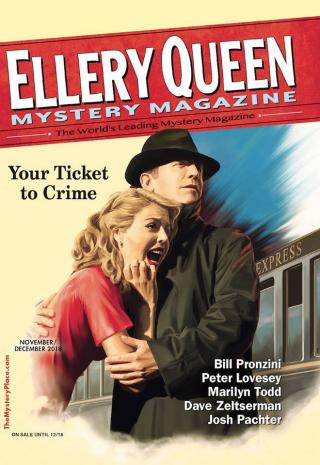
Ellery Queen’s Mystery Magazine. Vol. 152, Nos. 5 & 6. Whole Nos. 926 & 927, November/December 2018
- Автор: Ловси Питер, Зельцерман Дэйв
- Год: 2018
- Язык: английский
- Год: Dell Magazines
- ISBN: 0013-6328
- Жанр: Другие детективы

Электронная книга - «Ellery Queen’s Mystery Magazine. Vol. 152, Nos. 5 & 6. Whole Nos. 926 & 927, November/December 2018». Краткое содержание книги:
But I didn’t care about my elegant mother, about my gentlemanly father, about half-mad Philomena, or even about Jenny when I discovered how overworked she was. I was filled with delight. The seaside had always seemed a dull place to me, but with Jenny everything was different. It was the most wonderful summer of my whole life — a summer that ended when Jenny disappeared. Jenny had never been to the seaside before, and together we made many exciting discoveries. We would skip down to the little town feeling the sun on our faces. We would take the shallow steps down onto the beach, where we paddled and splashed and built sandcastles that never lasted. We would stroll along the promenade, then take the winding path up to the top of Danagher’s Head, where we would gather pink and white sea flowers to make caterpillars that blew away with the wind.
Quite often, we would find that Sergeant Monaghan had followed us up to Danagher’s, and he would cough and clear his throat and try to talk to Jenny, or sometimes just stare at her. I would snigger behind my hands without quite knowing why, and Jenny would stop picking flowers and tuck her flapping skirt between her knees. Once, when my father anticipated his postprandial constitutional to the summit, Sergeant Monaghan happened to be there, staring. My father raised his Panama hat, bowed courteously to Jenny and to me, then paused, tapped the ferrule of his silver-knobbed cane on a rock, and said “Good day,” to the sergeant in a stern way. I watched as Sergeant Monaghan’s face became swollen and red. “Sure what would I be doing up here on a windy day like this,” he muttered hoarsely, “unless ’tis to warn ye keep away from the edge.”
Not long after that, Jenny said she didn’t want to make flower caterpillars anymore, so instead we found a spot on the barrier of rocks at the foot of Danagher’s Head. There, we would sit on a slab of pewter rock to gaze at the shifting jewel colours of the sea and laugh if sea spray caught us unawares. Sometimes, we would search among the rock pools for shells and unusual sea creatures, or play hide-and-seek using the gaps and hollows in the rocks as hiding places. When Jenny won, she would pounce and then cuddle me in case I’d taken fright.
As the days went by and my mother had no complaints to make, Jenny and I became bolder. We broke my mother’s rules and wandered through the little town like day-trippers, munching on chocolate bars or licking penny ice creams. We bought periwinkles wrapped in newspaper from noisy vendors and learned to extract with a pin the whorled mollusks that tasted so tart our tongues curled. We crossed the threshold of the moth-eaten cinema where musty smells clung to our clothes as we gazed at true love conquering all in flickering Technicolor.
And one Saturday afternoon, following the source of strange, chaotic music coming from a field behind Danagher’s Head, we plunged into the dizzying excitement of the carnival.
It was shortly before my bedtime on the evening of that same Saturday, in Jenny’s poky bedroom beside the pantry, that I first set eyes on Jenny’s necklace. Jenny was brushing her hair in front of the sea-rusted mirror propped on the warped dresser, and I kept bouncing up and down on Jenny’s rickety bed and breaking into hectic bursts of laughter, still excited from our afternoon at the carnival.
“Hush!” Jenny set her brush down and sketched the Sign of the Cross — the windmill dab on her forehead, breast, left and right shoulder. “Your mother might hear you.”
“And what if she does!” I shouted.
“Hush now and I’ll show you something.”
Jenny opened the top drawer of the dresser where she kept her cardboard treasure box, and I jumped to the floor and held my breath as she removed the lid and held up something pearly and white for me to see.
“Oh, Jenny,” I said. “It’s like something a princess might wear.”
Jenny smiled and with her free hand, stroked my cheek. Then she turned back to the rusted mirror, lifted her brown waves from her nape, and clipped on the pearly necklace. The bloom on Jenny’s cheeks never faded, but that day, wearing the necklace, she glowed with an enchanted radiance I had never seen before. She smiled and again came the sketchy windmill gesture, but with her left hand because with her right she was touching the necklace. I remembered that Father Clooney often warned against making the Sign of the Cross with the wrong hand, because it brought bad luck. He said it must always be the right because the left hand belonged to Beelzebub himself. But I didn’t say that to Jenny. Instead, I pulled at her skirt and asked if she could give me the necklace.
“I can’t give it to you, honeybunch,” she said. She often called me “honeybunch” which I liked; the nickname came from the Hollywood film-star magazine she had found one day on the beach. “I just can’t.”
“But why can’t you give it to me, Jenny? Why?”
“Oh, honeybunch, I can’t. I just can’t.”
Jenny seemed truly distraught that she had to refuse me and tried to console me with a stub of crimson lipstick instead. She made a game of painting my lips with it and adding some pancake to my cheeks, but the result was disappointing because my skin had turned a grubby brown from the sun and my pigtails seemed spikier than ever. I wasn’t ungrateful for the lipstick, but couldn’t help thinking that if Jenny had given me the necklace instead, my ugliness would slough from me like the skin of a lizard and I would look beautiful too.
“At least tell me why you can’t give it to me,” I kept saying. Poor Jenny, how I pestered her. I can still hear that petulant childish whine, and in the end, I wore her down, because she told me.
“It’s a present from my boyfriend,” she said softly. “I can’t give it to anyone — not even to you.”
“Sergeant Monaghan!” I said.
Jenny shuddered. “That fella!”
So Jenny had a boyfriend who wasn’t Sergeant Monaghan, and I was glad at least for that because I didn’t like him either. But I couldn’t speak. I felt betrayed, excluded, unloved by the one person I believed truly loved me.
But Jenny understood me. “Don’t be upset,” she said, kissing the top of my head. “That doesn’t mean I’d ever leave you. Sure, I’d never leave my little honeybunch. Never.”
She dabbed a spot of perfume behind her ears and dabbed a little behind mine too. Her gentleness and the scent of violets warmed me a little. “You never told me you had a boyfriend,” I said sullenly. “How long has he been your boyfriend?”
“I met him this afternoon at the carnival.”
“But I didn’t see you with anyone!”
“It was while you were on the swings,” she said apologetically. “He came up to me and asked me my name. He gave me the necklace and asked me to be his girl. He said he’d seen me in the town several times before, so it wasn’t as if we were strangers.”
Much of Jenny’s meagre salary was spent on Holy Masses for her mother, whom she had never known, but she had set aside a little pile of silver sixpences and shillings for cinema matinees, chocolate bars, and ice creams. At the carnival, Jenny had paid for several rides for me on “the swings,” a merry-go-round with seats suspended on chains that spun faster and faster and wider and wider so that it felt like flying above the earth. While I had been spinning through the air, Jenny had been below, a blur, talking with her boyfriend. And I hadn’t noticed.