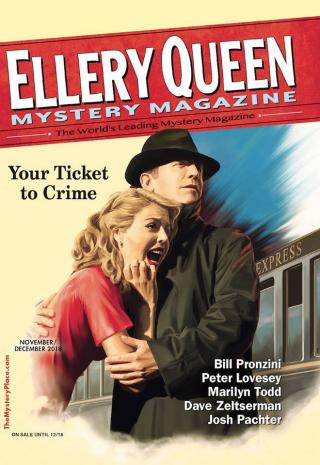
Ellery Queen’s Mystery Magazine. Vol. 152, Nos. 5 & 6. Whole Nos. 926 & 927, November/December 2018
- Автор: Ловси Питер, Зельцерман Дэйв
- Год: 2018
- Язык: английский
- Год: Dell Magazines
- ISBN: 0013-6328
- Жанр: Другие детективы

Электронная книга - «Ellery Queen’s Mystery Magazine. Vol. 152, Nos. 5 & 6. Whole Nos. 926 & 927, November/December 2018». Краткое содержание книги:
After the movie he thought they should splurge on a fancy dinner. Ruby Tuesday. Sky’s the limit, he told her, whatever your heart desires. He ordered the most expensive steak on the menu, a rib-eye, well done, he told the waitress, and she frowned writing it down as if her pen had run out of ink. When Monica ordered a bacon cheeseburger, it was his turn to frown. He ordered appetizers too, and a pitcher of Pepsi. He’d have preferred a mug of beer, but he wasn’t about to give the bitchy waitress a chance to ask to see his ID. When she left, Monica said, “Boy, she sure is grumpy.”
“Well, she’s not getting a tip,” he said. He didn’t tell her the waitress was probably grumpy because she didn’t expect a tip in the first place, because they looked too young and too cheap, not the kind who tipped well. If at all. Rosemary, who used to wait tables in Ballston Spa, had told him: Anytime she saw someone like him heading for her station, she’d try to switch with another server. She said they did that all the time.
In the middle of the food court was a carousel that used to be in the park, and after dinner, wandering through the nearly empty mall, he thought taking it for a spin might be fun, just the thing to lend a more festive air to their evening. She was reluctant. “I don’t like that thing,” she said. “I lost Trevor on it once.”
He remembered. Trevor had sat on the bench, and she’d never thought to look there, looking on every animal, every horse and monkey and elephant and giraffe instead, in a panic. “C’mon,” Donnie said. “The best thing to do is get right back up on that horse.” He smiled at his joke, even though she didn’t. She looked grim waiting at the little gate for the ride to stop. There was only one kid on it, and he and Monica were the only ones waiting, but the operator, a bony, older man, unshaven, with dark, frosted whiskers, was bound to give the kid his full allotment of time.
The bony old man wore a railroad engineer’s cap. They watched the creaky contraption go round and round, listened to the squeaky tune. “Did you ever have a dog?” the man said.
Donnie looked around to make sure he was talking to them. “Naw,” he said. “We live in a trailer park.” Muddy, their cat, he didn’t bother mentioning.
“Good for you,” the man said. “Never get one. They’ll just break your heart.”
“How?” Monica said. A frown of deep concern.
“Just take my word for it,” he said with an all-knowing nod, stopping the carousel.
The kid got off, Donnie and Monica got on. Round and round they rode, up and down, circling and circling, for what seemed a very long time, longer than it should have been. The operator must have liked them. Or maybe he didn’t — maybe it was the opposite. Donnie couldn’t tell which. No one else was waiting for a ride. Monica tried without much success to reach across the void and hold his hand, but all in all, the ride was without much joy. Across the food court, in front of the Taco Bell, a little boy pointed at them in wonder, though whatever he exclaimed to his mother never made it through to their ears.
Outside, the snow fell steadily, drifting through the glow of the parking-lot lights, making ghosts of the few cars still parked here and there. Donnie wasn’t worried. His tires were good, his driving was excellent. He headed for the camp at Lake Desolation. On the way, Nellie called Monica. Where was she? She’d tried to reach her at Stewart’s but they said she’d called in sick. Trevor had fallen and cut his lip. He needed his mother. While Monica was talking to her grandmother, Rosemary texted Donnie. State police had been there. They wanted to talk to him. Someone driving by had seen his old blue Toyota at Matson’s around the time Andrea had been killed. Rosemary told the cops she didn’t know where he was. She didn’t tell them about the camp at Lake Desolation. Where the hell was he? What the hell had he done?
Where could they go? Long into the night they talked, huddled close in the bed at the camp, dread in the air as thick as the dark. All the talk, all the declarations, fears, and doubts were spun out. She was an unfit mother. That much was clear. Trevor would be better off without her. But where could they go? What could they do? Prison was not an option, even if only for a year or two — a single day without each other was not an option. His fortune consisted of less than a hundred dollars now, her bank account under three hundred. Not enough to start a new life. He didn’t want to go up in the trees anymore. After last time, he’d lost his enthusiasm for heights — this was how he put it; actually, he was afraid. He didn’t want her to find out that he was not the bravest man in the world after all. Florida was a fine and crowded place, but his old blue Toyota would never make it so far. Where could they go? What could they do? By the time they awoke in the camp after pitifully fitful sleep to a brilliant sun and strong breezes sweeping the fresh snow up in swirls and eddies, all the talking was over. When it was all said and done, whose idea was it?
Roger had a snowmobile. Donnie gassed it up. It started fine. He kept it in good shape, one of his chores in return for camp privileges. Monica climbed on behind him, her arms around his waist.
“What do you think?” he said.
“Oh, I don’t,” she said. “I don’t want to.”
He maneuvered the thing up the little dirt road, then down the trail through the pines, a filter of fresh snow falling from the limbs, swirling in the morning light. He stopped at the edge of the lake, Lake Desolation. In the middle was a little island with three tall trees, and a large boulder jutting out from the shore into the half-frozen waters. He took her glasses and cleaned them. She took his hand, kissed the back of it, nibbled the knuckle. He put her glasses in his shirt pocket, and she pressed her cheek into his back, holding him as close as she could. Eyeing the boulder, he gunned the machine, once, twice. Let’s see what this baby’ll really do, he might have said.
© 2018 by Dennis McFadden
Jenny’s Necklace
by O. A. Tynan
O. A. Tynan debuted in EQMM’s Department of First Stories in 2013. A longtime resident of Italy, she is a professional translator from Italian to English. As she explained on somethingisgoingtoliappen.net (EQMM’s blog) in 2017, despite her immersion in another culture, she continues to find her native Ireland, in the period of her childhood, the most fertile soil for her fiction.
The last time I saw Jenny, she was lying unconscious in the sandy hollow at the foot of Danagher’s Head. Its looming shadow concealed us from the eye of the summer sun. Her cheek lay against a sea-smooth stone, her blue dress flared from her waist like the gown of a fairy princess, a fleck of green seaweed was caught in her wavy brown hair. Her white high heels, her Sunday best, were nowhere to be seen. Her necklace, too, was gone. It was quiet in the hollow; even the seagulls wheeling overhead were silent. The only sound was the tide whispering in under the barrier of rocks and then a sudden hoarse shout as someone found us.
That was long ago, in the summer of 1961.I was nine years old at the time and still remember the horrible hushed atmosphere about the house after I was dragged, kicking and screaming, my dress soaked from the tide, away from Jenny. The window blinds were drawn halfway down, a sign a death had occurred. Jenny had only fainted, so perhaps it was the uncle who suffered from a weak heart. “Mark my words,” my mother often said. “One minute alive and breathing, the next dropped down dead at our feet. That is how it will be.”