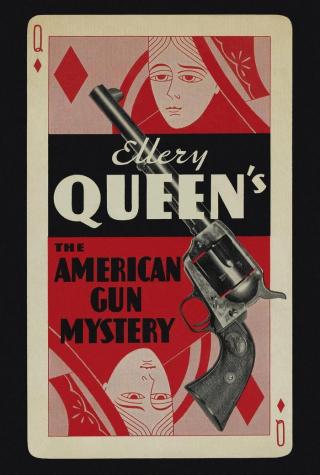
The American Gun Mystery (Death At the Rodeo)
- Автор: Куин (Квин) Эллери
- Серия: Ellery Queen #6
- Год: 1933
- Язык: английский
- Год: Frederick A. Stokes Company
- Жанр: Классические детективы

Электронная книга - «The American Gun Mystery (Death At the Rodeo)». Краткое содержание книги:
“That’s right, Inspector.”
“Go on, Miss Horne.”
She shrugged helplessly. “But there’s nothing more to tell. Buck was making out a check. I said hello and left the Colosseum—”
“Time,” said Ellery pleasantly; he was interested again. “What was the purpose of this check, Mr. Grant?”
“Nothin’ special. Buck asked me if I could cash a twenty-five dollar check fer him, an’ I said yes. So he made it out an’ I gave him the money.”
“Indeed,” said Ellery without inflection. “And what did you do with this check? Have you got it on you, Mr. Grant?”
“Why, no,” drawled Grant. “I stepped out a minute m’self a little later an’ stopped in at my bank — the Seaboard National. So I deposited it.”
“Innocent enough,” agreed Ellery, and retired.
The Inspector gave him a sharp look, then turned back to Grant. “Was that the last you saw of him?”
“No. I was comin’ back from the bank, just in the entrance to the buildin’ here, when I bumped into Buck again. Had his hat an’ coat on. ‘Where ya bound?’ I asked ’im. ‘Hotel,’ he says. ‘Want to rest up fer t’night.’ An’ that’s all. Never had another word with ’im. He come in late tonight, kind of excited, I thought, waved ’is hand at me as he rushed fer his dressin’ room. There was hardly enough time fer him to change ’is duds an’ get into the arena.”
The Queens looked at each other. “That might be important,” muttered the Inspector. “Got in late, did he? What time was it when he said he was going to the Barclay?”
“Round about four o’clock.”
“Hmm. Did you see Buck again after you left the building, Miss Horne?”
“Yes. When I left I went straight back to the hotel. Buck came in about a half-hour or so later, and said he was going to take a nap. I changed my things and — and went downstairs. And—”
Curly Grant spoke for the first time. “From that time on,” he said belligerently, “Miss Horne was with me. I met her in the lobby, and we went out for the rest o’ the afternoon.”
“Yes,” said Kit in a whisper.
“And when you got back?” asked the Inspector.
“Buck was already gone; he’d left a note for me on my night-table. So I changed into “my evening things and taxied to the Colosseum. I didn’t see him again until,” her voice quavered, “until he rode into the arena.”
“Oh, so you were late, too?” said the Inspector slowly.
“What do you mean?”
The old man smiled and waved a deprecating hand. “Nothing at all, my dear, nothing at all!” He took a pinch of snuff and sneezed with violence. “Only — Mr. Grant (k’choo!) Mr. Grant said your father was late, so that means you must have been later still. You see? Very simple!”
Curly took a step forward. “Look here,” he growled, “I don’t cotton to that remark a-tall. I tell you Miss Horne was with me—”
“Ah, so you were late, too, young man?”
Grant looked from Kit to his son, with quick stony eyes. Curly set his jaw. “No, I wasn’t. I left Kit when we passed the Colosseum; she said I’d better not take her to the hotel—”
The Inspector rose. “I understand. All right, Miss Horne. You, too, Mr. Grant—”
There was a reverberating knock on the door.
“Well?” snapped Inspector Queen. The door was kicked open; a cadaverous Machiavelli scowled in at them. His jowls were black and he wore an iron derby; between his teeth there was a foul-smelling sample of some misguided cigar-maker’s art He carried a black kit.
“Here I am,” he announced. “Where’s the stiff?”
“Uh — that’s all, Miss Horne, Mr. Grant. Thank you,” said the Inspector hastily, and bundled the Grants and the girl out of the room. Sergeant Velie detached himself from a shadow of the wall outside and joined them quietly. “Back to the arena, Thomas!” shouted the Inspector, and Velie nodded.
“Now, you lazy son of an African witch-doctor,” snarled the old man to the black-jowled newcomer, “what in time d’ye mean by holding us up two hours on a homicide? By the—”
“And so on,” said Machiavelli with a sour grin. “The old song-and-dance. Well, where’s the stiff, you old pirate?”
“All right, Sam, all right. He’s next door, gettin’ stiffer.”
“Just a moment, Dr. Prouty,” said Ellery, as the newcomer turned to go. The deus ex machina who presided over the post-mortems of half New York City’s murdered population stopped. Ellery put his arm on Dr. Prouty’s shoulder and said something very earnestly. The police physician nodded, gripped his fulminating cigar more firmly, and hastened out.
The Queens were left alone.
Father and son regarded each other gloomily.
“Well?” said the Inspector.
“A very deep well, I must say,” sighed Ellery. “We return to criminal investigation in the best Queen manner — nothing less than suspects by the carload. You remember that damned Field case? A theatre full of potential murderers![1] The French murder? A department store jammed with shoppers.[2] Old lady Doorn’s queer demise? Just a hospital packed with doctors, nurses, patients, and neurotics.[3] And now a sports arena. Our next murderer,” he said dreamily, “will undoubtedly choose the Yankee Stadium as the scene of his crime, and then we’ll have to call out the Jersey reserves to help us sift a crowd of 70,000!”
“Stop babbling,” said the Inspector irritably. “That’s what’s got me worried, blast it all. We can’t keep twenty thousand people under wraps forever. Lucky the Commissioner’s out of town, or I’d have him on my neck for bottling up half of New York this way. I’m sort of glad Henry Sampson’s away, too.”
“Nevertheless, despite commissioners and district attorneys,” said Ellery inflexibly, “it must be done.”
“What did you say to Prouty?”
“I told your estimable Examiner’s physician to dig the bullet out of Horne’s body.”
“Ginger, that can wait! That rodeo medic — what’s ’s-name — said it was a .22 or .25, didn’t he?”
“Let’s be a little more scientific, Inspector dear. I’m very curious about that little messenger of death. Until we find out the story of that bullet, you mustn’t permit a single member of the audience — or anyone else, for that matter — to get out of the building.”
“Don’t intend to,” said the Inspector shortly, and after that they were silent.
Ellery began to hum a sad little tune.
“El what do you think?”
The tune stopped. “I’m thinking of poor Djuna, sitting in that box with the horrible lady from Hollywood, and Tommy Black.”
“Cripes!” cried the Inspector. “I clean forgot about Djuna!”
“Don’t fret,” said Ellery dryly, “he’s having the time of his life. His gods are smiling broadly tonight. The point is: what were you saying?”
“What d’ye make of this case?”
Ellery puffed thoughtfully at the low white ceiling.
“Strangely enough, a good deal.”
The Inspector’s mouth popped open; but a wordy catastrophe was averted by the opening of the door and the reappearance of Dr. Prouty, sans coat and hat, his shirt-sleeves rolled up to his elbows and his right hand displaying with something like gloomy triumph a very bloody little object wrapped in gauze.
The Inspector snatched it from Dr. Prouty’s hand without ceremony, heedless of the red smear it communicated to his fingers. Ellery came forward quickly.
“Ha!” said the old man, examining the object intently. “A .25 — automatic, all right. That rodeo doctor was right, Pretty good condition, eh, son?”
1
“The Roman Hat Mystery.”
2
“The French Powder Mystery.”
3
“The Dutch Shoe Mystery.”