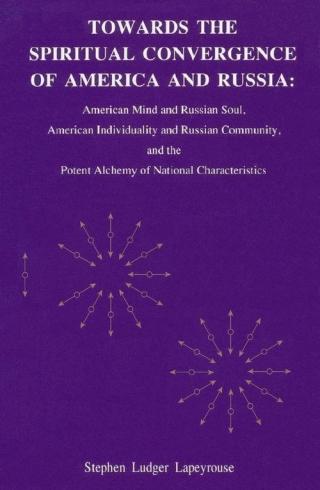
Towards the Spiritual Convergence of America and Russia: American Mind and Russian Soul, American Individuality and Russian Community, and the Potent Alchemy of National Characteristics
- Автор: Lapeyrouse Stephen Ludger
- Год: 1990
- Язык: английский
- ISBN: 0-9628048-0-0
- Жанр: История

Электронная книга - «Towards the Spiritual Convergence of America and Russia: American Mind and Russian Soul, American Individuality and Russian Community, and the Potent Alchemy of National Characteristics». Краткое содержание книги:
“If my efforts in this work are adequate to the task, I wish to make substantial intellectual contributions towards a clear description of how essential and profound a spiritual, philosophical and psychological relation exists, between characteristic highest (“vertical”) conceptions and aspirations — and tasks — of Mankind in America and Russia. The hope is that such understanding could contribute, essentially, towards a clearer, creative, and mutually-beneficial spiritual orientation — in thoughtful and heartful individuals of both nationalities — which might lead to a more conscious spiritual meeting of “Russian” and “American”; and thereby, possibly, promote an alchemical blending of the American Mind and Russian Soul, American Individuality and Russian Community. Such a greater clarity towards a greater spiritual realization, and more complete wholeness, in some men and women of each country, and thereby, perhaps, in portions of Mankind as a whole.” — the Author
“Alone is heaven”. It would be difficult to find a more succinct summary of Emerson’s conception of spiritual individualism. [170] Such an understanding and summons of Man remained the essential core of Emerson’s philosophy until the quiet end of his life. The point to recognize here, is that Emerson returned from the Old World to the New World — and to the young United States of America — more reconciled to his own individual self. Kireyevsky, coming from Czarist, post-Decembrist Russia, had seen the “present” in Central Europe, and returned to develop a renewed recognition and appraisal of Old Holy Russia’s past — and potent future. Emerson had come from the “future”, the New World of America, through the ne plus ultra of the Pillars of Hercules, [171] and reviewed parts of the West’s own historical past in the Old World: Malta, Sicily, Rome (Pope Gregory XVI in the Sistine Chapel), Florence, Padua, Venice, Geneva, Paris, London, Edinburgh, Liverpool; thence returning to New York. He returned, reinvigorated, to embrace his own life in America, in his own “present”. The “past” [in Europe] was for Emerson instructive and informative, but essentially lifeless; the “present” to Kireyevsky was educational, but deadening; returning to a Russia whose deep past of traditions, customs and lore he soon came to herald. Emerson’s individualism could stand in the American “present” and live into the future; Kireyevsky’s rejection of Europe’s “present” with its psychic and social isolation, had him look into the past, towards the community, traditions and heritage of Old Holy Russia — and its potency for the future.
It is helpful, in order to understand Emerson’s thought — and much of America’s spiritual history — to consider in what other directions Emerson might have turned, during his lifetime, in the United States of America during the nineteenth-century, to come to a personal resolution with the deeper questions of meaning in life. New England, while it had some of the oldest transplanted customs, ideas and traditions from the Old World to the New, was not itself the revered, old sourceful site for most of them. Of course, the New World had its own story; but its intellectual life was essentially transported from the Old World ‘in the minds’ of the settlers and colonists — it was not one deep with its own philosophic age. The bulk of the religious ideas by which the colonists to the New World lived, had come from distant lands, from Jerusalem to Canterbury. The New World was religiously dependent on the Old; such traditions as it had, were, in the main, importations into a “strange new world”; they were not inherent to it.
Emerson did not find the vitality and immediacy, which his soul sought, amidst his New England surroundings. The United States of America was, by the time of Emerson’s maturation, safely established in its political independence from the Old World. However, Emerson was not satisfied. He thirsted for more spiritual content to ensoul the inherited religious forms; enthusiasm to inspire pastoral exegesis; originality and presence to enliven accumulated doctrine. Such he did not find around him. What he experienced in the pulpits of the churches — there where spiritual truth and moral challenge should have most been spoken — he described in a rather devastating, but caring critique, of contemporary “preaching”:
But, with whatever exception, it is still true that tradition characterizes the preaching of this country; that is comes out of the memory, and not out of the soul; that it aims at what is usual, and not at what is necessary and eternal; that thus historical Christianity destroys the power of preaching, by withdrawing it from the explanation of the moral nature of man; where the sublime is, where are the resources of astonishment and power…
I think no man can go with his thoughts about him into one of our churches, without feeling that what hold the public worship had cm men is gone, or going. It has lost its grasp on the affection of the good and the fear of the bad. [172]
Emerson asks the students of Harvard’s divinity class concerning the religious life around them:
In how many churches, by how many prophets, tell me, is man made sensible that he is an infinite Soul; that the earth and heavens are passing into his mind; that he is drinking forever the soul of God? Where now sounds the persuasion, that by its very melody imparadises my heart, and so affirms its own origin in heaven? Where shall I hear words such as in elder ages drew men to leave all and follow — father and mother, house and land, wife and child? Where shall I hear these august laws of moral being so pronounced as to fill my ear, and I feel ennobled by the offer of my uttermost action and passion? [173]
Emerson could not find the answers to these questions, in his New England surroundings; thus he turned to reliance on his own self, and the “Soul” of the individual. But a full response to Emerson’s questions could have been found — even during the time when he asked them — In Russia. Where, despite the partial subservience of Church to State, there was present the deep heritage of a spiritual conception of Man which we have considered above. Such plaintive questions as Emerson asked in America, could not have been so queried in Orthodox Russia. For the spiritual life which he solicited, could be found in Russia; at least, for example, in the lives and wisdom of the elders (starzi) of the monasteries of Holy Russia. Admittedly, it is doubtful that Emerson, the American, would have been contented with any sort of reclusive monasticism, any withdrawal from the world, into a cloistered, quiet, holy life devoted to God. Even a pursuit of deification would, in so far as it was a retirement from the life and activity — and sovereignty — of man and human society, not have been one which Emerson, as an American, could affirm without qualification. Emerson’s “Man” should not retire from the complexities and secularity of life and world to seek God; rather he should actively restore, and represent, God in life, and in the world of Man. Could Emerson, as Emerson, somehow have lived in Holy Russia, rather than New England, during the time of his life, he would certainly have had differing challenges to issue towards its religious life and traditions, not the least of which might have been to provoke it from “otherworldliness” and ‘God-reliance’. But that the religious life of Holy Russia, with its deep lineage back into Constantinople, Mt Athos, etc., was yet a living source of spiritual presence and wisdom, can be recognized by considering one single monastery: Optina Pustyn. For not only did Ivan Kireyevsky, his brother Peter, and Khomyakov, have close relations there during their lives; but also such leading spirits as Gogol, Dostoyevsky, Leo Tolstoy, Vladimir Soloviev, N. F. Fedorov, and others of creativity and learning, had personal relations to this monastery — and its elders — which were vital to their inner lives. While these leading personalities of nineteenth century Russia held meaningful relations to the spiritual and religious heritage present in this and other monasteries, New England had no such “Optina Pustyn”, with its elders.
[170] Compare this idea of Emerson, with thoughts on “heaven” articulated by “the mysterious visitor”, in The Brothers Karamazov, when he is talking to “Father Zossima” (when he was a younger man). “For everyone strives to keep his individuality, everyone wants to secure the greatest possible fullness of life for himself. But meantime all his efforts result not in attaining fullness of life but self-destruction, for instead of self-realization he ends by arriving at complete solitude. All mankind in our age is split up into units…he [man] is accustomed to rely upon himself alone and to cut himself off from the whole; he has trained himself not to believe in the help of others, in men and in humanity…Everywhere in these days men have ceased to understand that the true security is to be found in social solidarity rather than in isolated individual effort. But this terrible individualism must inevitably have an end, and all will suddenly understand how unnaturally they are separated from one another.” See Part 2, Book VI, 1 (d).
[171] The mythical limits, westward, of the ancient world: the Straits of Gibraltar as they are known today. Images of the Pillars of Hercules, seem to have contributed to the now well-known symbol of the United States dollar sign.
[172] From “Address to the Divinity Class”, Ralph Waldo Emerson: Essays and Journals, ed. Lewis Mumford, p. 60.
[173] “Address to the Divinity Class”, Ralph Waldo Emerson: Essays and Journals, ed. Lewis Mumford, p. 57.