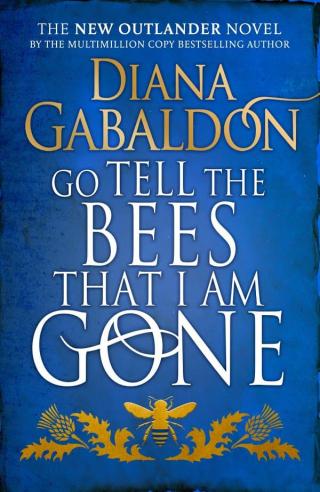
Go Tell the Bees That I Am Gone
- Автор: Гэблдон Диана
- Серия: Outlander #9
- Год: 2021
- Язык: английский
- Год: Delacorte Press
- ISBN: 978-1-473-51900-8
- Жанр: Исторические приключения

Электронная книга - «Go Tell the Bees That I Am Gone». Краткое содержание книги:
The past may seem the safest place to be . . . but it is the most dangerous time to be alive. . . .
Jamie Fraser and Claire Randall were torn apart by the Jacobite Rising in 1746, and it took them twenty years to find each other again. Now the American Revolution threatens to do the same. It is 1779 and Claire and Jamie are at last reunited with their daughter, Brianna, her husband, Roger, and their children on Fraser’s Ridge. Having the family together is a dream the Frasers had thought impossible. Yet even in the North Carolina backcountry, the effects of war are being felt. Tensions in the Colonies are great and local feelings run hot enough to boil Hell’s teakettle. Jamie knows loyalties among his tenants are split and it won’t be long until the war is on his doorstep. Brianna and Roger have their own worry: that the dangers that provoked their escape from the twentieth century might catch up to them. Sometimes they question whether risking the perils of the 1700s—among them disease, starvation, and an impending war—was indeed the safer choice for their family. Not so far away, young William Ransom is still coming to terms with the discovery of his true father’s identity—and thus his own—and Lord John Grey has reconciliations to make, and dangers to meet . . . on his son’s behalf, and his own. Meanwhile, the Revolutionary War creeps ever closer to Fraser’s Ridge. And with the family finally together, Jamie and Claire have more at stake than ever before.
“I should like to shoot Gabriel,” she said, and stared some more, her lips pressed tight together. Then she shook her head and got unsteadily to her feet. “But thee is right. I won’t.”
She drew a deep breath and reached for the bridle in his hand.
“But I must have my girls with me now. Will thee help me to go and get them?”
The light was fading fast and a wind with the cold breath of night came into the barn and stirred the scattered bits of straw along the packed-dirt floor. Ian merely nodded and bent to heave the saddle up.
“Go and fetch your cloak, lass. Ye’ll freeze, else.”
IT WAS LESS than an hour’s ride to the inn, but the sun had gone down, swallowed in a sudden bank of cloud that rose up from the trees like black bread rising. It began to snow.
Ian had put Silvia up before him, saying that she might become tangled in the rope leading their second horse. So much was true. It was more true that while she was no longer starved, she was still thin as an icicle and just as brittle, and he felt an urgent need to shelter her.
The wind had dropped, thank God, but the snow fell thick and silent, muting all sound and burdening the branches of the pines and fir trees. It was a good road, but he still pushed Henry a little, lest it disappear under the horse’s hooves. This wasn’t his country, and he didn’t want to go astray and end up spending the night in the woods with Silvia.
“I met Gabriel in Philadelphia,” she said, unexpectedly. “My parents were still alive then, and we belonged to the same meeting. They’d chosen someone else for me—a blacksmith who owned his own forge. Older than I by ten years, well established. A kind man,” she added after a pause. “With a house and property. Gabriel was a clerk, my own age, and earned barely enough to keep himself, let alone a wife.”
“Well, I was nay more than an Indian scout when I met Rachel,” Ian said, watching Henry’s misty breath flow back over the horse’s neck as they rode. “And a man of blood, forbye. I did own some land, though,” he added fairly.
“And thee had a family,” she said softly. “My parents both died within the year—smallpox—and there was no one left but me; I had no brothers or sisters. Gabriel had broken with his people when he became a Friend—he wasn’t born to it, as I was.”
“So ye only had each other, then.”
“We did,” she said, and fell silent for a bit.
“And then we had the girls,” she said, so softly that he barely heard her. “And we were happy.”
THE SNOW HAD stopped by the time they reached the inn, though everything in sight was lightly frosted, shining gold where lamplight fell through windows, silver in the fitful streaks of moonlight breaking through the clouds. Silvia let him lift her down from the horse, but when he made to come in with her, she put a hand on his chest to stop him.
“I thank thee, Ian,” she said quietly. “I need to talk with my daughters alone. Thee should go back to Rachel and thy son.”
He could see her thin, worn face in the changing light, one moment smoothed with shadow, the next strained with anxiety.
“I’ll wait,” he said firmly.
She laughed, to his surprise. It was a small and weary laugh, but a real one.
“I promise I shall not seize the girls and ride off into a blizzard alone,” she said. “I had peace to think while we rode, and to pray—and I thank thee for that, too. But it became clear to me that I must let Patience and Prudence see their father. I need to talk with them first, though, and explain what has happened to him.” Her voice wavered a little on “happened,” and she cleared her throat with a little hem.
“I’ll stay in the taproom, then.”
“No,” she said, just as firmly as he had. “I can smell the landlady’s supper cooking; the girls and I will eat together and talk and sleep—and in the morning, I will comb their hair and dress them in clean clothes and ask the innkeeper to arrange for us to be taken back in a wagon. Thee need not worry for me, Ian,” she added gently. “I shall not be alone.”
He studied her for a moment, but she meant it. He sighed and dug out his purse.
“Ye’ll need money for the wagon.”
86
Unwelcome Prophecy
IT WAS COLD, BUT the air of dawn was clear as broken glass and just as sharp in the lungs. Ian was hunting with Thayendanegea this morning, and they were following a glutton. Following, not hunting. Fresh snow had fallen in the night—was still falling, though lightly for the moment—and the animal was visible, a tiny black blot on gray snow at this distance, but moving in the stolid, rolling fashion that spoke of long patience, rather than the graceful diving lope of pursuit. The glutton, too, was following something.
“Ska’niònhsa,” Thayendanegea said, nodding at a patch of muddied snow, in which the curve of a hoofprint showed.
“Wounded, then,” Ian replied, nodding in agreement. A glutton wouldn’t take on a healthy moose—few things would—but it would follow a wounded one for days, patiently waiting for weakness to bring the ska’niònhsa to its knees. “He’d best hope the wolves don’t find it first.”
“Everything is chance,” Thayendanegea said philosophically, and brought his rifle down from its sling. The rifle notwithstanding, Ian thought the remark was not entirely philosophical. Ian tilted his head to and fro in equivocation.
“My uncle is a gambler,” he said, though the Mohawk word he used didn’t carry quite the same meaning as the English one. It meant something more like “one who seizes boldly” or “one who is careless with his life,” depending on the context. “He says one must take risks, but only a fool takes risks without knowing what they are.”
Thayendanegea glanced at him, slightly amused. And that wee bit wary, too, Ian thought.
“And how is one to know, then?”
“One asks and one listens.”
“And have you come to listen to me?”
“I came to see Wakyo’teyehsnonhsa,” Ian said courteously, “but it would be wasteful indeed to leave again without listening to a man of your experience and wisdom, since you are good enough to talk with me.”
The chuckle that came in response to that was Joseph Brant, not Thayendanegea, and so was the knowing look that came with it.
“And your uncle, of course, might be interested in what I have to say?”
“Maybe,” said Ian, equably. He was carrying his old musket; good enough for anything they were likely to find. They were passing through a growth of enormous spruce, and the snow was sparse beneath the prickly branches, the thick layer of needles slippery underfoot. “He told me to judge whether I should say to you what he knows.”
“I suppose you’ve decided to do so, then,” Brant said, the look of amusement deepening. “What he knows? He said this? Not what he thinks?”
Ian shrugged, eyes on the distant glutton.
“He knows.” He and Uncle Jamie had discussed it, and Uncle Jamie had finally left it up to him to decide how to tell it. Whether to pass it off as knowledge gained from Jamie’s time as an Indian agent and his connections with both the British government and the Continental army—or tell the truth. Brant was the only military commander to whom this particular truth could be told—but that didn’t mean he’d believe it. He was still a Mohawk, though, half-Irish wife and college education notwithstanding.
“My uncle’s wife,” Ian said, watching the words leave him in small puffs of white mist. “She is an arennowa’nen, but she is more. She has walked with a ghost of the Kahnyen’kehaka, and she has walked through time.”