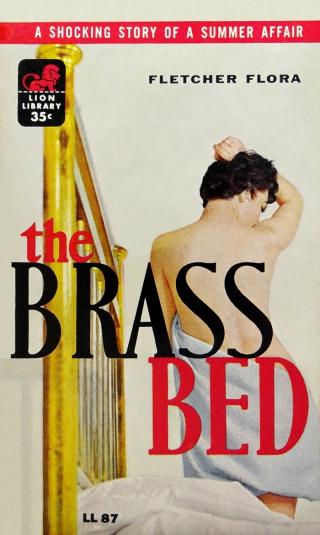
The Brass Bed
- Автор: Флора Флетчер
- Год: 1956
- Язык: английский
- Год: Lion Books
- Жанр: Романы для взрослых

Электронная книга - «The Brass Bed». Краткое содержание книги:
...and the root of it all lay hidden in the secret of THE BRASS BED.
“He couldn’t swim.”
“No? Not at all?”
“Not a stroke.”
“That’s odd, isn’t it? He was such an athletic bastard and all.”
“He was afraid of water.”
“You don’t say so. How do you know all this, old boy?”
“Jolly told me. Only yesterday, it was.”
“It makes it all the worse somehow, doesn’t it? It’s bad enough to die at all, but to die of something you’re afraid of, that seems to be the worst thing that could happen.”
“I don’t know. You generally die pretty fast, I think, once you get started, and I don’t suppose it made much difference in the end.”
He picked up a small stone and turned and looked at me without throwing the stone immediately into the river, and it broke the rhythm of his picking and throwing, which seemed somehow to make an enormous and overwhelming change in the established order of things.
“That’s a very neat way to look at it, old boy,” he said, “and it is apparent to me that you’re quite a philosopher about these things. You will surely be a great comfort to Jolly.”
I turned my head to meet his eyes, but he had already tossed the stone into the river and was reaching for another, and I was pretty certain that he hadn’t meant anything in particular by what he’d said, nothing ironical or anything, and I told myself that it was surely the same with what Jolly had said and repeated, that she had not really meant anything by wishing that Kirby would die, that it had been only like a child wishing it in anger about a parent or a sibling or a friend, not really meaning it or wanting it and certainly not planning to make it come true.
“How long do you suppose it will take Sid to bring the sheriff?” Harvey asked.
“Not long if he’s in his office. It’s only a short drive to the county seat.”
“Maybe he’s already back.”
“I doubt it. He might be, however.”
“There’s a funny guy. That Sid. Did you notice how he started giving orders and everything? He sort of took over, I mean. It was rather surprising in a guy who regularly takes all that snotty talk and all from Fran. He must be in love with her.”
“He’s not in love with Fran. He’s in love with Jolly.”
“Is that so? I thought it must be Fran.”
“No, Jolly’s the one.”
“Well, I can understand that. I admit that Jolly’s much the prettier.”
“Yes, she is.”
“That Fran’s passionate, though. She’s extremely passionate.”
I didn’t answer, and we were silent again, and pretty soon he sighed and stood up.
“I suggest that we go back now, old boy. How do you feel about it?”
“We might as well.”
“What shall we do about the boat? Do you think we ought to leave it here?”
“Why should we leave it here?”
“In cases like this, aren’t you supposed to leave everything alone or something?”
“That’s in cases of crime. An accident is no crime.”
“That’s so, of course. I must say, though, it will be a hell of a job rowing it back upstream.”
“We’ll take turns.”
“That’s fair, old boy. I’ll take first turn if it’s all right with you.”
We went down and got into the boat. Harvey sat between the oars and started rowing back upstream, and I twisted around and watched the dark water split on the bow and wondered if Sid was back yet with the sheriff. The bend in the river was about half way back, and when we reached it Harvey and I changed places, and I rowed on up to the gravel bar. We got out and pulled the boat up onto the bar and went up the path to the clearing, and Jolly and Fran were sitting close to each other on the ground among the empty beer cans, and Sid was just coming down the narrow road in the Caddy with someone following him in a Ford.
“Did you find anything?” Fran said.
“Yes,” I said. “We found the boat and brought it back.”
Jolly looked at me and didn’t say anything, and I didn’t say anything, either. Sid got out of the Caddy, and a tall, thin man with very round shoulders got out of the Ford, and they walked over to us together. The tall, thin man was wearing a beautiful cream colored hat with a wide brim. I was certain from this that he was the sheriff, because it seems to be imperative that sheriffs wear hats with wide brims.
He was the sheriff, all right, and it turned out that his name was Logan Pierce. He had an unpleasant, reedy voice, and his shoulders were so stooped that, in spite of his height, he gave the impression of looking up at everyone from under his brows in a sly way, and this was rather disconcerting after a while. When he spoke, Jolly got up off the ground and brushed off the seat of her shorts.
“Which one of you is Mrs. Craig?” he said.
“I am,” Jolly said.
“I’m sorry about Mr. Craig. I guess it must have been quite a shock.”
“Yes, it was. It was a shock.”
“Do you think you could tell me about it?”
“Of course. I can tell you exactly how it happened.”
No one said anything for a while, Logan Pierce just standing there looking at Jolly with this appearance of slyness, and then Jolly said, “Do you want me to go ahead and tell it?”
“Yes,” he said, “just in your own words the way you remember it.”
I thought afterward, thinking back on it, that this remark could have been interpreted to imply something pretty unpleasant, because Jolly could hardly have told it in any words other than her own unless she’d been coached ahead of time like a witness in a trial, and this suggested that there was something involved in Kirby’s drowning that she had to be careful about, to lie about or tell in just a certain way, but I doubt that he meant the implication at all, and it was probably just a sloppy way he had of expressing himself.
“Well,” Jolly said, “we went in the boat to run the trot line, but there weren’t any fish on it, and then Kirby wanted to go on around the bend for a ride, but I didn’t want to go. I told him I would rather come back here, but he said he was determined to have a ride around the bend after having come as far as the trot line, and so we went. When we were around the bend, he stopped rowing and stood up and for some reason started to walk down to where I was sitting, and that’s when he fell out of the boat.”
Logan Pierce lifted a big hand with the palm turned out in a gesture that meant to stop, and Jolly quit talking.
“That bothers me a little, I got to admit,” Logan Pierce said. “I been trying to figure the odds against a man’s falling out of a flat-bottomed boat, and the way I got it figured, they would be terrific.”
“He fell out,” Jolly said. “He fell right out into the water.”
“Okay. That’s established. But what made him fall? Can you explain what made him?”
“He just seemed to lose his balance, that’s all. The boat started to tip to one side, and he went over.”
I could see that she hadn’t answered the question to his satisfaction, and he stood looking at her with the slyness that was probably only an effect and not real. All at once he began to pop the knuckles of his right hand one at a time slowly.
“He had drunk quite a lot of beer,” I said.
Logan Pierce transferred his gaze from Jolly to me.
“Who are you?” he said.
I told him who I was, and how Harvey and I had come here fishing, and that I was a friend of Kirby and Jolly’s, which wasn’t precisely true in the case of Kirby but did no harm so far as I could see, and he nodded his head two or three times and started looking around at the empty beer cans.
“Seems to me you all been drinking quite a lot of beer,” he said.
“That’s true,” I said. “We’ve all been drinking quite a lot.”