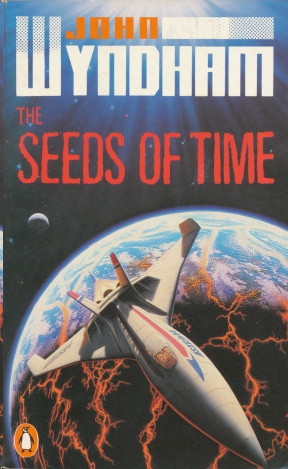
The Seeds of Time
- Автор: Уиндем Джон Паркс Лукас Бейнон Харрис
- Язык: английский
- Год: Michael Joseph
- ISBN: 0-7181-0362-9
- Жанр: Научная фантастика

Электронная книга - «The Seeds of Time». Краткое содержание книги:
‘Very well,’ he said, grimly. ‘We’re like rats in a trap, but Bowman and I aim to do more than just keep the trap going, and we’re going to try, even if we have to cut our way into the damned ship by hand.’
Captain Winters had okayed that; not that he believed that anything useful would come of it, but it would keep Jevons quiet, and do no one else any harm. So for weeks Jevons and Bowman had got into their spacesuits and worked their shifts. Oblivious after a time of the wheeling heavens about them, they kept doggedly on with their sawing and filing. Their progress, pitifully slow at best, had grown even slower as they became weaker.
Just what Bowman was attempting when he met his end still remained a mystery. He had not confided in Jevons. All that anyone knew about it was the sudden lurch of the ship and the clang of reverberations running up and down the hull. Possibly it was an accident. More likely he had become impatient and laid a small charge to blast an opening.
For the first time for weeks ports were uncovered and faces looked out giddily at the wheeling stars. Bowman came into sight. He was drifting inertly, a dozen yards or more outboard. His suit was deflated, and a large gash showed in the material of the left sleeve.
The consciousness of a corpse floating round and round you like a minor moon is no improver of already lowered morale. Push it away, and it still circles, though at a greater distance. Some day a proper ceremony for the situation would be invented-perhaps a small rocket would launch the poor remains upon their last, infinite voyage. Meanwhile, lacking a precedent, Captain Winters decided to pay the body the decent respect of having it brought inboard. The refrigeration plant had to be kept going to preserve the small remaining stocks of food, but several sections of it were empty….
A day and a night by the clock had passed since the provisional interment of Bowman when a modest knock came on the control-room door. The Captain laid blotting-paper carefully over his latest entry in the log, and closed the book.
‘Come in,’ he said.
The door opened just widely enough to admit Alice Morgan. She slipped in, and shut it behind her. He was somewhat surprised to see her. She had kept sedulously in the background, putting the few requests she had made through the intermediation of her husband. He noticed the changes in her. She was haggard now as they all were, and her eyes anxious. She was also nervous. The fingers of her thin hands sought one another and interlocked themselves for confidence. Clearly she was having to push herself to raise whatever was in her mind. He smiled in order to encourage her.
‘Come and sit down, Mrs Morgan,’ he invited, amiably.
She crossed the room with a slight clicking from her magnetic soles, and took the chair he indicated. She seated herself uneasily, and on the forward edge.
It had been sheer cruelty to bring her on this voyage, he reflected again. She had been at least a pretty little thing, now she was no longer that. Why couldn’t that fool husband of hers have left her in her proper setting-a nice quiet suburb, a gentle routine, a life where she would be protected from exaction and alarm alike. It surprised him again that she had had the resolution and the stamina to survive conditions on the Falcon as long as this. Fate would probably have been kinder to her if it had disallowed that. He spoke to her quietly, for she perched rather than sat, making him think of a bird ready to take off at any sudden movement.
‘And what can I do for you, Mrs Morgan?’
Alice’s fingers twined and intertwined. She watched them doing it. She looked up, opened her mouth to speak, closed it again.
‘It isn’t very easy,’ she murmured apologetically.
Trying to help her, he said:
‘No need to be nervous, Mrs Morgan. Just tell me what’s on your mind. Has one of them been-bothering you?’
She shook her head.
‘Oh, no, Captain Winters. It’s nothing like that at all.’
‘What is it, then?’
‘It’s-it’s the rations, Captain. I’m not getting enough food.’
The kindly concern froze out of his face.
‘None of us is,’ he told her, shortly.
‘I know,’ she said, hurriedly. ‘I know, but ‘
‘But what?’ he enquired in a chill tone.
She drew a breath.
‘There’s the man who died yesterday. Bowman. I thought if I could have his rations …’
The sentence trailed away as she saw the expression on the Captain’s face.
He was not acting. He was feeling just as shocked as he looked. Of all the impudent suggestions that ever had come his way, none had astounded him more. He gazed dumbfounded at the source of the outrageous proposition. Her eyes met his, but, oddly, with less timidity than before. There was no sign of shame in them.
‘I’ve got to have more food,’ she said, intensely. Captain Winters’ anger mounted.
‘So you thought you’d just snatch a dead man’s share as well as your own! I’d better not tell you in words just where I class that suggestion, young woman. But you can understand this: we share, and we share equally. What Bowman’s death means to us is that we can keep on having the same ration for a little longer-that, and only that. And now I think you had better go.’
But Alice Morgan made no move to go. She sat there with her lips pressed together, her eyes a little narrowed, quite still save that her hands trembled. Even through his indignation the Captain felt surprise, as though he had watched a hearth cat suddenly become a hunter. She said stubbornly:
‘I haven’t asked for any privilege until now, Captain. I wouldn’t ask you now if it weren’t absolutely necessary. But that man’s death gives us a margin now. And I must have more food.’
The Captain controlled himself with an effort.
‘Bowman’s death has not given us a margin, or a windfall -all it has done is to extend by a day or two the chance of our survival. Do you think that every one of us doesn’t ache just as much as you do for more food? In all my considerable experience of effrontery ‘
She raised her thin hand to stop him. The hardness of her eyes made him wonder why he had ever thought her timid.
‘Captain. Look at me!’ she said, in a harsh tone.
He looked. Presently his expression of anger faded into shocked astonishment. A faint tinge of pink stole into her pale cheeks.
‘Yes,’ she said. ‘You see, you’ve got to give me more food. My baby must have the chance to live.’
The Captain continued to stare at her as if mesmerized.
Presently he shut his eyes, and passed his hand over his brow.
‘God in heaven. This is terrible,’ he murmured.
Alice Morgan said seriously, as if she had already considered that very point:
‘No. It isn’t terrible-not if my baby lives.’ He looked at her helplessly, without speaking. She went on: ‘It wouldn’t be robbing anyone, you see. Bowman doesn’t need his rations any more-but my baby does. It’s quite simple, really.’ She looked questioningly at the Captain. He had no comment ready. She continued: ‘So you couldn’t call it unfair. After all, I’m two people now, really, aren’t I? I need more food. If you don’t let me have it you will be murdering my baby. So you must… must… My baby has got to live-he’s got to ‘
When she had gone Captain Winters mopped his forehead, unlocked his private drawer, and took out one of his carefully hoarded bottles of whisky. He had the self-restraint to take only a small pull on the drinking-tube and then put it back. It revived him a little, but his eyes were still shocked and worried.
Would it not have been kinder in the end to tell the woman that her baby had no chance at all of being born? That would have been honest; but he doubted whether the coiner of the phrase about honesty being the best policy had known a great deal about group-morale. Had he told her that, it would have been impossible to avoid telling her why, and once she knew why it would have been impossible for her not to confide it, if only to her husband. And then it would be too late.