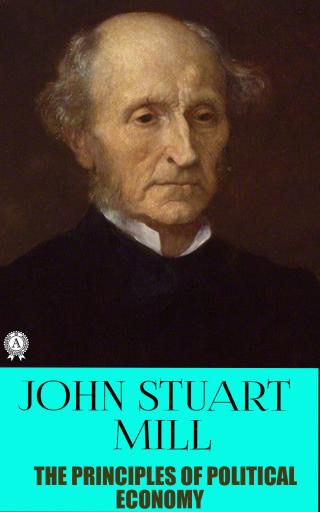
Principles Of Political Economy
- Автор: Mill John Stuart
- Год: 2022
- Язык: английский
- Год: Strelbytskyy Multimedia Publishing
- Жанр: Политика

Электронная книга - «Principles Of Political Economy». Краткое содержание книги:
Beside discussing descriptive issues such as which nations tended to benefit more in a system of trade based on comparative advantage (Mill's answer: those with more elastic demands for other countries' goods), the work also discussed normative issues such as ideal systems of political economy, critiquing proposed systems such as communism and socialism.
Along with A System of Logic, Principles of Political Economy established Mill's reputation as a leading public intellectual. Mill's sympathetic attitude in this work and in other essays toward contemporary socialism, particularly Fourierism, earned him esteem from the working class as one of their intellectual champions.
Explain and prove this proposition, and illustrate it from the circumstances of the United States.
299. State under what limitations the proposition is correct, that profits vary inversely with wages. Explain the circumstances which cause both a higher rate of wages and profits to prevail in a young country, such as the United States, than in England.
300. In America wages are much higher than in England, yet the general rate of profits is higher also, according to Mr. Mill. How do you reconcile the two facts?
301. Examine the following:
“It seems to me that protection is absolutely essential to the encouragement of capital, and equally necessary for the protection of the American laborer.... He must have good food, enough of it, good clothing, school-houses for his children, comforts for his home, and a fair chance to improve his condition. To this end I would protect him against competition with the half-paid laborers of European countries.”—Congressional Globe.
302. An American newspaper has said of the burning of Chicago: “The money to replace what has been burned will not be sent abroad to enrich foreign manufacturers; but, thanks to the wise policy of protection which has built up American industries, it will stimulate our own manufactures, set our mills running faster, and give employment to thousands of idle working-men.” Comment on this passage.
303. On whom does a tax on imports, if not prohibitory, fall?
304. In what cases would duties on imported commodities fall on the producers?
305. Are taxes on imports in any way paid by foreigners?
306. Discuss the effects of duties on exports.
307. Trace the effects of duties on the importation of raw materials, and distinguish, with examples, between duties that violate and duties which do not violate the principle of free trade.
308. Is it possible for any country by legislative enactments to engross a larger share of the advantages of foreign trade than it would naturally have? Discuss the question fully.
309. “Those are, therefore, in the right who maintain that taxes on imports are partly paid by foreigners; but they are mistaken when they say it is by the foreign producer. It is not on the person from whom we buy, but on all those who buy from us, that a portion of our customs duties spontaneously falls.” Explain and examine the reasons for this conclusion.
310. State the principle which determines the relation between the amount of a country's imports and that of its exports, and show how this relation is affected by a system of protective duties.
THE END.
Advertisements.
SCIENCE.
Huxley and Youmans's Physiology and Hygiene. By Thomas H. Huxley, LL. D., F.R.S., and William J. Youmans, M.D. New and revised edition. With numerous Illustrations. 12mo. 420 pages.
Coming's Class-Book of Physiology. With 24 Plates, and numerous Engravings on Wood. 12mo. 324 pages.
Youmans's Hand-Book of Household Science. A Popular Account of Heat, Light, Air, Aliment, and Cleansing, in their Scientific Principles and Domestic Applications. With numerous illustrative Diagrams. 12mo. 470 pages.
Physiography: An Introduction to the Study of Nature. By Thomas H. Huxley. With Illustrations and Colored Plates. 12mo.
Nicholson's Biology. Illustrated. 12mo. 163 pages.
Nicholson's Ancient Life-History of the Earth. A Comprehensive Outline of the Principles and Leading Facts of Paleontological Science. 12mo. 407 pages.
Anthropology: An Introduction to the Study of Man and Civilization. By Edward B. Tylor, D.C.L., F.R.S. With 78 Illustrations. 12mo. 448 pages.
Science Primers. Edited by Professors Huxley, Roscoe, and Balfour Stewart.
Chemistry: H. E. Roscoe. Physics: Balfour Stewart. Physical Geography: A. Geikie. Geology: A. Geikie. Physiology: M. Foster. Astronomy: J. N. Lockyer. Botany: J. D. Hooker. Logic: W. S. Jevons. Inventional Geometry: W. G. Spencer. Pianoforte: Franklin Taylor. Political Economy: W. S. Jevons. Natural Resources of the United States: J. Harris Patton. Scientific Agriculture: N. T. Lupton.D. APPLETON & CO., Publishers,
NEW YORK, BOSTON, CHICAGO, SAN FRANCISCO.
PHYSICS.
Quackenbos's Natural Philosophy. Embracing the most Recent Discoveries in the Various Branches of Physics. 12mo. 455 pages.
The revised edition of this standard text-book continues to be a favorite in the schools. Its numerous illustrations (338 in number) and full descriptions of experiments adapt it specially for use in institutions that have little or no apparatus, and it is particularly happy in showing the application of scientific principles in every-day life.
Ganot's Natural Philosophy. For Schools and General Readers. Translated and edited by E. Atkinson, Ph.D., F.C.S. Revised edition. 12mo. Copiously illustrated. 575 pages.
Arnott's Elements of Physics; or, Natural Philosophy. Seventh edition, edited by Alexander Bain, LL.D., and Alfred Swaine Taylor, M.D., F.R.S. 873 pages.
Elementary Treatise on Natural Philosophy. By A. Privat Deschanel, formerly Professor of Physics in the Lycée Louis-le-Grand, Inspector of the Academy of Paris. Translated and edited, with Extensive Additions, by J. D. Everett, Professor of Natural Philosophy in the Queen's College, Belfast. In Four Parts. 12mo. Flexible cloth. Part I. Mechanics, Hydrostatics, and Pneumatics. Part II. Heat. Part III. Electricity and Magnetism. Part IV. Sound and Light. Complete in one volume, 8vo. 1,156 pages. Illustrated with 783 fine Engravings on Wood and Three Colored Plates.
Science Primer: Physics. 18mo. Flexible cloth. 135 pages.
Experimental Series. By Alfred M. Mayer and Charles Barnard.
Light: A Series of Simple, Entertaining, and Inexpensive Experiments in the Phenomena of Light. By Alfred M. Mayer and Charles Barnard. 12mo. 112 pages.
Sound: A Series of Simple, Entertaining, and Inexpensive Experiments in the Phenomena of Sound, for the Use of Students of every Age. By Alfred M. Mayer. 12mo. 178 pages.