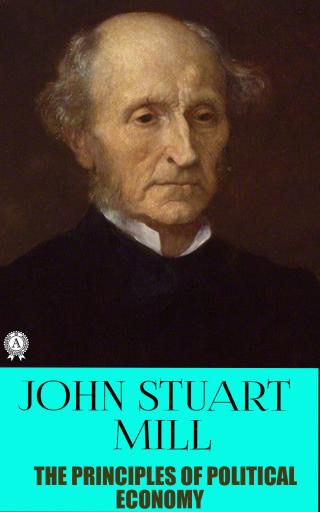
Principles Of Political Economy
- Автор: Mill John Stuart
- Год: 2022
- Язык: английский
- Год: Strelbytskyy Multimedia Publishing
- Жанр: Политика

Электронная книга - «Principles Of Political Economy». Краткое содержание книги:
Beside discussing descriptive issues such as which nations tended to benefit more in a system of trade based on comparative advantage (Mill's answer: those with more elastic demands for other countries' goods), the work also discussed normative issues such as ideal systems of political economy, critiquing proposed systems such as communism and socialism.
Along with A System of Logic, Principles of Political Economy established Mill's reputation as a leading public intellectual. Mill's sympathetic attitude in this work and in other essays toward contemporary socialism, particularly Fourierism, earned him esteem from the working class as one of their intellectual champions.
113. In order that the actual payments made by farmers to landlords should generally correspond with “economic rent,” what conditions must be observed?
114. What is assumed, as to competition, in all Mr. Mill's reasoning on wages, profits, and rent? Explain its action in each case.
Value.
115. Enumerate, compare, and criticise any opinions known to you which have been held concerning the nature, origin, or measure of value in exchange.
116. Define precisely what it is which gives value to objects, and point out the causes which vary the value of the same object under differing circumstances.
117. Do men dive to the bottom of the sea to get pearls because they are valuable; or are pearls valuable because men must dive to the bottom of the sea to get them?
118. There are three forms of difficulty of attainment. State the law of value applicable to each.
119. Explain the exact economic meaning of the words supply and demand.
120. When it is said that the value of certain commodities depends upon supply and demand, what is meant by demand?
121. If the supply of all commodities were suddenly doubled, would any changes in their relative values ensue or not, and why?
122. State the laws which regulate the permanent and temporary values of agricultural products.
123. How far does the value of commodities depend on the quantity of labor required for their production?
124. Has the term exchange value any precise meaning when we are comparing times or places very remote from one another?
125. What is meant by the natural (or normal) price and the market price of commodities? To what extent can they differ?
126. Does a general rise of wages raise the prices of commodities in general or not, and why? Does it tend to cause any change in the relative prices of commodities or not, and why?
127. Suppose that wages were double, would the values of commodities be affected? What would be the effect on prices and profits of such an increase of wages?
128. Are wages and profits influenced by prices?
129. Can employers recoup themselves by a rise of prices for a rise of—
(a.) Wages in particular employments? (b.) General wages?How does this question bear on the efficacy of trades-unionism?
130. Do values depend on wages?
131. Explain the following statement: “It is true the absolute wages paid have no effect upon values; but neither has the absolute quantity of labor.”
132. Explain the statement that “high general profits can not, any more than high general wages, be a cause of high values.... In so far as profits enter into the cost of production of all things, they can not affect the value of any.”
133. Explain fully why it is that capitalists can not compensate themselves for a general high cost of labor through any action on values and prices.
134. “The value of a commodity depends on its cost of production.” Under what conditions is this true, and what causes interfere with it?
135. Describe the hindrances which impede the free movement of capital to those fields which apparently offer the highest return for its employment.
136. Give J. S. Mill's analysis of the “cost of production,” and also Professor Cairnes's, with the arguments for and against each.
137. Analyze cost of production. What is its connection with cost of labor?
138. Give an analysis of cost of production of any commodity.
139. Show carefully the distinction between wages, cost of labor, and cost of production.
140. Define clearly value, price, real wages, and cost of production.
141. Define real wages, money wages, cost of labor.
Money.
142. Point out the difference between the scientific and popular conceptions implied in the terms wealth and money.
143. Show the fallacy of confounding capital with money. Can there be a glut of capital?
144. What is money? To what sort of necessity does it owe its existence? What articles have been used for money? Enumerate the qualities which render a commodity fit to serve as money.
145. What are the qualities requisite in any commodity in order that it may serve as money?
146. Distinguish accurately between the functions of money.
147. How far is a fixed standard of value possible?
148. What effect does the great durability of gold and silver have upon the value of money?
149. How far does the law of demand and supply govern the value of money?
150. Explain fully how it is that the value of the precious metals is affected by “questions of quantity only, with little reference to cost of production.”
151. What is to be said to the following: “Some political economists have objected altogether to the statement that the value of money depends on its quantity combined with the rapidity of circulation; which, they think, is assuming a law for money that does not exist for any other commodity”?
152. Under what conditions is it true that the “value of money is inversely as its quantity”?
153. Explain carefully the following: “The average value of gold is made to conform to its natural value in the same manner as the values of other things are made to conform to their natural value.”
154. In what various meanings is the phrase “the value of money” used? How far does the value of money in each of these meanings depend on (1) the cost of production, (2) supply and demand?
155. Are the values of gold and silver subject to exactly the same natural laws as other commodities?
156. Give the explanations and qualifications required to render the following proposition true: “The quantity of coin in every country is regulated by the value of the commodities which are to be circulated by it.”
157. Would the world be richer if every individual in it suddenly found the quantity of money in his possession doubled?
158. How far, or in what way, do you consider it correct to say that the general level of prices in a country depends upon the quantity of gold coin existing in that country?
159. A single good harvest causes a considerable fall in the value of wheat; but a great addition to the year's supply of gold from the mines produces little effect on its general value. How do you account for the difference?
160. Show the effect of establishing a double standard.
161. Show how Gresham's law is illustrated by the history of the currency in the United States between 1834 and 1873.
162. What effect had the discovery of gold in this century upon the coinage of the United States?
163. What is the system upon which the small silver currency of the United States is coined and issued?
164. State briefly the aim of the United States coinage act of 1853.
Credit.
165. How do you define credit? Form a classification of credit documents.
166. It has been said that “credit is capital.” Is this so or not?
167. Define capital, and examine the meaning of the term in the following statements:
(a.) Demand for commodities can not create capital.
(b.) Credit is not a creation, but a transfer of capital.
(c.) Wages depend upon the proportion between population and capital.
168. State the law of the value of money which governs general prices. What change is to be made in the statement, if credit is to be taken into consideration?