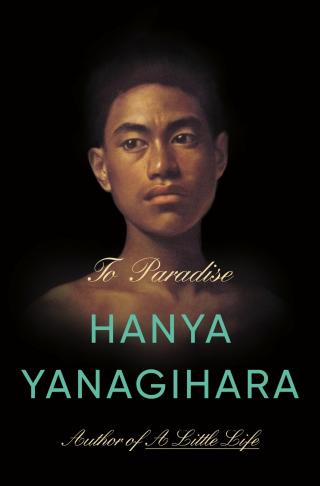
To Paradise
- Автор: Yanagihara Hanya
- Год: 2022
- Язык: английский
- Год: Knopf Doubleday Publishing Group
- Жанр: Современная русская и зарубежная проза

Электронная книга - «To Paradise». Краткое содержание книги:
In an alternate version of 1893 America, New York is part of the Free States, where people may live and love whomever they please (or so it seems). The fragile young scion of a distinguished family resists betrothal to a worthy suitor, drawn to a charming music teacher of no means. In a 1993 Manhattan besieged by the AIDS epidemic, a young Hawaiian man lives with his much older, wealthier partner, hiding his troubled childhood and the fate of his father. And in 2093, in a world riven by plagues and governed by totalitarian rule, a powerful scientist's damaged granddaughter tries to navigate life without him--and solve the mystery of her husband's disappearances.
These three sections are joined in an enthralling and...
“What do people do there?” I asked.
“The same things we do here,” he said. “But not just sex.”
“No?” I asked.
“No,” he said. “They also talk. They go there and talk.”
“About what?” I asked.
He shrugged. “The things people talk about,” he said, and as he did, I realized: I no longer knew what people talk about. If you were to listen to us on the Committee, you would think that all people talk about is how to overthrow the state, how to escape the country, how to cause mayhem. And yet what else is there to discuss? There are no movies, no television, no internet. You can’t, as we once had, spend an evening debating an article or a novel or bragging about a vacation to someplace far away. You can’t discuss the person you’ve just had sex with, or how you were interviewing for a new job, or how much you wanted to buy a new car or apartment or pair of sunglasses. You can’t do these things because none of those things are possible any longer, at least not openly, and with their elimination has also disappeared hours’, days’ worth of conversations. The world we live in now is about survival, and survival is always present tense. The past is no longer relevant; the future has failed to materialize. Survival allows for hope—it is, indeed, predicated on hope—but it does not allow for pleasure, and as a topic, it is dull. Talk, touch: the things C. and I kept reuniting to find—somewhere downtown, in a house by the river, there were other people like us, talking to each other just to hear the sound of someone responding to them, proof that the self they remembered still existed after all.
Later, I went home. I had a female guard from Security sit downstairs on the nights I knew I’d be out, and after I had dismissed her, I climbed up to Charlie’s room and sat on the edge of her bed, staring at her. She’s one of those children who look like neither their mother nor their father. Her nose resembles Eden’s perhaps, and I suppose she has David’s long, thin mouth, but somehow nothing in her face reminds me of either of them, and I am grateful for that. She is her own creature, one unfreighted by history. She was wearing a pair of short-sleeved pajamas, and I ran my fingers over her arms, which are pocked by little craters left behind by the scars. Next to her wheezed Little Cat, a sore on his right foreleg oozing pus, and I knew that I would soon have to take him to the clinic, have him injected with poison, come up with a lie to tell Charlie.
In bed, I thought about Nathaniel. If I’m lucky, I can conjure him as a source not of shame or self-flagellation but of neutrality. When I’m with C., I can sometimes close my eyes and pretend he’s Nathaniel at fifty-two. C. looks and smells and sounds and tastes entirely different than Nathaniel did, but skin is skin. I dare not admit this to anyone but you (not that there’s anyone else left to tell), but increasingly I have these dreams in which I revisit scenes and moments from my life with Nathaniel but in which David—and later, Eden, and later still, even Charlie—are missing, as if they never existed. These dreams are often banaclass="underline" Nathaniel and I, getting older and older, arguing about whether we should plant sunflowers or not, or, once, trying to chase a raccoon out of our attic. We seem to live in a cottage by the sea in Massachusetts, and although I never see the outside of the structure, I have a sense of what it looks like anyway.
In the daytime, I sometimes speak aloud to Nathaniel. Out of respect, I rarely discuss work, for that would upset him too much. Instead, I ask him about Charlie. After that first incident with those boys, I had told her about sex, and sexual threats, in a much more complete way than I had told her before. “Do you have any questions?” I had asked her, and after a silence, she had shaken her head. “No,” she’d said. She still doesn’t like to be touched by anyone, and while I sometimes mourn for her, I envy her, too: To live a life without desire (not to mention imagination) would once have been something to pity, but now it might ensure her survival—or at least increase her chances. Yet her distaste has not stopped her from wandering off again, and after the second incident, I sat down with her again. “Little cat,” I began, and then I didn’t know what else to say. How could I tell her that those boys weren’t attracted to her, that they saw her only as something to use and toss aside? I couldn’t, I couldn’t—I felt traitorous even thinking the words. In those moments, I wished that someone felt lust for her, that even if that lust was muddied with cruelty, it would at least be passion, or a form of it—it would mean that someone saw her as lovely and special and desirable; it would mean that someone might one day love her as deeply as I do, but differently, too.
More and more frequently these days, I think about how, of all the horrors the illnesses wreaked, one of the least-discussed is the brisk brutality with which it sorted us into categories. The first, most obvious one was the living and the dead. Then there was the sick and the well, the bereaved and the relieved, the cured and the incurable, the insured and the uninsured. We kept track of these statistics; we wrote them all down. But then there were the other divisions, the kind that didn’t appear to warrant recording: The people who lived with other people, and the people who lived alone. The people who had money, and the people who didn’t. The people who had connections, and the people who didn’t. The people who had somewhere else to go, and the people who didn’t.
In the end, it hadn’t made as much of a difference as we thought it would. The rich died anyway, maybe more slowly than they should have; some of the poor survived. After the first round of the virus had whipped through the city, scooping up all the easiest prey—the indigent and the infirm and the young—it had returned for seconds, and thirds, and fourths, until it was only the luckiest who remained. And yet no one was truly lucky: Is Charlie’s life lucky? Perhaps it is—she is here, after all, she can talk and walk and learn, she is able-bodied and lucid, she is loved and, I know, capable of loving. But she is not who she might have been, because none of us are—the illness took something from all of us, and so our definition of luck is a matter of relativity, as luck always is, its parameters designated by others. The disease clarified everything about who we are; it revealed the fictions we’d all constructed about our lives. It revealed that progress, that tolerance, does not necessarily beget more progress or tolerance. It revealed that kindness does not beget more kindness. It revealed how brittle the poetry of our lives truly is—it exposed friendship as something flimsy and conditional; partnership as contextual and circumstantial. No law, no arrangement, no amount of love was stronger than our own need to survive, or, for the more generous among us, our need for our people, whoever they were, to survive. I sometimes sense a faint mutual embarrassment among those of us who lived—who had sought to deprive someone else, maybe even someone else we knew, or a relative of someone we knew, of medication or hospitalization or food if it meant we could save ourselves? Who had reported someone they knew, perhaps even liked—a neighbor, an acquaintance, a colleague—to the Health Ministry, and who had turned up the volume on their headphones to muffle the sounds of them begging for help as they were led away to the waiting van, shouting all the while that someone had been misinformed, that the rash that had spread across their daughter’s arm was only eczema, that the sore on their son’s forehead was only a pimple?
And now the illness is under control, and we are back to considering the incidentals of life once more: whether we might be able to find chicken rather than tofu at the grocery; or whether our children might be admitted into this college versus that one; or whether we might be lucky in this year’s housing lottery, and move from Zone Seventeen to Zone Eight, or Zone Eight to Zone Fourteen.