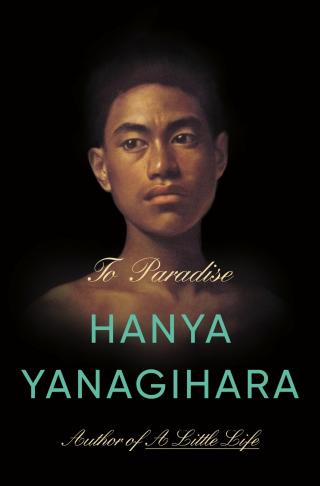
To Paradise
- Автор: Yanagihara Hanya
- Год: 2022
- Язык: английский
- Год: Knopf Doubleday Publishing Group
- Жанр: Современная русская и зарубежная проза

Электронная книга - «To Paradise». Краткое содержание книги:
In an alternate version of 1893 America, New York is part of the Free States, where people may live and love whomever they please (or so it seems). The fragile young scion of a distinguished family resists betrothal to a worthy suitor, drawn to a charming music teacher of no means. In a 1993 Manhattan besieged by the AIDS epidemic, a young Hawaiian man lives with his much older, wealthier partner, hiding his troubled childhood and the fate of his father. And in 2093, in a world riven by plagues and governed by totalitarian rule, a powerful scientist's damaged granddaughter tries to navigate life without him--and solve the mystery of her husband's disappearances.
These three sections are joined in an enthralling and...
I sat down next to her, trying to calm myself. “Little cat,” I said, “I saw you in the Square today.” She didn’t turn from me. “On the camera,” I told her, but she remained silent. “Who were those boys?” I asked, and, when she still didn’t speak, “I’m not angry, Charlie. I just want to know who they are.”
She was silent. After four years, I’ve grown used to her silences. She isn’t being insubordinate or stubborn—she’s just trying to think of how to answer, and it takes time. Finally, she said, “I met them.”
“All right,” I said. “When did you meet them? And where?”
She frowned, concentrating. “A week ago,” she said. “On University Place.”
“Near the Mews?” I asked, and she nodded. “What are their names?” I asked, but she shook her head, and I knew she was getting upset—that she didn’t know, or didn’t remember. It was one of the things I was always reminding her: Ask people’s names. And if you forget, ask them again. You can always ask—you have every right. “It’s okay,” I told her. “Have you seen them every day since you met them?” Again, a shake of her head.
Finally, she said, in a small voice, “They told me to meet them in the park today.”
“And what did you do?” I asked.
“They said we should go on a walk,” she said. “But then—” And here she stopped, and pressed her face into Little Cat’s back. She began to rock herself, which she does when she’s upset, and I rubbed her back as she did. “They said they were my friends,” she said, at last, and she hugged the cat so tightly that he yelped. “They said they wanted to be friends,” she repeated, almost in a moan, and I pulled her close to me, and she didn’t resist.
The doctor has said there won’t be any permanent damage: minor tearing, minor abrasions, some bleeding. She suggested a psychologist, and I agreed, not telling her that Charlie already sees one, along with an occupational therapist and a behavioral therapist. Then I turned the video over to Interior and ordered a full search—they found the boys, fourteen-year-olds, both residents of Zone Eight, sons of research fellows at Memorial, one white, the other Asian, within three hours. One of their parents is a friend of a friend of Wesley’s, and he sent a note asking for mercy for his son, which Wesley hand-delivered to the house yesterday, his face expressionless. “It doesn’t matter to me, Charles,” he said, and when I crumpled the note and handed it back to him, he just nodded, and wished me good night, and left.
Tonight, as I have for the past three nights, I’ll sit near Charlie’s bed. On Thursday, about thirty minutes after she had fallen asleep, she began to make a low growling noise deep in her throat, twitching her shoulders and head. But then she stopped, and after watching her for another hour or so, I finally went to bed myself. I wished, as I often did, for Nathaniel. I also wished, as I rarely did, for Eden. I suppose, though, that what I was really wishing was for someone to be responsible for Charlie alongside me.
I can’t say that what happened was my greatest fear for her—my greatest fear is that she’ll die—but it was close. I had tried to talk to her about her body, about how it was hers only, about how she didn’t have to do anything she didn’t want to. No, that’s not accurate. I hadn’t tried—I had. I knew she was vulnerable; I knew something like this could happen. Not even that—I knew it would happen. And I knew we were lucky—that, as bad as it was, it could have been worse.
When I was an undergraduate, a professor of mine had said there were two types of people: those who wept for the world, and those who wept for themselves. Weeping for your family, he said, was a form of weeping for yourself. “Those who congratulate themselves on their sacrifices for their families aren’t actually sacrificing at all,” he said, “because their family is an extension of their selves, and therefore a manifestation of the ego.” True selflessness, he said, meant giving of yourself to a stranger, someone whose life would never be entangled with your own.
But hadn’t I tried to do that? I had tried to make things better for people I didn’t know, and it had cost me my family, and therefore my self. And yet the improvements I had attempted are now in dispute. I cannot do anything else to help the world—I can only try to help Charlie.
Now I am very tired. I’m crying, of course, I suppose selfishly. I don’t know, though, of anyone who doesn’t cry for themselves these days—sickness makes the self indivisible from strangers, and so, even if you’re thinking of them, those millions of people with whom you navigate the city, you are by definition wondering when their lives might brush against yours, each encounter an infection, each touch a potential death. It’s selfishness, but there seems to be no other way—not now.
My love to you and Olivier—Charles
My dear Peter, December 3, 2076
Years ago, when I was traveling through Ashgabat, I met a man in a café. This was in the ’20s, when the Turkmen Republic was still known as Turkmenistan, and still under authoritarian rule.
I had been in university then, and this man had engaged me in conversation: What brought me to Ashgabat, and what did I think of it? Now I realize he was likely a spy of one sort or another, but then, being callow and stupid, as well as lonely, I was eager to share my thoughts about the inhumanity of an autocratic state, and how, although I wasn’t arguing for democracy, there was a difference between a constitutional monarchy of the sort I lived in and the dystopia he lived in.
He listened patiently as I bloviated, and then, when I was finished, said, “Come with me.” We walked to one of the open windows. The café was on the second floor of a building on a narrow tributary, a shortcut to the Russian Market, one of the last streets in the city not to be razed and rebuilt in glass and steel. “Look outside,” the man said. “Does this look like a dystopia to you?”
I looked. One of the great dissonances of Ashgabat was watching people who were dressed for the 19th century navigate a city that had been built for the 22nd. Below me, I saw women in bright-patterned head scarves and dresses hefting bulging plastic bags, and men zipping by on motorized handcarts, and schoolchildren shouting to one another. It was a sunny, crisp day, and even now, even as it’s no longer possible to remember the feeling of winter, I can still recall cold by visualizing the scenery of it: a gaggle of teenage girls’ cheeks stippled with scarlet; an elderly man tossing a just-roasted potato from hand to hand, the steam shimmering before his face; a woman’s wool scarf fluttering around her forehead.
It had not been the cold that the man had wanted me to see, though, but the life being lived in it. The middle-aged women, bags stuffed with groceries, gossiping in front of a blue-painted doorway, the group of boys playing soccer, the two girls walking down the street eating meat buns, their arms linked—as they passed beneath us, one of them said something to the other and they both began giggling, covering their mouths with their hands. There was a soldier, but he was leaning against the side of a building, his head resting against the brick, his eyes closed, a cigarette balanced on his lower lip, relaxing in the pale sun.
“So you see,” my companion said.
I think about that exchange often these days, as well as its underlying question: Does this place look dystopic? I ask it often about this city, where, in the absence of shops, there is still commerce, conducted now in the Square, but still populated by the same kinds of people—strolling couples, children wailing because they’ve been denied a treat, a strident woman haggling with a truculent vendor over the price of a copper pan—as before. In the absence of theaters, there are still people gathering for concerts at the community centers they’re establishing in every zone. In the absence of the number of children and young people that there should be, there is more care, more love, lavished on the ones who remain, although I know firsthand that that care can resemble something more dictatorial than loving. The answer, implicit in the man’s question, was that a dystopia doesn’t look like anything; indeed, that it can look like anywhere else.