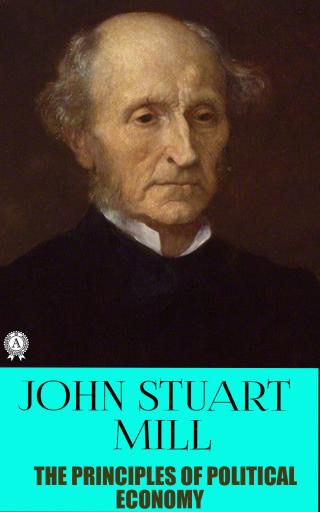
Principles Of Political Economy
- Автор: Mill John Stuart
- Год: 2022
- Язык: английский
- Год: Strelbytskyy Multimedia Publishing
- Жанр: Политика

Электронная книга - «Principles Of Political Economy». Краткое содержание книги:
Beside discussing descriptive issues such as which nations tended to benefit more in a system of trade based on comparative advantage (Mill's answer: those with more elastic demands for other countries' goods), the work also discussed normative issues such as ideal systems of political economy, critiquing proposed systems such as communism and socialism.
Along with A System of Logic, Principles of Political Economy established Mill's reputation as a leading public intellectual. Mill's sympathetic attitude in this work and in other essays toward contemporary socialism, particularly Fourierism, earned him esteem from the working class as one of their intellectual champions.
In the first place, as soon as any purely agricultural country gains even a slight density of population—a density only such as to warrant the introduction of the principle of division of labor—there comes an inevitable differentiation of pursuits, wholly outside of legislation, and through the operation of natural causes. Not all of any population is required in agriculture to provide the whole with food. By a division of labor, one man in agriculture can produce the sustenance of himself and many others. “The United States have at the present time but five persons engaged in agriculture for each square mile of settled area.” By the side of the farm must early spring up a wide circle of industries—the shoemaker, the carpenter, the blacksmith, the wagon-maker, the painter, the builder, the mason, and all the ordinary employments which arise in any small community from the earliest division of labor. Moreover, “agriculture” is often used in a too limited sense as confined to producing food alone (although even in that limited sense employing nearly one half of the total number of our laborers). In a new country the natural field of employment is found in the “extractive industries,” which include the preparation for the market not only of food, but also of all ores, coal, minerals, oils, hides, leather, wool, lumber, and the industries intimately connected with them; all the employments which transport these from one part of the country to another (employing at present over one ninth of all our laborers); and professional and personal services of an extended variety. Even, therefore, if we were obliged to forego manufactures entirely, the “extractive industries” would necessarily involve a very extensive diversity of employments.
The real question, however, for most persons, centers in the next stage of the industrial evolution—that of the manufactures of these above-mentioned products of the “extractive industries.” It will be remembered, here, that a country does not possess an equal ability in producing each of these or any commodities: the timber formerly near great rivers may vanish into the interior; the oil-sources may be more or less fertile; or the ore-deposits may be more or less rich, more or less accessible, than those of other countries. This being understood, then, as soon as the demand in the country calls for an increased quantity of a particular article, the cost may increase under the law of diminishing returns until a foreign country—having inferior agents of production as compared with our best—may be able to send supplies into our markets. It all depends on whether the United States wants more articles than can be produced on grades of natural agents superior to those possessed by foreigners, taking cost of carriage to this country into consideration. Even though foreign competition appears when we reach poorer grades of natural agents, it does not follow that some of the particular articles will not be produced. What ought to be clear is, that untrammeled exchange between countries will not prevent the existence of various industries, but only limit production to those grades of agents which are its best. This may be better seen by a simple diagram:
Iron and Coaclass="underline" England 7 6 5 4 3 2 1 Iron and Coaclass="underline" United States 4 3 2 1 Wheat: England 4 3 2 1 Wheat: United States 7 6 5 4 3 2 1England may have seven different grades of productiveness in her iron and coal supplies, of which her grades 1, 2, and 3 are superior to the best grade of the United States, while grades 1, 2, 3, and 4 in the United States may compare only with grades 4, 5, 6, 7 of England. So long as England can supply herself and the United States also with coal and iron from the three superior grades, the United States can not work grade 1 at home. But if the supply for England and the world requires grade 5 to be worked, then the United States can begin the industry on her best grade, although that is far inferior to the best grade in England. Likewise, if the United States has three grades of wheat-land superior to England's best grade, the ability of England to grow wheat depends on whether the United States can, or can not, supply both herself and England from grades 1, 2, and 3. If we must resort to grade 4, then England can begin to grow wheat as well as we. In short, under a system of free exchange, as great a diversity as under protection is probably possible, but only in such a way that the best possible advantages in each particular industry are employed. Smaller amounts in some branches, and greater amounts in others, may be produced under a free than under a restrictive system, but with all the greater gain which arises from a proper and healthy adjustment of trade. The most poorly endowed enterprises in each occupation would be given up, but not the whole industry itself. No class of persons feel the competition of rivals more than English farmers since American wheat has come into English markets, and yet it does not follow that England can not grow a bushel of wheat. The fact is, merely, that some kinds of lands were thrown out of cultivation, and a readjustment made, to the benefit of those wanting cheaper food. So with us: we should not, by the free exchange, be forced to give up the iron and coal industries entirely; for the best mines would still keep that occupation in existence to “diversify” the others.
So far the explanation covers the “extractive industries” only, or those industries affected by the law of diminishing returns when a larger quantity is demanded. The real question arises as to the manufactures of these materials. But we count upon larger industrial rewards, in the form of wages, and profits, here than in England; we must get more from an industry than England in order to satisfy us. Our grades of occupations, therefore, must be more productive to a certain extent, grade for grade, than English grades, in order to allow of their remaining free from competition. But we have this superiority, as regards our home market, owing to natural causes: (1) cheap raw materials (if we except wool and other commodities whose price is raised by the tariff); (2) advantage over England in cost of transportation of raw products; and (3) in the cost of transportation, again, of the finished goods in reaching our markets. Now, the processes of manufacture which do not put much labor upon the materials, especially where the articles are bulky, are conducted in this country without fear of foreign competition. And the range of this class of manufactures is surprisingly large. It includes the manufactures of iron, such as stoves, and the common utensils of every-day life; of hides, such as leather, harnesses, etc.; and of wood, such as all the furniture of common use. The list is too long to be fully stated here. These industries are not kept in existence by the tariff; and a diversity as wide as this would arise under a system of free exchange, as well as of restriction. Indeed, if duties were removed from so-called “raw materials,” it is altogether probable that a wider diversity would exist than ever before.