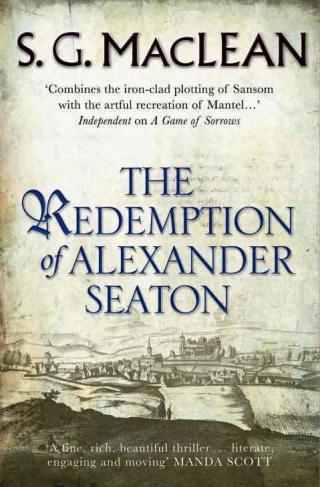
The Redemption of Alexander Seaton
- Автор: Маклин Шона Дж.
- Серия: Alexander Seaton #1
- Год: 2009
- Язык: английский
- Год: Quercus
- ISBN: 1847247911
- Жанр: Исторические детективы

Электронная книга - «The Redemption of Alexander Seaton». Краткое содержание книги:
Is the young man merely drunk or does his tottering walk suggest something more sinister?
When he collapses, vomiting, over the two whores who find him on that dark wet night, they guess rightly that he’s been murdered by poisoning.
So begins this gripping tale set in the town of Banff, Scotland in the 1620s. The body of the victim, the provost’s nephew and apothecary’s apprentice, is found in Alexander Seaton’s school house. Seaton is a school master by default, and a persona non-grata in the town – a disgraced would-be minister whose love affair with a local aristocrat’s daughter left him disgraced and deprived of his vocation. He has few friends, so when one of them is accused of the murder, he sets out to solve the crime, embarking on a journey that will uncover witchcraft, cruelty, prejudice and the darkness in men’s souls.
It is also a personal quest that leads Alexander to the rediscovery of his faith in God as well as his belief in himself.
Among her many strengths, Shona MacLean is brilliant at evoking period and place. You feel you are in those cold, dark, northern rooms, eavesdropping on her characters. You are totally involved in the rich, convincing world she has re-created.
At the tolbooth, we were allowed to pass without question, and were soon shown with little ceremony through the great timber door of the council chamber. I had entered this room only once before – on the same occasion that Gilbert Grant had taken us boys to the tolbooth jail two floors above, he had also been allowed to bring us into this hallowed place. I could still remember the words of the old provost, whose name I had now forgotten – another Ogilvie, no doubt – we stood in awe in the oak-panelled room with its huge, finely polished table and its ornately carved chairs. ‘The room above, boys, you must ever strive to avoid. This, this,’ he had repeated with a proprietorial sweep of his hand, ‘is what you should aspire to.’ I never had.
Waiting for us in the room were not only the provost and the baillie, but also Edward Arbuthnott and Thomas Stewart, notary public of the burgh of Banff. For the notary, unlike for Baillie Buchan and James Cardno, the world did not begin and end with the kirk. He was not ungodly, but he was a man of the world, a measured man who understood the needs and failings of his fellow creatures without seeing sin at the root of them all. Where he had been yesterday I did not know, but I was heartily glad to see him today. Stewart did not look up when Grant and I entered the room, engaged as he was on the removal of some papers from the open chest at the far end of the room. The apothecary looked somewhat shaken, ill at ease, but it was the demeanour of the provost that I marked most. His complexion was of a greater pallor than I had ever seen it, and his hand shook so that he had to steady himself by leaning on the back of a chair. He never once took his eyes off Thomas Stewart and the papers.
My companion was the first to speak. ‘We have come, provost, as we were sent for. What business here requires us?’
Walter Watt, scarcely hearing, I think, made no response. It was the baillie who replied. ‘We require your assistance, and that also of Mr Seaton there,’ he nodded towards me in a perfunctory manner, ‘in the examination of these papers.’ He indicated the chest over which Thomas Stewart was again bent. ‘The notary and I went to Arbuthnott’s this morning with the purpose of examining Charles Thom’s belongings in the hope of finding some evidence of evil intent against Patrick Davidson, since he denies involvement in the crime. I am glad to say – and I pray you would mark this, Mr Seaton – that we could find nothing amongst the belongings of Charles Thom to suggest anything other than a blameless life on the part of that young man.’ The involuntary relaxation of my shoulders and hands must have been noticed, for he continued, emphasis on his next words, ‘However, the absence of evident guilt is not the same as the proof of innocence, and that we have not found.’
‘Nor will find,’ I responded, ‘unless Patrick Davidson arises and tells you the name of the one who slew him.’
The baillie probed me with his long, unflinching gaze. ‘Charles Thom is at liberty to talk for himself, but chooses not to. If his reasons are known to you, you would do well to divulge them. It would go the better for you both.’ His eyes searched mine for a moment, but he returned to the matter in hand. ‘It is not in the case of Charles Thom we require help from yourself and Mr Grant. The papers we wish you to examine belong to Mr Patrick Davidson.’
Now I thought I understood something of the provost’s pallor.
‘What are these papers?’ I asked.
Stewart turned the first of the piles and passed it across the table. ‘That is what we would like you to tell us, although we know, broadly, what they are. What we would ascertain is what they mean.’
I pulled over a chair for Gilbert Grant but remained standing myself. Buchan placed a new-lit candle at the older schoolmaster’s elbow. My own eyesight was far better than my colleague’s. At first glance I saw what the papers were. I would have to choose my words with care.
‘These are maps,’ I said.
‘Indeed,’ agreed Buchan. ‘But have you ever seen such maps before, Mr Seaton?’
I looked again and shook my head. It was the truth. I had seen town sketches, and maps, in my college days. Yet, for all I had seen before, I had never seen such work as this. The maps, perhaps a dozen in all, were not printed copies but original hand-drawn sketches, showing natural coastline features such as bays, river mouths, sandbars and rocks – all annotated and named. The Collie Rocks were there, Meavie Point, the Maiden Craig, the Bow Fiddle Rock, and many more besides. The hills and cliffs that rose above them were named. But there too were the man-made features – the new harbour works at Banff, the harbour at Sandend, the fastness of Findlater above the bay at Darkwater. And roads there were, and bridges, kirks, townships, strongholds. The whole coastline from Gamrie and Troup Head to Findlater and beyond to Cullen was sketched out in a manner which, to one who knew these places, could not be mistaken. At the edge of each sketch an arrow, next to what could only be a roadway, annotated ‘to Elgin’, ‘to Turriff’, ‘to Strathbogie’. It was this last that began to give me the clue, if I had needed it, to the possible significance of the discovery of these documents, and the unrest they caused to those in the room, not least the provost. Gilbert Grant passed me paper after paper. ‘These are astonishing; I have never seen such work.’ He looked towards Thomas Stewart. ‘I had not thought the coastline here to be mapped.’
‘It is – or rather was – not,’ replied the notary. ‘The fishermen have their charts of course, but these are rudimentary and obscure, and can only be understood by those with great knowledge of the sea hereabouts.’
Grant shook his head in wonder. ‘Then where did he get them? Whose work are they?’
‘His own.’ Baillie Buchan’s voice was dry and deliberate.
‘You cannot be sure.’ Again the provost was in a rash of panic. The baillie lost patience and almost spat.
‘Arbuthnott confirms it.’ He thrust a paper towards the provost. ‘Do you deny yourself that it is his hand?’ And then another, and another. ‘Or this? Or this?’ The provost nodded slowly then sat down on a chair, his head in his hands. I picked up the papers he had let fall to the floor. Not maps these, but notes, numbered notes and symbols with their meaning. A symbol for a bridge, for a well, for a mill, for a farmstead, a ferry, a ford. Notes on strongholds and the names of those who held them – Findlater, Inchgower, Carnousie, Delgatie, Rothiemay, Frendraucht – all and many more were there. To my surprise, Buchan seemed to address himself to me rather than to Gilbert Grant. ‘What do you make of these documents?’
I chose my words with care. ‘I have some little knowledge of mapping, but I do not claim great expertise.’
‘And it is taught at neither of the colleges in Aberdeen?’
I considered. ‘No. There is some talk of a mathematics professor at Marischal College, but no man has yet been found to take the post.’
The baillie nodded, satisfied. ‘Mr Grant?’
My elder colleague sighed. ‘I can add little to what Alexander has said. The craftsmanship, the penmanship is of a high quality – but as to cartography, I know near to nothing of that.’
‘And why should you?’ asked the baillie, ‘for maps are scarce the business of honest men.’
Notary Stewart cleared his throat and the provost roused himself. ‘Have a care, Buchan. You might not slander the dead, but you risk great slander of the living. Robert Gordon of Straloch is known to have an interest in the matter of maps.’
Buchan was unbowed. ‘A Gordon is not above suspicion. Straloch may well have a hand in this. Did the boy speak of any commission, any patron in this work?’
Arbuthnott, to whom the question was chiefly addressed, asserted, with some vehemence, that Davidson had not spoken of this work at any time. The provost also denied ever having heard mention that his nephew was engaged on such an enterprise.