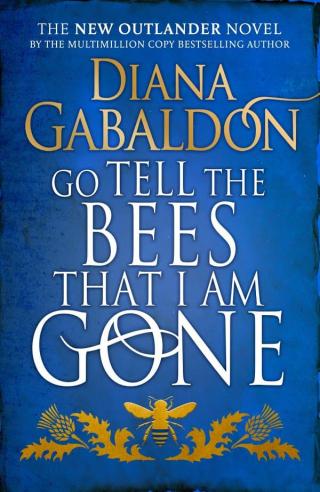
Go Tell the Bees That I Am Gone
- Автор: Гэблдон Диана
- Серия: Outlander #9
- Год: 2021
- Язык: английский
- Год: Delacorte Press
- ISBN: 978-1-473-51900-8
- Жанр: Исторические приключения

Электронная книга - «Go Tell the Bees That I Am Gone». Краткое содержание книги:
The past may seem the safest place to be . . . but it is the most dangerous time to be alive. . . .
Jamie Fraser and Claire Randall were torn apart by the Jacobite Rising in 1746, and it took them twenty years to find each other again. Now the American Revolution threatens to do the same. It is 1779 and Claire and Jamie are at last reunited with their daughter, Brianna, her husband, Roger, and their children on Fraser’s Ridge. Having the family together is a dream the Frasers had thought impossible. Yet even in the North Carolina backcountry, the effects of war are being felt. Tensions in the Colonies are great and local feelings run hot enough to boil Hell’s teakettle. Jamie knows loyalties among his tenants are split and it won’t be long until the war is on his doorstep. Brianna and Roger have their own worry: that the dangers that provoked their escape from the twentieth century might catch up to them. Sometimes they question whether risking the perils of the 1700s—among them disease, starvation, and an impending war—was indeed the safer choice for their family. Not so far away, young William Ransom is still coming to terms with the discovery of his true father’s identity—and thus his own—and Lord John Grey has reconciliations to make, and dangers to meet . . . on his son’s behalf, and his own. Meanwhile, the Revolutionary War creeps ever closer to Fraser’s Ridge. And with the family finally together, Jamie and Claire have more at stake than ever before.
5
Meditations on a Hyoid
“IT ALL BEGINS IN medias res, and if you’re lucky, it ends that way as well.” Roger swallowed, and I felt his larynx bob under my fingers. The skin of his throat was cool, and smooth where I held it, though I could feel a tiny prickle of beard stubble brush my knuckle just under his jaw.
“That’s what Dr. McEwan said?” I asked curiously. “What did he mean by it, I wonder?”
Roger’s eyes were closed—people normally closed their eyes when I examined them, as though needing to preserve what privacy they could—but at this, he opened them, an arresting deep green lit by the morning sun.
“I asked him. He said that nothing ever truly starts or stops, so far as he could see. That people think a child’s life begins at birth, but plainly that’s not so—ye can see them move in the womb, and a child that comes too soon will often live for a short time, and ye see that it’s alive in all its senses, even though it can’t sustain life.”
Now I’d closed my own eyes, not because I found Roger’s gaze unsettling, but in order to concentrate on the vibrations of his words. I moved my grip on his throat a little lower.
“Well, he’s quite right about that,” I said, envisioning the inner anatomy of the throat as I talked. “Babies are born already running, as it were. All their processes—except breathing—are working long before birth. But that’s still a rather cryptic remark.”
“Yes, it was.” He swallowed again and I felt his breath, warm on my bare forearm. “I prodded him a bit, because he’d obviously meant it by way of explanation—or at least the best he could do by way of explanation. I don’t suppose you could describe what it is you actually do when you heal someone, could you?”
I smiled at that without opening my eyes. “Oh, I might have a go at it. But there’s an implied error there; I don’t actually heal people. They heal by themselves. I just … support them.”
A sound that wasn’t quite a laugh made his larynx execute a complicated double bob. I thought I could feel a slight concavity under my thumb, where the cartilage had been partially crushed by the rope … I put my other hand round my own throat, for comparison.
“That’s actually what he said, too—Hector McEwan, I mean. But he did heal people; I saw him do it.”
My hands released both our throats, and I opened my eyes.
He gave me a quick précis of his relations with William Buccleigh, from Buck’s role in his hanging at Alamance, through the reappearance of his ancestor in Inverness in 1980, and Buck’s joining him in the search for Jem, after Brianna’s erstwhile co-worker, Rob Cameron, had kidnapped the boy.
“That was when he became … a bit more than a friend,” Roger said. He looked down and cleared his throat. “He came with me to search for Jem. Jem wasn’t there, of course, but we did find another Jeremiah. My father,” he said abruptly, his voice cracking on the word. I reached by reflex for his hand, but he waved me off, clearing his throat again.
“It’s okay. I’ll—I’ll tell you about that … later.” He swallowed and straightened a little, meeting my eyes again. “But Buck—that’s what we called him, Buck—when we came through the stones in search of Jem, we were both … damaged by the passage. You said, I think, that it got worse, if you did it more than once?”
“I wouldn’t say once isn’t damaging,” I said, with a small internal shudder at the memory of that void, a chaos where nothing seems to exist but noise. That, and the faint flicker of thought, all that holds you together between one breath and the next. “But yes, it does get worse. What happened to you?”
“To me, not that much. Unconscious for a bit, woke up strangling, fighting for air. Muck sweat, disorientation; couldn’t keep my balance for a bit, staggered all over. But Buck—” He frowned, and I saw his eyes change as he looked inward again, seeing the green hilltop of Craigh na Dun as he woke with the rain on his face. As I had waked three times. The hair on my neck rose slowly.
“It seemed to be his heart. He had a pain in his chest, his left arm, and he couldn’t breathe well, said it was like a weight on his chest, and he couldn’t get up. I got him water, though, and after a bit he seemed okay. At least he could walk, and he brushed off any suggestion that we stop and rest.”
They had separated then, Buck to search the road toward Inverness, Roger to go to Lallybroch, and—
“Lallybroch!” This time I did grab him by the arm. “You went there?”
“I did,” he said, and smiled. He clasped my hand, where it lay on his arm. “I met Brian Fraser.”
“You—but—Brian?” I shook my head in order to clear it. That made no sense.
“No, it didn’t make sense,” he said, plainly reading my thoughts from my face and smiling at the results. “We … didn’t go where—I mean when—we thought we were going. We ended in 1739.”
I stared at him for a moment, and he shrugged helplessly.
“Later,” I said firmly, and reached for his throat again, thinking, “In medias res.” What the devil did McEwan mean by that?
I could hear distant childish shouts from the direction of the creek, and the high, cracked screech of a hawk in the tall snag at the far side of our clearing; I could just see him—or her—from the corner of my eye: a large dark shape like a torpedo on a dead branch. And I was beginning to hear—or to think I heard—the thrum of blood in Roger’s neck, a faint sound, separate from the thump of his pulse. And the fact that I was evidently hearing it through my fingertips seemed shockingly ordinary.
“Talk to me a bit more,” I suggested, as much to avoid hearing what I thought I heard as in order to loosen up his larynx. “About anything.”
He hummed for a moment, but that made him cough, and I dropped my hand so he could turn his head.
“Sorry,” he said. “Bobby Higgins was just telling me the Ridge is growing—a lot of new families, I hear?”
“Like weeds,” I said, replacing my hand. “We came back to find that at least twenty new families had settled down, and there’ve been three more just since we came back from Savannah, where the winds of war had briefly blown us.”
He nodded, a slight frown on his face, and gave me a sidelong green glance. “I don’t suppose any of the new settlers is a minister?”
“No,” I said promptly. “Is that what you—I mean, you still think you—”
“I do.” He looked up at me, a little shyly. “I’m not fully ordained yet; I’ll need to take care of that, somehow. But when we decided to come back, we talked—Bree and I. About what we might do. Here. And …” He lifted both shoulders, palms on his knees. “That’s what I might do.”
“You were a minister here before,” I said, watching his face. “Do you really have to be formally ordained to do it again?”
He didn’t have to think; he’d done his thinking long since.
“I do,” he said. “I don’t feel … wrong … about having buried or married folk before, or christened them. Someone had to do it, and I was all there was. But I want it to be right.” He smiled a little. “It’s maybe like the difference between being handfast and being properly married. Between a promise and a vow. Even if ye ken ye’d never break the promise, ye want—” He struggled for the words. “Ye want the weight of the vow. Something to stand at your back.”
A vow. I’d made a few of those. And he was right; all of them—even those I’d broken—had meant something, had weight. And a few of them had stood at my back, and were still standing.