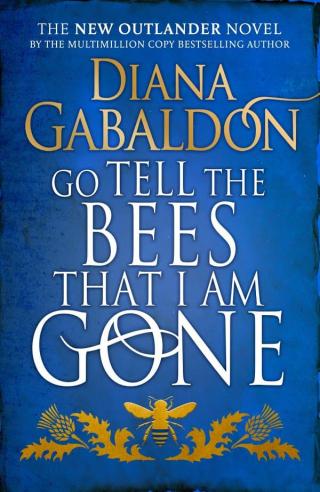
Go Tell the Bees That I Am Gone
- Автор: Гэблдон Диана
- Серия: Outlander #9
- Год: 2021
- Язык: английский
- Год: Delacorte Press
- ISBN: 978-1-473-51900-8
- Жанр: Исторические приключения

Электронная книга - «Go Tell the Bees That I Am Gone». Краткое содержание книги:
The past may seem the safest place to be . . . but it is the most dangerous time to be alive. . . .
Jamie Fraser and Claire Randall were torn apart by the Jacobite Rising in 1746, and it took them twenty years to find each other again. Now the American Revolution threatens to do the same. It is 1779 and Claire and Jamie are at last reunited with their daughter, Brianna, her husband, Roger, and their children on Fraser’s Ridge. Having the family together is a dream the Frasers had thought impossible. Yet even in the North Carolina backcountry, the effects of war are being felt. Tensions in the Colonies are great and local feelings run hot enough to boil Hell’s teakettle. Jamie knows loyalties among his tenants are split and it won’t be long until the war is on his doorstep. Brianna and Roger have their own worry: that the dangers that provoked their escape from the twentieth century might catch up to them. Sometimes they question whether risking the perils of the 1700s—among them disease, starvation, and an impending war—was indeed the safer choice for their family. Not so far away, young William Ransom is still coming to terms with the discovery of his true father’s identity—and thus his own—and Lord John Grey has reconciliations to make, and dangers to meet . . . on his son’s behalf, and his own. Meanwhile, the Revolutionary War creeps ever closer to Fraser’s Ridge. And with the family finally together, Jamie and Claire have more at stake than ever before.
“Ah,” Ian said, properly appreciating the importance of this. Her father’s rifle was a very fine one, a long rifle from Pennsylvania, he’d told her. Plainly he was prepared to wait as long as it took—and was probably a lot more stubborn than the bear, she thought, with a small interior gurgle.
“Ye may as well go on,” Jamie said, looking up at them. “It may be a wee while.”
“I could probably shoot it from here,” Bree offered, judging the distance. “I can’t kill it, but a load of bird shot might make it leave.”
Her father made a Scottish noise in response to this, and a violent gesture of prevention.
“Dinna try it,” he said. “All ye’ll do is maybe madden it—and if I could get down that slope, yon beast can certainly get up it. Now away wi’ ye; I’m getting a crick in my neck talkin’ up at ye.”
Bree gave Ian a sidelong glance and he gave her back the ghost of a nod, acknowledging her reluctance to leave her father shoeless on a ledge no more than twenty feet from a hungry bear.
“We’ll bear ye company for a bit,” he announced—and before Jamie could object, Ian had grasped a stout pine sapling and swung himself down onto the cliff face, where his moccasined toes at once found a hold.
Brianna, following his example, leaned over and dropped her fowling piece into her father’s hands before finding her own way down, more slowly.
“I’m surprised ye didna have at it wi’ your dirk, Uncle Jamie,” Ian was saying. “Bear-Killer, is it, that the Tuscarora called ye?”
Bree was pleased to see that Jamie had regained his equanimity and gave Ian no more than a pitying look.
“Are ye maybe familiar with a saying about how a man grows wiser wi’ age?” he inquired.
“Aye,” Ian replied, looking baffled.
“Well, if ye dinna grow wiser, ye’re no likely to grow older,” Jamie said, leaning the gun against the cliff. “And I’m old enough to ken better than to fight a bear wi’ a dirk for a deer’s carcass. Have ye got anything to eat, lass?”
She’d quite forgotten the small bag over her shoulder, but she now took it off and groped inside, removing a small packet of bannocks and cheese supplied by Amy Higgins.
“Sit down,” she said, handing this to her father. “I want to look at your leg.”
“It’s no bad,” he said, but he was either too hungry to argue or simply conditioned to accept unwanted medical treatment by her mother, for he did sit down and stretch out the wounded leg.
It wasn’t bad, as he’d said, though there was a deep puncture wound in his calf, with a couple of long scrapes beside it—these presumably left as he’d hastily pulled his foot out of the bear’s mouth, she thought, feeling a little faint at the vision of this. She had nothing with her of use save a large handkerchief, but she soaked this in the icy water from the rivulet that flowed down the cliff face and cleaned the wound as well as she could.
Could you get tetanus from a bear’s bite? she wondered, swabbing and rinsing. She’d made sure to have all the kids’ shots up to date—including tetanus—before they’d left, but a tetanus immunization was only good for what, ten years? Something like that.
The puncture wound was still oozing blood, but not gushing. She wrung out the cloth and tied it firmly but not too tightly around his calf.
“Tapadh leat, a gràidh,” he said, and smiled at her. “Your mother couldna have done better. Here.” He’d saved two bannocks and a bit of cheese for her, and she leaned back against the cliff between him and Ian, surprised to discover that she was very hungry, and even more surprised to realize that she wasn’t worried by the fact that they were chatting away in the near vicinity of a large carnivorous animal that could undoubtedly kill them all.
“Bears are lazy,” Ian told her, observing the direction of her glance. “If he—is it a he-bear, Uncle?—has a fine deer down there, he’ll no bother to climb all the way up here for a scrawny wee snack. Speakin’ of which”—he leaned past her to address Jamie—“did it eat your sandal?”
“I didna stay to watch,” Jamie said, his temper seeming to have calmed as a result of food. “But I’ve hopes that he didn’t. After all, wi’ a perfectly good pile of steaming deer guts just at hand, why would ye bother wi’ a piece of old leather? Bears aren’t fools.”
Ian nodded at this and leaned back against the cliff, rubbing his shoulders gently on the sun-warmed stone.
“So, then, cousin,” he said to Bree. “Ye said ye’d tell me how it was ye came home. As we’ve likely a bit of time to pass …” He nodded toward the now-rhythmic noises of tearing flesh and mastication below.
The bottom of her stomach dropped abruptly, and her father, seeing her face, patted her knee.
“Dinna trouble yourself, a leannan. Time enough. Perhaps ye’d rather tell it to everyone, when Roger Mac’s with ye.”
She hesitated for a moment; she’d visualized it many times, telling her parents the whole of it, imagined herself and Roger telling the tale together, taking turns … but seeing the intent look in her father’s eyes, she realized belatedly that she couldn’t have told her part of it honestly in front of Roger—she hadn’t even told him everything when she’d found him again, seeing how furious he was at the details she had shared.
“No,” she said slowly. “I can tell you now. At least my part of it.” And washing down the last bannock crumbs with a handful of cold water, she began.
Yes, her mother did know men, she thought, seeing Ian’s fist clench on his knee, and hearing the low, involuntary growl her father made at hearing about Rob Cameron’s cornering her in the study at Lallybroch. She didn’t tell them what he’d said, the crude threats, the orders—nor what she’d done, taking off her jeans at his command, then slashing him across the face with the heavy denim before tackling him and knocking him to the floor. She did mention smashing the wooden box of letters over his head, and the two of them made small hmphs of satisfaction.
“Where did that box come from?” she interrupted herself to ask her father. “Roger found it in his adopted father’s garage—that’s a place where you park a car, I mean—” she added when she saw a look of confusion touch Jamie’s face. “Never mind, it was a sort of storage shed. But we always wondered where you’d put it at this end?”
“Och, that?” Jamie’s face relaxed a bit. “Roger Mac had told me how his father was a priest and lived for a great many years at his manse in Inverness. We made three boxes—it was a good bit of work to copy out all the letters, mind—and I had them sealed and sent to three different banks in Edinburgh, with instructions that in such and such a year, each box was to be sent on to the Reverend Wakefield at the manse in Inverness. We hoped at least one would turn up; I put Jemmy’s whole name on each one, thinkin’ that would mean something to you, but no one else. Go on, though—ye smashed yon Cameron wi’ the box and then …?”
“It didn’t knock him out all the way, but I got past him and into the hall. So I ran down to the hall tree—it’s not the same as the one your parents have,” she said to Ian, and then remembered what one of the last letters had said. “Oh, God! Your father, Ian … I’m so sorry!”
“Oh. Aye,” he said, looking down. She’d grasped his forearm, and he put his own big hand over hers and squeezed it lightly. “Dinna fash, a nighean. I feel him wi’ me, now and then. And Uncle Jamie brought my mam back from Scotland—oh, Jesus.” He stopped, looking at her round-eyed. “She doesna ken ye’re here!”
“She’ll find out soon enough,” Jamie said testily. “Will ye tell me what the devil happened to this gobshite Cameron?”