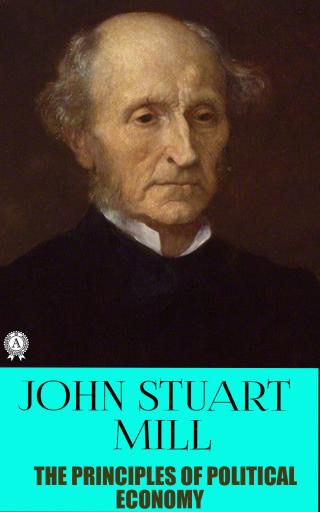
Principles Of Political Economy
- Автор: Mill John Stuart
- Год: 2022
- Язык: английский
- Год: Strelbytskyy Multimedia Publishing
- Жанр: Политика

Электронная книга - «Principles Of Political Economy». Краткое содержание книги:
Beside discussing descriptive issues such as which nations tended to benefit more in a system of trade based on comparative advantage (Mill's answer: those with more elastic demands for other countries' goods), the work also discussed normative issues such as ideal systems of political economy, critiquing proposed systems such as communism and socialism.
Along with A System of Logic, Principles of Political Economy established Mill's reputation as a leading public intellectual. Mill's sympathetic attitude in this work and in other essays toward contemporary socialism, particularly Fourierism, earned him esteem from the working class as one of their intellectual champions.
Chapter IV. Consequences Of The Tendency Of Profits To A Minimum, And The Stationary State.
§ 1. Abstraction of Capital not necessarily a national loss.
The theory of the effect of accumulation on profits must greatly abate, or rather, altogether destroy, in countries where profits are low, the immense importance which used to be attached by political economists to the effects which an event or a measure of government might have in adding to or subtracting from the capital of the country. We have now seen that the lowness of profits is a proof that the spirit of accumulation is so active, and that the increase of capital has proceeded at so rapid a rate, as to outstrip the two counter-agencies, improvements in production and increased supply of cheap necessaries from abroad. A sudden abstraction of capital, unless of inordinate amount, (would not) have any real effect in impoverishing the country. After a few months or years, there would exist in the country just as much capital as if none had been taken away. The abstraction, by raising profits and interest, would give a fresh stimulus to the accumulative principle, which would speedily fill up the vacuum. Probably, indeed, the only effect that would ensue would be that for some time afterward less capital would be exported, and less thrown away in hazardous speculation.
In the first place, then, this view of things greatly weakens, in a wealthy and industrious country, the force of the economical argument against the expenditure of public money for really valuable, even though industriously unproductive, purposes. In poor countries, the capital of the country requires the legislator's sedulous care; he is bound to be most cautious of encroaching upon it, and should favor to the utmost its accumulation at home, and its introduction from abroad. But in rich, populous, and highly cultivated countries, it is not capital which is the deficient element, but fertile land; and what the legislator should desire and promote, is not a greater aggregate saving, but a greater return to savings, either by improved cultivation, or by access to the produce of more fertile lands in other parts of the globe.
The same considerations enable us to throw aside as unworthy of regard one of the common arguments against emigration as a means of relief for the laboring-class. Emigration, it is said, can do no good to the laborers, if, in order to defray the cost, as much must be taken away from the capital of the country as from its population. If one tenth of the laboring people of England were transferred to the colonies, and along with them one tenth of the circulating capital of the country, either wages, or profits, or both, would be greatly benefited, by the diminished pressure of capital and population upon the fertility of the land. The landlords alone would sustain some loss of income; and even they, only if colonization went to the length of actually diminishing capital and population, but not if it merely carried off the annual increase.
§ 2. In opulent countries, the extension of machinery not detrimental but beneficial to Laborers.
From the same principles we are now able to arrive at a final conclusion respecting the effects which machinery, and generally the sinking of capital for a productive purpose, produce upon the immediate and ultimate interests of the laboring-class. The characteristic property of this class of industrial improvements is the conversion of circulating capital into fixed: and it was shown in the first book[303] that, in a country where capital accumulates slowly, the introduction of machinery, permanent improvements of land, and the like, might be, for the time, extremely injurious; since the capital so employed might be directly taken from the wages fund, the subsistence of the people and the employment for labor curtailed, and the gross annual produce of the country actually diminished. But in a country of great annual savings and low profits no such effects need be apprehended. It merely draws off at one orifice what was already flowing out at another; or, if not, the greater vacant space left in the reservoir does but cause a greater quantity to flow in. Accordingly, in spite of the mischievous derangements of the money market which have been occasioned by the great sums in process of being sunk in railways, I can not agree with those who apprehend any mischief, from this source, to the productive resources of the country. Not on the absurd ground (which to any one acquainted with the elements of the subject needs no confutation) that railway expenditure is a mere transfer of capital from hand to hand, by which nothing is lost or destroyed. This is true of what is spent in the purchase of the land; a portion too of what is paid to agents, counsels, engineers, and surveyors, is saved by those who receive it, and becomes capital again: but what is laid out in the bona fide construction of the railway itself is lost and gone; when once expended, it is incapable of ever being paid in wages or applied to the maintenance of laborers again; as a matter of account, the result is, that so much food and clothing and tools have been consumed, and the country has got a railway instead.
It already appears, from these considerations, that the conversion of circulating capital into fixed, whether by railways, or manufactories, or ships, or machinery, or canals, or mines, or works of drainage and irrigation, is not likely, in any rich country, to diminish the gross produce or the amount of employment for labor. There is hardly any increase of fixed capital which does not enable the country to contain eventually a larger circulating capital than it otherwise could possess and employ within its own limits; for there is hardly any creation of fixed capital which, when it proves successful, does not cheapen the articles on which wages are habitually expended.
As regards the effects upon the material condition of the wages-receiving class, since it seems clear that capital increases faster than improvements, and probably faster even than population, it follows that in countries where the laboring-classes are evidently growing in intelligence, they gain in wages with the progress of society. Such certainly seems to be the teaching of Mr. Giffen's late studies (see Book IV, Chap. III, § 5).
§ 3. Stationary state of wealth and population dreaded by some writers, but not in itself undesirable.
Toward what ultimate point is society tending by its industrial progress? When the progress ceases, in what condition are we to expect that it will leave mankind?
It must always have been seen, more or less distinctly, by political economists, that the increase of wealth is not boundless; that at the end of what they term the progressive state lies the stationary state, that all progress in wealth is but a postponement of this, and that each step in advance is an approach to it. We have now been led to recognize that this ultimate goal is at all times near enough to be fully in view; that we are always on the verge of it, and that, if we have not reached it long ago, it is because the goal itself flies before us. The richest and most prosperous countries would very soon attain the stationary state, if no further improvements were made in the productive arts, and if there were a suspension of the overflow of capital from those countries into the uncultivated or ill-cultivated regions of the earth. Adam Smith always assumes that the condition of the mass of the people, though it may not be positively distressed, must be pinched and stinted in a stationary condition of wealth, and can only be satisfactory in a progressive state. The doctrine that, to however distant a time incessant struggling may put off our doom, the progress of society must “end in shallows and in miseries,” far from being, as many people still believe, a wicked invention of Mr. Malthus, was either expressly or tacitly affirmed by his most distinguished predecessors, and can only be successfully combated on his principles.
303
Book I, Chap. V, § 2.