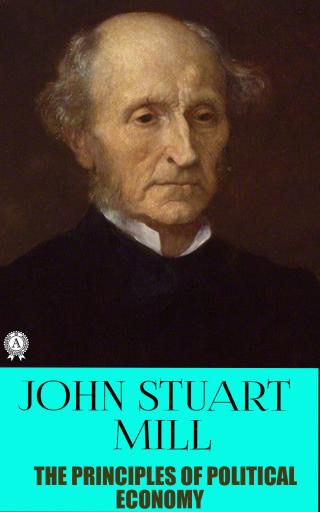
Principles Of Political Economy
- Автор: Mill John Stuart
- Год: 2022
- Язык: английский
- Год: Strelbytskyy Multimedia Publishing
- Жанр: Политика

Электронная книга - «Principles Of Political Economy». Краткое содержание книги:
Beside discussing descriptive issues such as which nations tended to benefit more in a system of trade based on comparative advantage (Mill's answer: those with more elastic demands for other countries' goods), the work also discussed normative issues such as ideal systems of political economy, critiquing proposed systems such as communism and socialism.
Along with A System of Logic, Principles of Political Economy established Mill's reputation as a leading public intellectual. Mill's sympathetic attitude in this work and in other essays toward contemporary socialism, particularly Fourierism, earned him esteem from the working class as one of their intellectual champions.
Chapter III. Of The Tendency Of Profits To A Minimum.
§ 1. Different Theories as to the fall of Profits.
The tendency of profits to fall as society advances, which has been brought to notice in the preceding chapter, was early recognized by writers on industry and commerce; but, the laws which govern profits not being then understood, the phenomenon was ascribed to a wrong cause. Adam Smith considered profits to be determined by what he called the competition of capital. In Adam Smith's opinion, the manner in which the competition of capital lowers profits is by lowering prices; that being usually the mode in which an increased investment of capital in any particular trade lowers the profits of that trade. But, if this was his meaning, he overlooked the circumstance that the fall of price, which, if confined to one commodity, really does lower the profits of the producer, ceases to have that effect as soon as it extends to all commodities; because, when all things have fallen, nothing has really fallen, except nominally; and, even computed in money, the expenses of every producer have diminished as much as his returns. Unless, indeed, labor be the one commodity which has not fallen in money price, when all other things have: if so, what has really taken place is a rise of wages; and it is that, and not the fall of prices, which has lowered the profits of capital. There is another thing which escaped the notice of Adam Smith; that the supposed universal fall of prices, through increased competition of capitals, is a thing which can not take place. Prices are not determined by the competition of the sellers only, but also by that of the buyers; by demand as well as supply. The demand which affects money prices consists of all the money in the hands of the community destined to be laid out in commodities; and, as long as the proportion of this to the commodities is not diminished, there is no fall of general prices. Now, howsoever capital may increase, and give rise to an increased production of commodities, a full share of the capital will be drawn to the business of producing or importing money, and the quantity of money will be augmented in an equal ratio with the quantity of commodities. For, if this were not the case, and if money, therefore, were, as the theory supposes, perpetually acquiring increased purchasing power, those who produced or imported it would obtain constantly increasing profits; and this could not happen without attracting labor and capital to that occupation from other employments. If a general fall of prices and increased value of money were really to occur, it could only be as a consequence of increased cost of production, from the gradual exhaustion of the mines.
It is not tenable, therefore, in theory, that the increase of capital produces, or tends to produce, a general decline of money prices. Neither is it true that any general decline of prices, as capital increased, has manifested itself in fact. The only things observed to fall in price with the progress of society are those in which there have been improvements in production, greater than have taken place in the production of the precious metals; as, for example, all spun and woven fabrics. Other things, again, instead of falling, have risen in price, because their cost of production, compared with that of gold and silver, has increased. Among these are all kinds of food, comparison being made with a much earlier period of history. The doctrine, therefore, that competition of capital lowers profits by lowering prices, is incorrect in fact, as well as unsound in principle.
Mr. Wakefield, in his Commentary on Adam Smith, and his important writings on Colonization, takes a much clearer view of the subject, and arrives, through a substantially correct series of deductions, at practical conclusions which appear to me just and important. Mr. Wakefield's explanation of the fall of profits is briefly this: Production is limited not solely by the quantity of capital and of labor, but also by the extent of the “field of employment.” The field of employment for capital is twofold: the land of the country, and the capacity of foreign markets to take its manufactured commodities. On a limited extent of land, only a limited quantity of capital can find employment at a profit. As the quantity of capital approaches this limit, profit falls; when the limit is attained, profit is annihilated, and can only be restored through an extension of the field of employment, either by the acquisition of fertile land, or by opening new markets in foreign countries, from which food and materials can be purchased with the products of domestic capital.[300]
§ 2. What determines the minimum rate of Profit?
There is at every time and place some particular rate of profit which is the lowest that will induce the people of that country and time to accumulate savings, and to employ those savings productively. This minimum rate of profit varies according to circumstances. It depends on two elements: One is the strength of the effective desire of accumulation; the comparative estimate, made by the people of that place and era, of future interests when weighed against present. This element chiefly affects the inclination to save. The other element, which affects not so much the willingness to save as the disposition to employ savings productively, is the degree of security of capital engaged in industrial operations. In employing any funds which a person may possess as capital on his own account, or in lending it to others to be so employed, there is always some additional risk over and above that incurred by keeping it idle in his own custody. This extra risk is great in proportion as the general state of society is insecure: it may be equivalent to twenty, thirty, or fifty per cent, or to no more than one or two; something however, it must always be; and for this the expectation of profit must be sufficient to compensate.
There would be adequate motives for a certain amount of saving, even if capital yielded no profit. There would be an inducement to lay by in good times a provision for bad; to reserve something for sickness and infirmity, or as a means of leisure and independence in the latter part of life, or a help to children in the outset of it. Savings, however, which have only these ends in view, have not much tendency to increase the amount of capital permanently in existence. The savings by which an addition is made to the national capital usually emanate from the desire of persons to improve what is termed their condition in life, or to make a provision for children or others, independent of their exertions. Now, to the strength of these inclinations it makes a very material difference how much of the desired object can be effected by a given amount and duration of self-denial; which again depends on the rate of profit. And there is in every country some rate of profit below which persons in general will not find sufficient motive to save for the mere purpose of growing richer, or of leaving others better off than themselves. Any accumulation, therefore, by which the general capital is increased, requires as its necessary condition a certain rate of profit—a rate which an average person will deem to be an equivalent for abstinence, with the addition of a sufficient insurance against risk.
300
Mr. Mill commended, as the most scientific treatment of the subject with which he had met, an “Essay on the Effects of Machinery,” by William Ellis, “Westminster Review,” January, 1826.