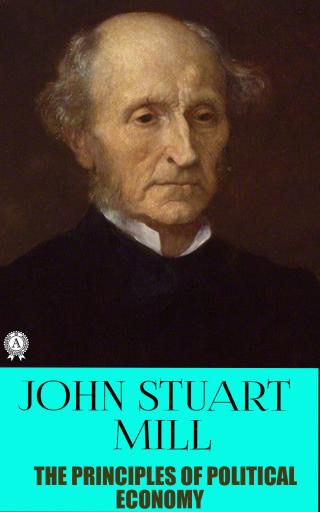
Principles Of Political Economy
- Автор: Mill John Stuart
- Год: 2022
- Язык: английский
- Год: Strelbytskyy Multimedia Publishing
- Жанр: Политика

Электронная книга - «Principles Of Political Economy». Краткое содержание книги:
Beside discussing descriptive issues such as which nations tended to benefit more in a system of trade based on comparative advantage (Mill's answer: those with more elastic demands for other countries' goods), the work also discussed normative issues such as ideal systems of political economy, critiquing proposed systems such as communism and socialism.
Along with A System of Logic, Principles of Political Economy established Mill's reputation as a leading public intellectual. Mill's sympathetic attitude in this work and in other essays toward contemporary socialism, particularly Fourierism, earned him esteem from the working class as one of their intellectual champions.
Even in a progressive state of capital, in old countries, a conscientious or prudential restraint on population is indispensable, to prevent the increase of numbers from outstripping the increase of capital, and the condition of the classes who are at the bottom of society from being deteriorated. Where there is not, in the people, or in some very large proportion of them, a resolute resistance to this deterioration—a determination to preserve an established standard of comfort—the condition of the poorest class sinks, even in a progressive state, to the lowest point which they will consent to endure. The same determination would be equally effectual to keep up their condition in the stationary state, and would be quite as likely to exist.
I can not, therefore, regard the stationary state of capital and wealth with the unaffected aversion so generally manifested toward it by political economists of the old school. I am inclined to believe that it would be, on the whole, a very considerable improvement on our present condition.
It is only in the backward countries of the world that increased production is still an important object; in those most advanced, what is economically needed is a better distribution, of which one indispensable means is a stricter restraint on population. On the other hand, we may suppose this better distribution of property attained, by the joint effect of the prudence and frugality of individuals, and of a system of legislation favoring equality of fortunes, so far as is consistent with the just claim of the individual to the fruits, whether great or small, of his or her own industry. We may suppose, for instance (according to the suggestion thrown out in a former chapter[304]), a limitation of the sum which any one person may acquire by gift or inheritance, to the amount sufficient to constitute a moderate independence. Under this twofold influence, society would exhibit these leading features: a well-paid and affluent body of laborers; no enormous fortunes, except what were earned and accumulated during a single lifetime; but a much larger body of persons than at present, not only exempt from the coarser toils, but with sufficient leisure, both physical and mental, from mechanical details, to cultivate freely the graces of life, and afford examples of them to the classes less favorably circumstanced for their growth. This condition of society, so greatly preferable to the present, is not only perfectly compatible with the stationary state, but, it would seem, more naturally allied with that state than with any other.
There is room in the world, no doubt, and even in old countries, for a great increase of population, supposing the arts of life to go on improving, and capital to increase. But even if innocuous, I confess I see very little reason for desiring it. The density of population necessary to enable mankind to obtain, in the greatest degree, all the advantages both of co-operation and of social intercourse, has, in all the most populous countries, been attained. If the earth must lose that great portion of its pleasantness which it owes to things that the unlimited increase of wealth and population would extirpate from it, for the mere purpose of enabling it to support a larger but not a better or a happier population, I sincerely hope, for the sake of posterity, that they will be content to be stationary, long before necessity compels them to it.
It is scarcely necessary to remark that a stationary condition of capital and population implies no stationary state of human improvement. Even the industrial arts might be as earnestly and as successfully cultivated, with this sole difference, that instead of serving no purpose but the increase of wealth, industrial improvements would produce their legitimate effect, that of abridging labor. Hitherto it is questionable if all the mechanical inventions yet made have lightened the day's toil of any human being. They have enabled a greater population to live the same life of drudgery and imprisonment, and an increased number of manufacturers and others to make fortunes. They have increased the comforts of the middle classes.
The statement that inventions have not “lightened the day's toil of any human being” has been persistently misquoted by many persons and has been taken out of its connection. Mr. Mill distinctly holds that the laborer's lot could have been improved had there been any limitation of population; that it is the constant growth of population as society progresses which destroys the gains afforded to the laboring-classes by improvements. But it is quite certain that the material facts of Mr. Mill's statement are no longer true. In the United States wages have risen, with an additional gain in lower prices; and Mr. Giffen shows the same progress in England. Moreover, travelers on the Continent speak of a similar movement already noticeable there. Mr. Giffen's statement in his comparison[305] with fifty years ago, is as follows:
“While the money wages have increased as we have seen, the hours of labor have diminished. It is difficult to estimate what the extent of this diminution has been, but collecting one or two scattered notices I should be inclined to say very nearly 20 per cent. There has been at least this reduction in the textile, engineering, and house-building trades. The workman gets from 50 to 100 per cent more money for 20 per cent less work; in round figures he has gained from 70 to 120 per cent in fifty years in money return. It is just possible, of course, that the workman may do as much, or nearly as much, in the shorter period as he did in his longer hours. Still, there is the positive gain in his being less time at his task, which many of the classes still tugging lengthily day by day at the oar would appreciate.”
Chapter V. On The Possible Futurity Of The Laboring-Classes.
§ 1. The possibility of improvement while Laborers remain merely receivers of Wages.
There has probably never been a time when more attention has been called to the material and social conditions of the working-classes than in the last few years. The great increase of literature and the extension of the newspaper has brought to every reader, even where public and private charities have not sent eye-witnesses into direct contact with distress, a more explicit knowledge of the working-classes than ever before. The revelation of existing poverty and misery is, often wrongly, taken to be a proof of the increasing degradation of the working-men, and the cause has been ascribed to the grasping cruelty of capitalists. Instances of injustice arising from the relations of employers and employed will occur so long as human nature remains imperfect. But the world hopes that some other relation than that of master and workman may be evolved in which not only many admitted wrongs may be avoided, but also new forces may be applied to raise the laborer out of his dependence on other classes in the community.
We are, at present, living under a régime of private property and competition. But certainly the progress of the laborer is not that which can excite enthusiastic hopes for the future, so long as he remains a mere receiver of wages. The progress of industrial improvements has resulted, says Mr. Cairnes, in “a temporary improvement of the laborer's condition, followed by an increase of population and an enlarged demand for the cheapened commodity.... Laborers' commodities, however, are for the most part commodities of raw produce, or in which the raw material constitutes the chief element of the value (clothing is, in truth, the only important exception); and of all such commodities it is the well-known law that an augmentation of quantity can only be obtained, other things being the same, at an increasing proportional cost. Thus, it has happened that the gain in productiveness obtained by improved processes has, after a generation, to a great extent been lost—lost, that is to say, for any benefit that can be derived from it in favor of wages and profits.... The large addition to the wealth of the country has gone neither to profits nor to wages, nor yet to the public at large (as consumers), but to swell a fund ever growing even while its proprietors sleep—the rent-roll of the owners of the soil.... The aggregate return from the land has immensely increased; but the cost of the costliest portion of the produce, which is that which determines the price of the whole, remains pretty nearly as it was. Profits, therefore, have not risen at all, and the real remuneration of the laborer, taking the whole field of labor, in but a slight degree—at all events in a degree very far from commensurate with the general progress of industry.”[306]
304
Book II, Chap. I, § 6.
305
“Progress of the Working-Classes in the Last Half-Century” (1884), page 8.
306
“Leading Principles,” pp. 278-280.