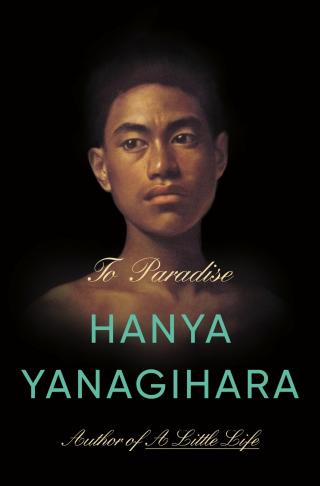
To Paradise
- Автор: Yanagihara Hanya
- Год: 2022
- Язык: английский
- Год: Knopf Doubleday Publishing Group
- Жанр: Современная русская и зарубежная проза

Электронная книга - «To Paradise». Краткое содержание книги:
In an alternate version of 1893 America, New York is part of the Free States, where people may live and love whomever they please (or so it seems). The fragile young scion of a distinguished family resists betrothal to a worthy suitor, drawn to a charming music teacher of no means. In a 1993 Manhattan besieged by the AIDS epidemic, a young Hawaiian man lives with his much older, wealthier partner, hiding his troubled childhood and the fate of his father. And in 2093, in a world riven by plagues and governed by totalitarian rule, a powerful scientist's damaged granddaughter tries to navigate life without him--and solve the mystery of her husband's disappearances.
These three sections are joined in an enthralling and...
I was worried I had been rude to reject him, but when I looked at him again, he was still smiling. “That was nice,” he said.
“Yes,” I said.
“Are you going to come next week?” he asked.
“I don’t know,” I said.
“Well,” he said, shifting his bag on his shoulder, “I am.” He paused. “Maybe I’ll see you again.”
“All right,” I said.
He smiled again and turned to leave. But after he had walked a few steps, he stopped and turned back around. “I never asked you your name,” he said.
He made it sound as if this were unusual, as if everyone I met or worked with knew my name, as if it were rude or extraordinary to not know. I cannot say that other people were not asked for their names; I cannot say that it was unsafe to tell someone your name. I thought of the two young women scientists at work, and how people must ask their names all the time. I thought of my husband in the house on Bethune Street, the familiar way that the man at the door had said, “You’re late tonight,” and how, in that house, everyone would know his name. I thought of the person sending him notes, and how that person too would know his name. I thought of the postdocs and scientists and Ph.D.s at work, all of whose names I knew—they knew my name, too, though not because it was mine; they knew it because they knew what it represented, they knew that my name explained why I was there at all.
But when was the last time someone had asked me my name simply because they wanted to know? Not because they needed it for a form or for a sample or to check my records—but because they wanted something to call me, because they were curious, because someone had thought to give it to me and they wanted to know what it was.
It had been years; it had been since I met my husband seven years ago in that marriage broker’s office in Zone Nine. I had told him my name, and he had told me his, and then we had talked. One year later, we were married. Three months after that, Grandfather was dead. It felt like no one had asked me since then.
So I turned to the man in gray, who was still standing there, waiting for me to answer.
“Charlie,” I told him. “My name is Charlie.”
“I’m pleased to meet you, Charlie,” he said.
PART IV
Winter, forty years earlier
Dearest P, February 3, 2054
Something strange happened to me today.
It was about two p.m., and I was about to catch the eastbound crosstown bus on 96th Street when, at the last minute, I decided to walk home instead. It’s been raining for weeks, so much that the East River flooded again, and they had to sandbag the entire eastern part of campus, and this was the first clear day. Not sunny, but not rainy, and warm, almost hot.
It had been a long time since I had walked through the Park, and after a few minutes, I found myself wandering north. It occurred to me as I did that I hadn’t been to this part of the Park—the Ravine, as it’s called, which is the wildest part, a large patch of simulated nature—since I was visiting New York as a university student, and how exotic it had seemed to me back then, exotic and beautiful. It had been December, when December was still cold, and although I had seen enough of East Coast and New England foliage by then, I had still been mesmerized by how brown it had been, brown and black and chill, dazzling in its starkness. I remember I had been impressed by how noisy winter was. The fallen leaves, the fallen twigs, the thin layer of ice that had accumulated on the paths: You stepped on them and they crunched and cracked beneath you, and above you the branches rustled in the wind, and around you there was the sound of melting ice dripping onto stone. I was used to being in jungles, where the plants are silent because they never lose their moisture. Instead of shriveling, they sag, and when they fall to the ground, they become not husks but paste. A jungle is silent.
Now, of course, the Ravine looks very different. It sounds different, too. Those trees—elms, poplars, maples—are long gone, withered to death by the heat, and replaced with trees and ferns that I remember from growing up, things that still look out of place here. But they’ve done well in New York—arguably, better than I have. Around 98th Street, I walked through a large copse of green bamboo, one that stretched north for at least five blocks. It created a tunnel of cool, green-scented air, something enchanted and lovely, and for a while I stood in it, inhaling, before finally exiting around 102nd Street, near the Loch, which is a man-made river that runs from 106th to 102nd Street. That picture I sent you, years ago, of David and Nathaniel wearing those scarves you gave to us? That was taken here, on one of his school field trips. I hadn’t been there.
Anyway, it was as I was leaving the bamboo tunnel, distracted, oxygen-dizzy, that I heard a sound, a splashing, coming from the Loch to my right. I turned, expecting to see a bird, perhaps, one of the flock of flamingos that flew north last year and then never left, when I saw it: a bear. A black bear, an adult by the looks of it. He was sitting, almost humanlike, on one of the large flat rocks on the riverbed, and leaning forward, resting his weight on his left paw as, with his right, he scooped the water, letting it run through his claws. As he did, he made a low sound, a growling. He wasn’t angry, I felt, but frantic—there was something intense and focused about his searching; he looked almost like a prospector from an old Western movie panning for gold.
I stood there, unable to move, trying to remember what you were supposed to do when you encountered a bear (Make yourself big? Or make yourself small? Make noise? Or run?), but he didn’t even turn toward me. But then the wind must have changed, and he must have smelled me, for he suddenly looked up, and as I took a first, tentative step away from him, he drew himself up on his hind legs and roared.
He was going to run at me. I knew it before I knew it, and I opened my mouth too, to scream, but before I could, there was a swift popping noise and the bear tumbled backward, all seven feet of him falling into the stream with a loud splash, and I saw the water staining itself red.
Then a man was by my side, another jogging toward the bear. “That was close,” said the man nearest me. “Sir? You okay? Sir?”
He was a ranger, but I wasn’t able to speak, and he unzipped a pocket on his vest, handed me a plastic sleeve of liquid. “You’re in shock,” he said. “Drink it—there’s sugar in it.” But my fingers wouldn’t work, and he had to open it for me, and help me detach my mask so I could drink. Next to me, I heard a second gunshot, and flinched. The man spoke into his radio: “We got him, sir. Yeah. The Loch. No—one passerby. No apparent fatalities.”
Finally, I was able to speak. “That was a bear,” I said, stupidly.
“Yes, sir,” said the ranger, patiently (I saw then that he was very young). “We’ve been hunting this one for a while.”
“This one?” I asked. “So there’ve been others?”
“Six over the past twelve months or so,” he said, and then, seeing my face, “We’ve kept it quiet. No fatalities, no attacks. This was the last of a clan we’ve been tracking. He’s the alpha.”
They had to take me back through the bamboo forest to their wagon to interrogate me about my encounter, and then they let me go. “Probably best not to be in this area of the Park anymore,” said the senior ranger. “Word is, the city’s going to shut it down in a couple of months anyway. The state’s commandeered it, going to use it as some facility.”
“The whole Park?” I asked.
“Not yet,” he said, “but likely north of Ninety-sixth Street. You take care, now.”
They drove away, and I stood there on the path for a few minutes. Next to me was a bench, and I stripped off my gloves and unbuckled my mask and sat there inhaling and exhaling, smelling the air, and running my hands over the wood, which was worn smooth and glossy from years of people sitting on it and touching it. It registered that I was lucky; to be saved, of course, and that my saviors were city rangers and not soldiers, who would surely have removed me to an interrogation center for questioning, because questioning is what soldiers do. Then I got up and walked quickly toward Fifth Avenue, and from there I caught a bus the rest of the way east.