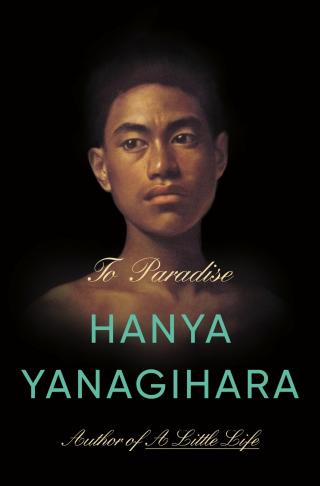
To Paradise
- Автор: Yanagihara Hanya
- Год: 2022
- Язык: английский
- Год: Knopf Doubleday Publishing Group
- Жанр: Современная русская и зарубежная проза

Электронная книга - «To Paradise». Краткое содержание книги:
In an alternate version of 1893 America, New York is part of the Free States, where people may live and love whomever they please (or so it seems). The fragile young scion of a distinguished family resists betrothal to a worthy suitor, drawn to a charming music teacher of no means. In a 1993 Manhattan besieged by the AIDS epidemic, a young Hawaiian man lives with his much older, wealthier partner, hiding his troubled childhood and the fate of his father. And in 2093, in a world riven by plagues and governed by totalitarian rule, a powerful scientist's damaged granddaughter tries to navigate life without him--and solve the mystery of her husband's disappearances.
These three sections are joined in an enthralling and...
I had been very smart about saving our coupons for the past four months so we could have a real feast, and along with the pig, I had also accumulated enough coupons so we could make dough: Half of the dough would be set aside for dumplings, and the other for an orange-flavored loaf. But mostly, I was excited about the pig. Every year or so, the state tried to introduce a new substitute for pig and other kinds of animal meat, and while some were very successful, the pig- and cow-protein replacements never were. There was something wrong with the flavor, no matter how hard they tried. Eventually, though, they would stop trying, because those of us who still remembered what cow and pig tasted like would forget, and at some point, there would be children born who would never know in the first place.
We spent the morning cooking, and then ate an early dinner at 16:00. There was enough food so that we were each able to have eight dumplings, as well as rice and mustard greens my husband had stewed in some sesame oil that we had saved up to buy, and we each had a slice of cake. This was the one day every year when conversation with my husband was easy, because we were able to talk about the food. Sometimes, we even talked about food we had eaten when we were young, between the periods of severe rationing, but that was always dangerous, because it made you start thinking about a lot of other things from when you were young.
Now my husband said, “My father used to make the best shredded pig.” It didn’t seem like I needed to reply, because it was a statement, not a question, and, indeed, he continued speaking. “We had it at least twice a year, even after the rationing, and he would slow-cook it for hours, and you only needed to touch it with your fork and it would fall apart on the plate. We’d have it with runner beans and macaroni, and if there were leftovers, my mother would make it into sandwiches. My sister and I used to—” And then he stopped talking abruptly, and put down his chopsticks, and looked at the wall for a moment before picking them up again. “Anyway,” he said, “I’m glad we were able to have this tonight.”
“As am I,” I said.
That night, as we lay in our beds, I wondered what my husband had been like before we met. I thought about this more the longer we were married, especially as I didn’t know that much about him. I knew that he was from Prefecture One, and that both of his parents had been professors at a big university, and that at some point both of them had been arrested and taken to rehabilitative camps, and that he had an older sister, who had also been removed to the camps, and that because his immediate family members had been declared enemies of the state, he had been expelled from the university where he had been a graduate student. We both had been officially forgiven under the 2087 Forgiveness Act and given good jobs, but we would never be allowed to reenroll in a university. Unlike my husband, I had no desire to return—I was satisfied being a lab tech. But my husband had wanted to be a scientist, and yet he never would. Grandfather had told me this. “I can only do so much, little cat,” he had said, but he never explained what he meant by that.
After Lunar New Year came Honor Day, which was always on a Friday. The state had instituted it in ’71. All businesses and institutes were closed on that day, and you were supposed to spend it quietly, thinking of people who had died, not just in ’70 but from any of the illnesses. The motto for Honor Day was “Not all who died were innocent, but all who died are forgiven.”
Couples usually spent Honor Day together, but my husband and I did not. He went to the center, where the state sponsored a concert of orchestral music, and lectures about grieving, and I took a walk around the Square. But now I wondered if he had in fact gone to Bethune Street.
Mostly, though, I thought of Grandfather, who had not died of an illness but was dead nonetheless. We had spent every Honor Day together, and Grandfather would show me pictures of my father, who had died in ’66, when I was two. He hadn’t died of disease, either, but it wasn’t until later that I learned that. That was also when my other grandfather had died—they had died at the same time, in the same place. It was this other grandfather to whom I was genetically related, although I can’t say I missed him, because I didn’t remember him at all. But Grandfather always said that he had loved me very much, and I liked hearing that, even though I didn’t remember him.
I can remember almost nothing of my father as well, because I have only a few memories of my life before the illness. Sometimes I had the sense that I had been a different person altogether, someone who didn’t have such a difficult time understanding other people and what they were really trying to say beneath the thing they were actually saying. One time, I asked Grandfather if he had liked me more before I got sick, and he turned his head away for a moment and then grabbed me and held me to him, even though he knew I didn’t like that. “No,” Grandfather said, in a funny, smothered voice, “I have always loved you just the same since the day you were born. I wouldn’t want my little cat any other way,” which was nice to hear and made me feel good, like I did when it was cool enough outside to wear long sleeves and I could walk and walk and never get overheated.
But one of the reasons I suspected that I might have been different was because, in the most vivid memory I have of my father, he is laughing and twirling a little girl around by her hands, spinning her so fast that she is soaring, her feet sweeping through the air. The little girl is wearing a pale-pink dress and has a black ponytail that sails behind her, and she is laughing, too. One of the only things I remember about being sick is this image, and after I got better, I had asked Grandfather who that little girl was, and he got a strange expression on his face. “That was you, little cat,” he said. “You and your father. He would spin you around like that until you both got dizzy.” At the time, I had thought this was impossible, because I was bald and couldn’t imagine having so much hair. But then, as I got older, I thought: Suppose that was me, with all that hair? What else had I had that I couldn’t remember? I thought of the little girl laughing, her mouth wide open, her father laughing with her. I could never make anyone laugh, not even Grandfather, and no one could make me laugh. But once I had. It was like being told I had once known how to fly.
Grandfather had always said that Honor Day was to honor me, because I had lived. “You have two birthdays in one year, little cat,” he said. “The day you were born, and the day you came back to me.” This is why I always thought of Honor Day as my day, though I would never say that aloud, because I knew it was selfish and, moreover, was impolite, because it disregarded all those who had died. The other thing I would never say aloud was that I had liked to hear Grandfather tell me about when I was sick; how I had lain in a hospital bed for months, and for weeks my fever had been so high that I couldn’t even talk; how almost all of my fellow patients on the ward had died; how I had one day opened my eyes and asked for Grandfather. I felt cozy hearing those stories, hearing Grandfather say how worried he had been, how he had sat by my bed every night, how he had read to me every day, how he had described to me the kinds of cakes he would get for me if I got better, cakes made with real strawberries swirled into the batter, or topped with sheets of chocolate that had been stamped to look like tree bark, or sprinkled with toasted sesame seeds. Grandfather said I had loved all sweets, especially cake, when I was a little girl, but after the illness, I had lost most of my taste for them, which was just as well, since by that point sugar had also been declared a restricted asset.