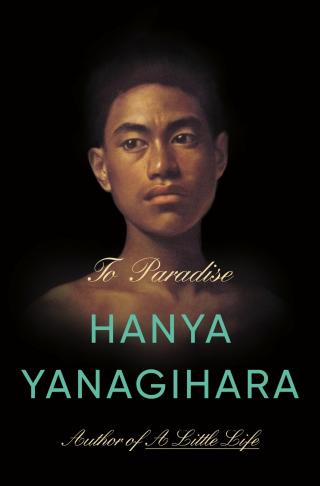
To Paradise
- Автор: Yanagihara Hanya
- Год: 2022
- Язык: английский
- Год: Knopf Doubleday Publishing Group
- Жанр: Современная русская и зарубежная проза

Электронная книга - «To Paradise». Краткое содержание книги:
In an alternate version of 1893 America, New York is part of the Free States, where people may live and love whomever they please (or so it seems). The fragile young scion of a distinguished family resists betrothal to a worthy suitor, drawn to a charming music teacher of no means. In a 1993 Manhattan besieged by the AIDS epidemic, a young Hawaiian man lives with his much older, wealthier partner, hiding his troubled childhood and the fate of his father. And in 2093, in a world riven by plagues and governed by totalitarian rule, a powerful scientist's damaged granddaughter tries to navigate life without him--and solve the mystery of her husband's disappearances.
These three sections are joined in an enthralling and...
How long had he been going there?
Once I was back in our apartment, I opened the box in the closet again and looked at the notes. I thought there might be a new one, but there wasn’t. As I was rereading them, I realized they didn’t say anything that interesting—they were just everyday words. And yet I somehow knew that they were never the sort of notes that my husband would write me or that I would write him. I knew this, but I couldn’t explain how they were different. I looked at them again, and then I put them all away and lay down on my bed. I realized that I wished I had never followed my husband, because what I had learned hadn’t helped me at all. In fact, all I had learned was that my husband was probably going to the same place on every one of his free nights, although this was just a theory, and I couldn’t prove it unless I followed him every free night from now on. But the detail that had upset me most was how, after my husband had answered the person on the other side of the door, he had laughed. I couldn’t remember the last time I had heard my husband laugh, or indeed, if I ever had—he had a nice laugh. He was in another house, laughing, and I was at home, waiting for him to return.
The next day, I went to RU, as always, where the mood in the lab was still strange, the postdocs still quiet and busy, the Ph.D.s still anxious and excited. I moved among them, distributing the new pinkies, removing the old ones, lingering near the Ph.D.s I knew were naturally talkative, the ones who liked to gossip. This time, however, there was only silence.
But I was patient, which Grandfather always said was an underrated virtue, and I knew that the Ph.D.s tended to relax around 15:00 through 15:30, when most of them took a break to drink tea. They weren’t supposed to drink tea around their work spaces, of course, but most of them did, especially as the postdocs were in another room then, having their daily meeting. And so I waited until a few minutes past 15:00 before I went to pick up the old embryos from the Ph.D.s’ area.
For a few moments, there was just the sipping of tea, which wasn’t actually tea but a nutrient-rich powder that was supposed to taste like tea and had been developed at the Farm. It always made me think of Grandfather. I was ten when tea was declared a restricted asset, but Grandfather had a small supply of smoked black tea that he had saved, and for a year, we drank that. He would measure it so carefully—just a few shreds of it per pot—but the leaves were so powerful that that was all you needed. After we finally ran out, he got the powder, but he never drank it himself.
Then, though, one of the Ph.D.s said, “Do you think it’s true?”
“They’re acting like it,” said another.
“Yeah, but how do we know this isn’t just another false positive?” asked a third.
“The genomic sequencing is different here,” said a fourth, and then the conversation became too technical for me to follow, though I stayed and listened anyway. I couldn’t comprehend much, but what I did understand was that there had been another new disease diagnosed, and that it was very bad, potentially disastrous.
New diseases were often being discovered at RU, and not just at RU but in other laboratories around the world as well. Every Monday, Beijing would send the principal investigators at every accredited research organization a status report listing the previous week’s tally of fatalities and new diagnoses of the three to five most severe ongoing pandemics, as well as new developments they were tracking. The tallies were broken down by continent, and then by country, and then, if need be, by prefecture and municipality. Then, every Friday, Beijing would compile and send out the latest research findings—whether clinical or epidemiological—reported by the member nations. The goal, Dr. Wesley once said, was not to eradicate the diseases, because that would be impossible—it was to contain them, preferably within the regions where they were discovered. “Epidemics, not pandemics,” Dr. Wesley said. “Our goal is to discover them before they disseminate.”
I have worked at RU, and in Dr. Wesley’s lab, for seven years, and at least once a year there was at least one scare, when there was an emergency radio announcement, as there had been the week before, and everyone in the institute grew frightened and excited, because it seemed that we were at risk of experiencing the next great pandemic, one as bad as the illnesses of ’56 and ’70, both of which Dr. Wesley said had “remapped the world.” But in the end, every one of those threats had been contained. In fact, none of them had even affected the island; there had been no quarantine or isolation mobilization, no special bulletins, no coordination with the National Pharmacology Unit. Still, the pattern was to remain alert in the first thirty days after the discovery of a new disease, because that was the typical incubation period of most of these illnesses—even though, as everyone would admit in private, just because that had been the pattern of these diseases, it didn’t mean that the successive diseases would behave the same way. That was why what the scientists in our lab did was so important—they tried to predict the next mutation, the next illness that would endanger us all.
I know this will be a surprising thing to hear, but many scientists can be very superstitious. I say this because, over the last few years, the alarm about these reports has grown; I think everyone believes that the upcoming plague—whatever it will be—is overdue. There had been fourteen years between the illness of ’56 and the illness of ’70; now it was ’94, and nothing catastrophic had happened. Of course, as Dr. Morgan likes to say, we are in a much better position now than they were in ’70, and this is true. Our labs are more sophisticated; there’s more scientific cooperation. It’s much more difficult to spread misinformation and therefore breed panic; you can’t just get on a plane and unknowingly infect people in other countries; you can’t just share your theories of whatever’s happening on the internet with whomever you want, whenever you want; there are systems in place to segregate and humanely treat the affected. So things are better.
I was not superstitious. I may not have been a scientist, but I knew that things don’t happen according to patterns, even if it may look like it. This is why I was confident that this was just another minor incident, just as the others had been, one that would excite for a few weeks longer and then vanish, another disease not even worthy of a name.
Every Lunar New Year, there was a limited amount of pig meat available at the grocery. Typically, the National Nutritional Unit would know by December how much pig they would be able to make available for chosen zones, and by the end of the month, a sign would go up in the grocery telling you how many half-kilo portions would be available, and how many extra protein coupons you would need to spend to purchase them. Then you had to sign up for the lottery, which was drawn on the last Sunday of January, unless the New Year came early, in which case the lottery was drawn ten days before the holiday, so you would have plenty of time to rearrange your plans if you didn’t win.
I had only won the pig lottery once, the second year my husband and I were married. After that, there had been bad weather in the prefectures and colonies where the pigs were grown, and there had been very little meat. But 2093 had been a good year, with no significant climatic events, and well-controlled outbreaks, and I was hopeful that this time, we would have pig for the holiday.
I was very excited when my number was among the chosen. It had been a long time since I had had pig, and I loved the taste of it—my husband liked it, too. I had been worried that the New Year celebration would fall on a Thursday, as it had two years ago, and I would be alone, but instead it was on a Monday, and my husband and I spent the day cooking. This is something that—two years ago aside—we had done every lunar holiday since we got married, and because of that, it was the day I looked forward to most.