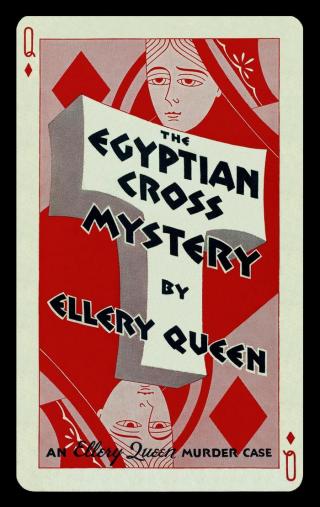
The Egyptian Cross Mystery
- Автор: Куин (Квин) Эллери
- Серия: Ellery Queen #5
- Год: 1932
- Язык: английский
- Год: Frederick A. Stokes Company
- Жанр: Классические детективы

Электронная книга - «The Egyptian Cross Mystery». Краткое содержание книги:
Ellery’s sharp eyes were fixed on that portion of the wooden floor which was directly before the rustic table. Scrawled there boldly, in blood, was a capital T.
“Pretty thing,” he muttered, and swallowed hard as he tore his gaze from the symbol. “Mr. Isham, have you been able to explain the T on the floor?”
The District Attorney spread his hands. “Now, I ask you, Mr. Queen. I’m an old hand at this game, and from what I know of you, you’ve had plenty of experience with such things. Could any reasonable man doubt that this is the crime of a maniac?”
“No reasonable man could,” said Ellery, “and no reasonable man would. You’re perfectly right, Mr. Isham. A totem pole! Felicitous, eh, Professor?”
“Post,” said Yardley. “You mean the possible religious significance?” He shrugged. “How anyone could put together symbols of North American fetishism, Christianity, and primitive phallicism is beyond the imagination of even a maniac.”
Vaughn and Isham stared; neither Yardley nor Ellery enlightened them. Ellery stooped to examine something which lay on the floor, near the coagulated blood. It was a long-stemmed brier pipe.
“We’ve looked that over,” said Inspector Vaughn. “Fingerprints on it. Brad’s. His pipe, all right; he was smoking in here. We’ve put it back for you just where we found it.”
Ellery nodded. It was an unusual pipe, of striking shape; its bowl was skillfully carved in the semblance of a Neptune’s head and trident. It was half full of dead gray ashes, and near the bowl on the floor, as Vaughn pointed out, were tobacco ashes of similar color and texture; as if the pipe had been dropped and some of the ashes had spilled.
Ellery stretched his hand out to take the pipe — and stopped. He looked at the Inspector. “You’re positive, Inspector, that this was the victim’s pipe? I mean — you’ve checked up with the residents of the house?”
“As a matter of fact, no,” replied Vaughn stiffly. “I don’t see why the hell we should doubt it. After all, his prints—”
“And he was wearing a smoking jacket, too,” pointed out Isham. “And no other form of tobacco on him — cigarettes or cigars. I can’t see, Mr. Queen, why you should think—”
Professor Yardley smothered a smile in his beard, and Ellery remarked almost idly: “But I don’t think anything of the sort. It’s merely habit with me, Mr. Isham. Perhaps...”
He picked up the pipe and carefully knocked the ashes out on the surface of the table. When no more ashes fell, he looked into the bowl and saw that a covering of half-burnt tobacco remained on the bottom. He produced a glassine envelope from his pocket-kit and, scraping the unsmoked tobacco from the bottom, poured it into the envelope. The others watched in silence.
“You see,” he said, rising, “I don’t believe in taking things for granted. I’m not suggesting that this isn’t Brad’s pipe. I do say, however, that the tobacco in it may be a definite clue. Suppose this is Brad’s pipe, but that he borrowed the tobacco from his murderer. Surely a common enough occurrence. Now, you’ll notice that this tobacco is cube-cut; not a common cut, as you perhaps know. We examine Brad’s humidor; do we find cube-cut tobacco? If we do, then this is his, and he did not borrow it from his murderer. At any rate we have lost nothing; confirmed the previous facts. But if we don’t find cube-cut tobacco, there’s a fair presumption that the tobacco came from his murderer, and that would be an important clue... Excuse me for babbling.”
“Very interesting,” said Isham. “I’m sure.”
“The minutiae of the detectival science,” chuckled Professor Yardley.
“Well, how does it stack up to you so far?” demanded Vaughn.
Ellery polished the lenses of his pince-nez thoughtfully; his lean face was absorbed. “It’s ridiculous, of course, to make any more concrete statement than this: The murderer was either with Brad when Brad came to the summerhouse, or he was not; there is nothing so far to tell. In any event, when Brad strolled out into his gardens, headed for his summerhouse, he had in his hand a red checker which for some peculiar reason he must have picked up in his house — wherever the remains of the checker game are to be seen. In the summerhouse he was attacked and killed. Perhaps the attack occurred while he was smoking; the pipe dropped from his mouth and fell to the floor. Perhaps, too, his fingers were in his pocket playing with the checker absently. At the time he died the checker was still clutched in his hand, and remained so all the time he was being decapitated, hauled to the totem post and lashed to the wings. Then the checker fell and rolled off in the gravel, unobserved by the murderer... Why he brought the checker with him at all seems to me a most relevant query. It may have a definite bearing on the case... An unilluminating analysis, eh, Professor?”
“Who knows the nature of light?” murmured Yardley.
Dr. Rumsen fussed into the summerhouse. “Job’s done,” he announced.
“What’s the verdict, Doc?” asked Isham eagerly.
“No signs of violence on the body,” snapped Dr. Rumsen. “From this it’s perfectly evident that whatever killed him was directed at his head.” Ellery started; it might have been Dr. Strang repeating the testimony he had given in the Weirton courtroom months before.
“Could he have been strangled?” asked Ellery.
“No way of telling now. Autopsy will show, though, by the condition of the lungs. The body’s stiffness is a simple rigor, which won’t wear off for another twelve to twenty-four hours.”
“How long has he been dead?” asked Inspector Vaughn.
“Just about fourteen hours.”
“Then it was in the dark!” cried Isham. “Crime must have been committed around ten o’clock last night!”
Dr. Rumsen shrugged. “Let me finish, will you? I want to go home. Strawberry birthmark seven inches above the right knee. That’s all.”
As they left the summerhouse Inspector Vaughn said suddenly: “Say, that reminds me, Mr. Queen. Your father mentioned over the phone that you had some information for us.”
Ellery looked at Professor Yardley, and Professor Yardley looked at Ellery. “Yes,” said Ellery, “I have. Inspector, does anything about this crime strike you as peculiar?”
“Everything about it strikes me as peculiar,” grunted Vaughn. “Just what do you mean?”
Ellery thoughtfully kicked a pebble out of his path. They passed the totem post in silence; the body of Thomas Brad was covered now, and several men were placing it on a stretcher, They headed down the path toward the house.
“Has it occurred to you to ask,” continued Ellery, “why a man should be beheaded and crucified to a totem post?”
“Yes, but what good does it do me?” snarled Vaughn. “It’s crazy, that’s all.”
“Do you mean to say,” Ellery protested, “that you haven’t noticed the multiple T’s?”
“The multiple T’s?”
“The pole itself — a fantastic T in shape. The pole for the upright, the flatout spread wings for the arms.” They blinked. “The body: head cut off, arms outstretched, legs close together.” They blinked again. “A T deliberately scrawled in blood on the scene of the crime.”
“Well, of course,” said Isham doubtfully, “we saw that, but—”
“And to bring it to a farcical conclusion,” said Ellery without smiling, “the very word totem begins with a T.”
“Oh, stuff and nonsense,” said the District Attorney instantly. “Pure coincidence. The pole, too, the position of the body — it just happened that way.”
“Coincidence?” Ellery sighed. “Would you call it coincidence if I told you that six months ago a murder was committed in West Virginia in which the victim was crucified to a T-shaped signpost on a T-shaped crossroads, his head cut off, and a T smeared in blood on the door of his house not a hundred yards away?”