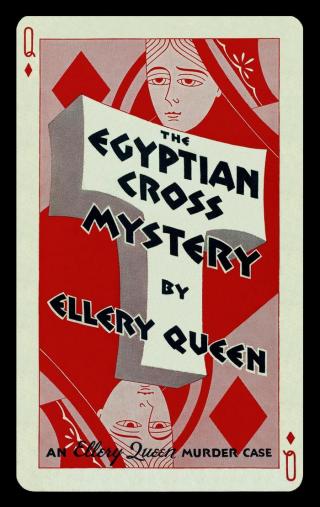
The Egyptian Cross Mystery
- Автор: Куин (Квин) Эллери
- Серия: Ellery Queen #5
- Год: 1932
- Язык: английский
- Год: Frederick A. Stokes Company
- Жанр: Классические детективы

Электронная книга - «The Egyptian Cross Mystery». Краткое содержание книги:
If the problem was too much for him, it was certainly too much for Coroner Stapleton, District Attorney Crumit, Colonel Pickett, the Coroner’s jury, the citizens of Arroyo and Weirton, and the scores of newspapermen who had flocked to town on the day of the inquest. Directed by the Coroner, who sternly resisted the temptation to leap to the obvious but unsupported solution, the jury scratched its collective head and brought in a verdict of “death at the hands of person or persons unknown.” The newspapermen prowled about for a day or so, Colonel Pickett and District Attorney Crumit went about in ever slowing circles, and finally the case died in the press — a death warrant indeed.
Ellery returned to New York with a philosophic shrug. He was inclined to believe, the longer he mulled over the problem, that the explanation was after all simple. There was no reason, he felt, to doubt the overwhelming indications of the evidence. Circumstantial, to be sure, but positive in their implications. There was a man by the name of Velja Krosac, an English-speaking foreigner, something of a charlatan, who for dark reasons of his own had planned, sought, and finally taken the life of a country schoolmaster, also foreign-born. The method, while interesting from the criminological standpoint, was not necessarily important. It was the horrible but comprehensible expression of a mind buckled by the strange fires of manic psychology. What lay behind — what sordid story of fancied wrong or religious fanaticism or blood-demanding vengeance — would probably never be known. Krosac, his gruesome mission accomplished, would naturally vanish, and perhaps even now was on the high seas, bound for his native country. Kling, the manservant? Undoubtedly the innocent victim, caught between two fires, done away with by the executioner because he had witnessed the crime or caught a glimpse of the murderer’s face. Kling represented in all likelihood a bridge that Krosac felt compelled to burn behind him. After all, a man who did not shrink from severing a human head merely to illustrate in broken flesh the symbol of his revenge would hardly turn squeamish at the necessity of killing an unexpected danger to his own safety.
And so Ellery returned to New York to accept the shrewd twigging of the Inspector.
“I’m not going to say ‘I told you so,’” chuckled the old man over the dinner table on the night of Ellery’s return, “but I want to point out a moral.”
“Do,” murmured Ellery, attacking a chop.
“The moral is: Murder is murder, and ninety-nine and nine-tenths per cent of the murders committed anywhere on the face of the globe, you young idiot, are as easy as pie to explain. Nothing fancy, you understand.” The Inspector beamed. “I don’t know what in time you expected to accomplish down in that God-forsaken country, but any flatfoot pounding a beat could have told you the answer.”
Ellery laid down his fork. “But logic—”
“Mumbo-jumbo!” snorted the Inspector. “Go on and get some sleep.”
Six months passed, during which Ellery completely forgot the bizarre events of the Arroyo murder. There were things to do. New York, unlike its kin in Pennsylvania, was not exactly a city of brotherly love; homicides were plentiful; the Inspector dashed about in an ecstasy of investigation, and Ellery trailed along, contributing his peculiar faculties to those cases which piqued his interest.
It was not until June, six months after the crucifixion of Andrew Van in West Virginia, that the Arroyo murder was forcibly brought back to his mind.
It was on Wednesday, the twenty-second of the month, that the spark was touched off. Ellery and Inspector Queen were at breakfast when the doorbell rang, and Djuna, the Queens’ boy-of-all-work, answered the door to find a messenger there with a telegram for Ellery.
“Queer,” said Ellery, tearing open the yellow envelope. “Who the deuce could be wiring me this early in the morning?”
“Who’s it from?” mumbled the old man out of a mouthful of toast.
“It’s from—” Ellery unfolded the message and glanced down at the typed signature. “From Yardley!” he cried, in vast surprise. He grinned at his father. “Professor Yardley. You remember, Dad. One of my profs at the University.”
“Sure I do. The Ancient History feller, hey? Stayed with us one weekend when he came into New York. Ugly chap with chin whiskers, as I recall.”
“One of the best. They don’t make ’em that way any more,” said Ellery. “God, it’s years since I’ve heard from him! Why on earth should he—”
“I’d suggest,” said the old man mildly, “That you read the message. That’s generally the way to find out why a person writes to you. In some ways, my son, you’re thicker than mud.”
The twinkle in his eye disappeared as he watched Ellery’s face. That gentleman’s jaw had dropped perceptibly.
“What’s the matter?” asked the Inspector in haste. “Somebody die?” He still preserved the middle-class superstition that telegrams boded no good.
Ellery tossed the yellow slip across the table, jumped from his chair, hurled his napkin at Djuna, and dashed into the bedroom, flinging off his dressing gown as he went.
The Inspector read:
THOUGHT AFTER ALL THESE YEARS YOU MIGHT LIKE TO COMBINE BUSINESS WITH PLEASURE STOP WHY NOT PAY ME THAT LONG DEFERRED VISIT STOP YOU WILL FIND NICE JUICY MURDER ACROSS THE ROAD FROM MY SHACK STOP HAPPENED THIS VERY MORNING AND LOCAL GENDARMES STILL ARRIVING STOP VERY INTERESTING STOP MY NEIGHBOR FOUND CRUCIFIED TO HIS TOTEM POST WITH HEAD MISSING STOP I SHALL EXPECT YOU TODAY