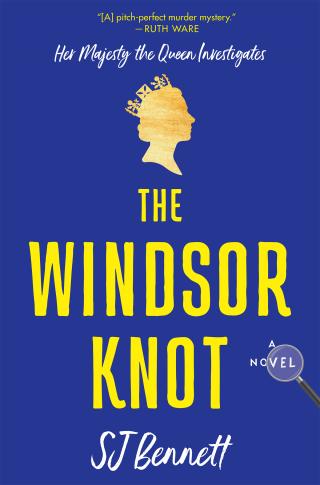
The Windsor Knot
- Автор: Беннет Си Джей
- Серия: Her Majesty the Queen Investigates #1
- Год: 2021
- Язык: английский
- Год: William Morrow
- ISBN: 978-0-06-305002-0
- Жанр: Другие детективы

Электронная книга - «The Windsor Knot». Краткое содержание книги:
It is the early spring of 2016 and Queen Elizabeth is at Windsor Castle in advance of her 90th birthday celebrations. But the preparations are interrupted when a guest is found dead in one of the Castle bedrooms. The scene suggests the young Russian pianist strangled himself, but a badly tied knot leads MI5 to suspect foul play was involved. The Queen leaves the investigation to the professionals—until their suspicions point them in the wrong direction.
Unhappy at the mishandling of the case and concerned for her staff’s morale, the monarch decides to discreetly take matters into her own hands. With help from her Assistant Private Secretary, Rozie Oshodi, a British Nigerian and recent officer in the Royal Horse Artillery, the Queen secretly begins making inquiries. As she carries out her royal duties with her usual aplomb, no one in the Royal Household, the government, or the public knows that the resolute Elizabeth will use her keen eye, quick mind, and steady nerve to bring a murderer to justice.
SJ Bennett captures Queen Elizabeth’s voice with skill, nuance, wit, and genuine charm in this imaginative and engaging mystery that portrays Her Majesty as she’s rarely seen: kind yet worldly, decisive, shrewd, and most importantly a great judge of character.
“I invited Henry Evans,” Fiona said cheerfully, as if the idea had been her own. “I believe you know each other.”
Mr. Evans bowed. When he straightened and smiled, the Queen suddenly remembered what a sweet, boyish expression he had, and how charmingly innocent he seemed, given his specialist subject. “We do indeed. Good afternoon. How nice to see you.”
“And you, Your Majesty.”
“I hope it wasn’t too much trouble to get here.”
“On the contrary. A positive delight. Especially to come to Henley. You have a beautiful home, Lady Hepburn.”
“Oh, Henry. You charmer.” Fiona grinned. “Have a scone.”
They chitchatted with friendly politeness, while Rozie sat at a nearby table, pretending to be engrossed in her notes. She was impressed that Henry Evans managed to talk animatedly about the journey from the Royal Military Academy at Sandhurst, where he worked as a lecturer, without showing the slightest concern about why he’d been summoned in the first place. Rozie hadn’t been able to explain much on the phone—beyond mentioning how much she, personally, had enjoyed his lectures when she had done her officer training there. That wasn’t relevant to today’s meeting, though, so she made do with a brief smile of recognition and kept herself apart.
After a while Lady Hepburn made some excuse about checking with the lady from the village who was helping out in the kitchen, and they were alone.
“Now, Mr. Evans, I wanted to ask you something,” the Queen said, almost without pause.
“Yes?”
“The suspicious deaths of Russians on British soil. You’ve been studying them for a while, haven’t you?”
“A couple of decades, ma’am.”
“You contributed to that report I got last year. I remember you accompanying the minister to the palace.”
“That’s right.”
“And you believe the Russian State has been murdering its enemies here in Britain with impunity?”
“Not exactly the Russian State, ma’am. Putin and his allies, specifically. I know he can be seen to embody the State these days. It’s all a bit murky.”
“Did the list include any journalists?”
“Only Markov, who worked for the BBC. He was the Bulgarian dissident writer, killed with the ricin bullet fired from an umbrella in seventy-eight. Before Putin’s time, of course—but it set a precedent.”
The Queen nodded. “On Waterloo Bridge, I remember.”
“Exactly, ma’am. It seemed almost too le Carré to be true.”
She nodded at the reference. People assumed she didn’t read—God knows why, she probably read more papers in a month than most people in a lifetime, and she was fond of a good spy story. Henry Evans understood her better than many of her ministers.
“How many deaths have there been since then?”
“On British soil? Five or six. The first was Litvinenko in 2006. He was the ex–FSB agent poisoned with polonium-210. Horrible business.”
“Quite. And yet no one was arrested or charged for any of them.”
“No, ma’am,” Evans confirmed. “Not since that agent we tried to extradite for the Litvinenko poisoning.”
“The Americans often tell my ambassador how furious they are with us.”
He gave a wry smile. “They’re welcome to supply the evidence.”
There was a pause while he took a quick sip of tea. Rozie noticed how naturally the Queen took the teapot to refill his cup. She was a remarkably practical person for someone with hundreds of servants to call on, and, in fact, an army. (As Rozie knew from experience, the British Army specifically pledged allegiance to her, not the government, and meant it.)
After another warming sip he went on. “Putin’s good these days. Since the slipup with Litvinenko, which was sloppy, all the subsequent deaths have been very professional. And there’s still a question mark over whether Boris Berezovsky was murder or suicide.”
“What do you think?”
“Oh, murder, definitely. The color of the face, the broken rib, the shape of the ligature . . . But one could of course argue, as they did, that he was found in a locked bathroom, and he was certainly depressed. Berezovsky’s a tricky case. He was the most high-profile of Putin’s critics, the richest, until the Abramovich lawsuit bankrupted him, the man most obviously in Putin’s sights. All I can say is whoever staged the suicide, if it was staged, did a damn good job of it. And the others were harder still to pin on Moscow.”
“Go on.”
“Well, Perepilichnyy died of a heart attack while out running four years ago. They found traces of a poison in his system, but no proof of how he came by it. Gorbuntsov was the victim of an assassination attempt in Mayfair the same year. He survived it, but the would-be assassin got away. Scott Young—he was the one with links to Berezovsky—was depressed when he fell onto railings. It’s not that we don’t suspect Russian involvement. It’s that we don’t want to start a diplomatic war without incontrovertible proof of why we’re doing it.”
“Naturally. They all died in their homes or public places?”
“Yes.” He seemed surprised that she would ask.
“And they all had high-level links to people in Moscow? I believe your report said as much.”
“Absolutely. These were quarrels about whistleblowing or money. That’s where their threat to Moscow lay.”
“Tell me, what do you think of the idea of these people killing someone purely to send a message?”
“What kind of message?”
“Just to say they can. Someone low-level. The wrong person in the wrong place, so to speak.”
Henry Evans considered the question. He stared out at the gunmetal-grey clouds, whose outline mirrored the billowing yew beneath. He was considering over two decades of research into suspicious deaths behind the old Iron Curtain, and later here at home, since he had first become interested as an A-level student at school in Manchester.
“It’s not Putin’s style,” he said eventually. “I can’t think of another example. Do you have someone in mind?”
The Queen ignored his question. “Imagine they’ve changed tack. That it’s not about who, it’s about where.”
Evans’s brow furrowed. “I don’t understand.”
The Queen tried to channel Gavin Humphreys as objectively as she could. “They’ve used poison in the past, have they not? Sometimes rare, radioactive poison, as if to make it clear that they are the perpetrators, even if they can’t be brought to justice.”
“Yes, but that’s for revenge. Revenge on individuals for specific acts, and to send a message to other individuals not to do the same. I can’t see how that works if it’s just the location that matters.” He still looked perplexed by the Queen’s line of reasoning.
“What if the location were very . . . specific? Designed to show how brazen they can be when they want to?”
“It just . . . I . . .” Evans trailed off. He was frustrated. He genuinely wanted to support his sovereign, to follow her argument and agree with it if he possibly could. He’d never known her to spout what in other company would be robustly referred to as “bollocks,” so he was very surprised by what she was suggesting. Whoever heard of an assassination based on location? What was she on about?
“And you said the Litvinenko murder was sloppy,” the Queen added. “Agents don’t always behave as professionally as they should. Do they sometimes panic? Have you come across this?”
Again he stared at her and tried not to seem rude. “Panic, ma’am?”
“Yes. The Berezovsky case, too. You said there were problems with the ligature.”