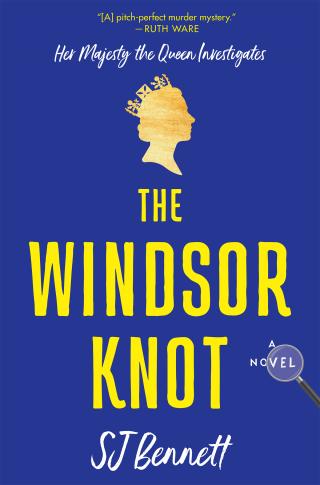
The Windsor Knot
- Автор: Беннет Си Джей
- Серия: Her Majesty the Queen Investigates #1
- Год: 2021
- Язык: английский
- Год: William Morrow
- ISBN: 978-0-06-305002-0
- Жанр: Другие детективы

Электронная книга - «The Windsor Knot». Краткое содержание книги:
It is the early spring of 2016 and Queen Elizabeth is at Windsor Castle in advance of her 90th birthday celebrations. But the preparations are interrupted when a guest is found dead in one of the Castle bedrooms. The scene suggests the young Russian pianist strangled himself, but a badly tied knot leads MI5 to suspect foul play was involved. The Queen leaves the investigation to the professionals—until their suspicions point them in the wrong direction.
Unhappy at the mishandling of the case and concerned for her staff’s morale, the monarch decides to discreetly take matters into her own hands. With help from her Assistant Private Secretary, Rozie Oshodi, a British Nigerian and recent officer in the Royal Horse Artillery, the Queen secretly begins making inquiries. As she carries out her royal duties with her usual aplomb, no one in the Royal Household, the government, or the public knows that the resolute Elizabeth will use her keen eye, quick mind, and steady nerve to bring a murderer to justice.
SJ Bennett captures Queen Elizabeth’s voice with skill, nuance, wit, and genuine charm in this imaginative and engaging mystery that portrays Her Majesty as she’s rarely seen: kind yet worldly, decisive, shrewd, and most importantly a great judge of character.
“When would you like?”
“As soon as possible. You know my schedule.” There was a pause. “And, Rozie—”
“Ma’am?”
The Queen gave her another odd look. This one was different from the last. That had been uncertain; this one was challenging. “A private conversation.”
Back at her desk, Rozie went over the whole encounter in her head.
What did “private” mean? Of course tea at Lady Hepburn’s house would be private. Was the expert—and Rozie thought she knew the man the Queen was referring to—supposed to keep quiet about meeting Her Majesty? Rozie would make sure he did, but why not just say so? Her relationship with the Boss had been pretty straightforward until now: she simply did whatever the Queen told her, and if there was any doubt, she checked with Sir Simon, who had nearly twenty years’ experience and knew everything, and . . .
And suddenly Rozie knew what the Queen meant. And why it had been impossible to say it out loud. And why this was a test, though one she sensed the Queen didn’t want to give her.
It was all rather frightening and just a little bit exciting.
She logged on to a government database of experts and set about finding a particular man to invite to tea.
The Queen sat up in bed, writing her diary entry for the day. She never wrote much, and certainly not what she was thinking now. Many historians would be itching at the opportunity to get their hands on the pages she dutifully composed in longhand each night, which one day would be deposited in the Royal Archives in the Round Tower, alongside those of Queen Victoria. But such historians would almost certainly be disappointed. Whoever read this document in the twenty-second century would find it a detailed source of racing information, observations on the dullness of certain prime ministers, and minor family anecdotes. Her deepest thoughts she kept between herself and God.
And God knew, Vladimir Putin was an infuriating individual, definitely a cruel one, but not stupid. You didn’t become the richest man in the world, as rumor had it, by making lazy mistakes. Nor was he the sort of person to ignore the unspoken accord among the ruling classes, among whom he was so proud to count himself these days: princes simply did not tread directly on the patch of other princes. One might spy, certainly, if one could. One might seek to undermine one’s enemies in negotiations or elections. But you did not commit lèse-majesté and cause havoc in their palaces. If you did—who knew?—perhaps one day they might do the same in yours. Even dictators understood this.
Technocratic heads of MI5, it seemed, did not.
The Queen had not bothered to try to correct Mr. Humphreys. He seemed so certain of himself and so little interested in her opinion, even though she had met Putin and ruled alongside him, temporally speaking, for decades.
Dogs. They knew. Like Candy this morning. The corgis had hated Mr. Putin on sight and tried to nip his ankles during a state visit. Even a minister’s guide dog had barked, she remembered. Dogs have such natural instincts. Putin used them to his advantage. He knew that Angela Merkel was afraid of them. Was that because she was brought up in East Germany, the Queen wondered, where they were more likely to be trained as guard dogs rather than pets? Armed with this information, he had ensured the German chancellor was met by two aggressive German shepherds when she came to visit him in the Kremlin. The poor woman. It was a mark of the smallness of the man. The Queen did not always agree with Mrs. Merkel’s politics, but she was fond of her. Merkel had managed to stay at the helm of a great democracy for a decade. She was a woman in a man’s world—as it most certainly had been when she started. As it still was, if one went by the photographs at meetings of heads of state: Merkel’s, the only trouser suit in a sea of trousers. The Queen knew very much how that felt—although of course she did not share Merkel’s rather Teutonic sense of fashion.
She realized she hadn’t written anything in her diary for about ten minutes and tried to get back to the sentence she had left half finished, but her mind continued on its train of thought.
Putin was absolutely the sort of man who would seek to make a woman like Merkel uncomfortable. He was a bully, an ex–KGB officer with an unhealthy fondness for control. His attitude to canines, and theirs to him, said it all. Yet this did not mean he would have a very junior young expat killed on one’s own turf. When such a thing was so unnecessary.
According to Humphreys, this cold and calculating man had established a spy in her Household just in case one of his enemies should come to visit—a very junior enemy indeed—so that he could show off the extent of his power. And when that moment had come, this “sleeper”—who had presumably been in place for years, simply waiting—had set up an elaborate attempt to suggest suicide and had failed to check the simplest of knots. Why suggest suicide at all if you wanted to make a statement about yourself? Was the idea that the police would realize it was murder after all? If so, surely there were more subtle ways of doing so than to make the whole sordid affair look so ham-fistedly botched. She liked to think that if one did have a traitor in one’s midst, he would at least be half competent. Oh, the whole thing was unutterably ridiculous.
And yet, “It wouldn’t be the first time. . . .”
Well, no, it wouldn’t. And that had seemed impossible, too.
Anthony Blunt was her first surveyor of pictures, having worked for her father before her. What an erudite, cultured man, so at home among the courtiers. A Cambridge don, he was an art historian, an expert on Poussin and the Sicilian Baroque, and a member of MI5 himself. He had saved her uncle Edward from embarrassment by rescuing some of his letters during the closing stages of the war.
He was also, as he later confessed, a long-term committed Communist and a Soviet agent. He and his friends had caused untold damage to the people she held most dear. He had remained at work at the palace for years after she was told, to spare the shame and embarrassment of admitting how far he had come—until Margaret Thatcher let the cat out of the bag and Blunt had to go. He seemed repentant for some of it, but one could never be sure.
She couldn’t pretend that all her servants were above reproach. There had even been a play by Alan Bennett, and the BBC had made a film of it, with a comic actress who portrayed her as a prig and a frump. Not the Crown’s finest hour in any sense.
Gavin Humphreys’s words brought back unpleasant memories and made her doubt herself, which was not something she particularly liked to do. Nor did she enjoy having to rely on Rozie Oshodi when the girl was so new and so young. But one did what one had to. And hoped to be pleasantly surprised.
She wrote another paragraph about something else entirely and drifted off, with difficulty, to sleep.
Part 2
The Last Dance
7
“What’s this in the diary for tomorrow?”
Rozie looked up from her keyboard at Sir Simon, who had popped his head round her office door. She tried to keep any hint of nerves from her voice.
“The afternoon, you mean?”
“Yes. She’s supposed to be visiting her cousin in the Great Park after lunch. It’s been in for weeks.”
“I know. But unfortunately Lady Hepburn’s brother died recently and the Queen wanted to see her. When the invitation to tea came, she asked me to accept.”