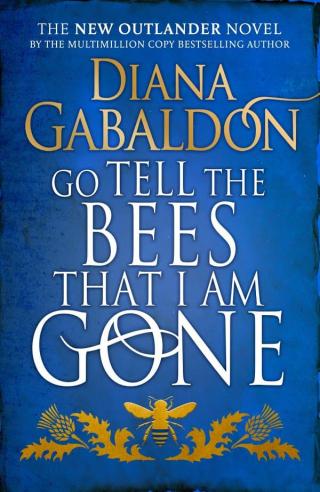
Go Tell the Bees That I Am Gone
- Автор: Гэблдон Диана
- Серия: Outlander #9
- Год: 2021
- Язык: английский
- Год: Delacorte Press
- ISBN: 978-1-473-51900-8
- Жанр: Исторические приключения

Электронная книга - «Go Tell the Bees That I Am Gone». Краткое содержание книги:
The past may seem the safest place to be . . . but it is the most dangerous time to be alive. . . .
Jamie Fraser and Claire Randall were torn apart by the Jacobite Rising in 1746, and it took them twenty years to find each other again. Now the American Revolution threatens to do the same. It is 1779 and Claire and Jamie are at last reunited with their daughter, Brianna, her husband, Roger, and their children on Fraser’s Ridge. Having the family together is a dream the Frasers had thought impossible. Yet even in the North Carolina backcountry, the effects of war are being felt. Tensions in the Colonies are great and local feelings run hot enough to boil Hell’s teakettle. Jamie knows loyalties among his tenants are split and it won’t be long until the war is on his doorstep. Brianna and Roger have their own worry: that the dangers that provoked their escape from the twentieth century might catch up to them. Sometimes they question whether risking the perils of the 1700s—among them disease, starvation, and an impending war—was indeed the safer choice for their family. Not so far away, young William Ransom is still coming to terms with the discovery of his true father’s identity—and thus his own—and Lord John Grey has reconciliations to make, and dangers to meet . . . on his son’s behalf, and his own. Meanwhile, the Revolutionary War creeps ever closer to Fraser’s Ridge. And with the family finally together, Jamie and Claire have more at stake than ever before.
It had, though, and she lifted her head to find her mother’s eyes fixed on her face, with a look of intent thoughtfulness she knew all too well. The heron.
“I’m fine,” she said firmly, trying anyway. “Just—I just got light-headed for a minute.”
One of her mother’s brows twitched up, but Claire said nothing. Her hand was still wrapped around Brianna’s telltale wrist.
“Really. It’s nothing,” she said, detaching herself from her mother’s grip.
Each time, she’d told herself it was nothing.
“When did it start?” Claire’s eyes were normally a soft amber—except when she was being a doctor. Then they went a sharp, dark-pupiled yellow, like the eyes of a bird of prey.
“When you told me you— Jesus, did you just tell me …” Brianna got her feet under her and rose. Cautiously, but her heart went on quietly beating, just as it should. It’s nothing.
“Yes, I did. And I don’t mean this time,” her mother said dryly, rising, too. “When did it first happen?”
She debated lying, but the urge to keep denying that anything was truly amiss was fading fast against the need—the hope—of being reassured.
“Right after we came through the stones on Ocracoke. It was—I didn’t think I’d make it.” The giddiness threatened to come back with the memory of that … that … Her gorge rose suddenly, and she leaned over and threw up, a light spatter of half-digested porridge on the clean new boards of the surgery.
“Dear me.” Her mother’s voice was mild. “You aren’t pregnant, are you?”
“Don’t even think it!” She shuddered, wiping her mouth on her apron. “I can’t be.” She hadn’t even thought of the possibility, and wasn’t about to start. She was already haunted by the idea that she might die and leave Jem and Mandy …
“On Ocracoke,” she repeated, getting hold of herself. “I came out of the stones with Mandy in my arms. I couldn’t see—it was all black and white spots, and I thought I was going to faint, and then I sort of did … I was lying on the ground and I still had hold of Mandy; she was fighting to get loose and yelling, ‘Mummy, Mummy!’ but I couldn’t answer her and then I realized my heart wasn’t beating. I thought I was dying.” She smelled something sweet and pungent, and her mother wrapped Bree’s fingers around a cup and guided it to her lips.
“You’re not going to die,” her mother said, with a welcome tone of conviction. Bree nodded, wanting to believe it, even though her heart was still skipping beats, leaving moments of emptiness in her chest. She sipped the liquid; it was whisky, sweetened with honey, and with something herbal and very fragrant in it.
She closed her eyes and concentrated on taking slow sips, willing things to settle down, to go back to normal. Her surroundings were beginning to come back. The sun from the big window fell warm on her shoulders.
“How often has it happened?”
She swallowed, savoring the sweetness that was seeping into her bloodstream, and opened her eyes.
“Four times, before now. At Ocracoke, then again the next night. We were camping, on the road.” She flinched at the memory; lying rigid on the ground next to Roger, the children asleep between them. Her heart racing, fists clenched not to grab Roger’s arm and shake him awake. “That was bad—it went on for hours. Or at least it seemed like hours. It stopped finally, just before dawn.” She’d felt wrung out, limp as the dew-damp clothes that wrapped her limbs; she still remembered the terrible effort needed to rise, to put one foot in front of the other …
The next time had been a week later, on a barge in the Yadkin River, and the last before this on the road from Cross Creek to Salisbury.
“Those weren’t so bad. Just a few minutes—like this one.” She took another sip, held it in her mouth, then swallowed and looked up at her mother. “Do you know what it is?”
Her mother was wiping up the last of the vomit from the raw floorboards, lips compressed, a pair of vertical lines visible between her soft brows.
“There’s a limit to what I can say for certain, lacking an EKG,” Claire said, eyes on the cloth she was using. “But speaking very generally—it sounds as though you’re exhibiting something called atrial fibrillation. It’s not life threatening,” she added quickly, looking up and seeing the alarm on Bree’s face.
Her heart had given a sort of flopping leap at her mother’s words, and was beating now in what seemed a tentative fashion. Her knees were quivering and she sat down, quite suddenly. Her mother dropped the cloth, got down beside her, and pulled her close. Her face was half buried in her mother’s coarse gray apron, smelling of grease and rosemary, soft soap and cider. The smell of the cloth, of Mama’s body, brought helpless tears to her eyes. Maybe it wasn’t life threatening, but she could tell that it wasn’t nothing, either.
“It’s going to be all right,” her mother whispered into her hair. “It’ll be all right, baby.”
She was clutching her mother’s arm, hard, the slender bone a life raft.
“If—if anything happens—you’ll take care of the kids for me.” It wasn’t a question and her mother didn’t take it as one.
“Yes,” she said, without hesitation, and the quivering sensation eased in Bree’s chest. She was breathing hard, but there didn’t seem room for enough air.
“Okay,” she said. She could feel her fingers trembling on her mother’s arm, and with an effort let go. “Okay,” she said again, and sitting up straight, pushed her hair out of her face. “Okay. Now what?”
LUB-DUB, LUB-DUB … THE meaty sounds of a healthy heart were clear through my wooden Pinard stethoscope. Beating a little faster than normal—and no wonder—but healthy. I straightened up and Bree instantly clutched the neck of her blouse closed, her face tense.
“Your heart sounds perfect, darling,” I said. “I’m sure that it’s a bit of atrial fibrillation, but that’s just a matter of stray electrical impulses. You aren’t going to have a heart attack or anything of that sort.”
The tension in her face eased, and my own heart clenched a little.
“Well, thank God for that.” A thick lock of hair had come loose from its ribbon, and I saw that her hand was trembling as she brushed it back from her face. “But it—is it going to keep happening?”
“I don’t know.” Aside from bad news, “I don’t know” is the worst thing a doctor can say to a patient, but it’s unfortunately the most usual thing, too. I took a deep breath and turned to my medicine shelves.
“Oh, God,” Bree said, the genuine apprehension in her voice tinged with reluctant amusement. “You’re getting out more whisky. It must be serious.”
“Well, if you don’t want any, I do,” I said. I’d chosen the good stuff, the Jamie Fraser Special, rather than the strictly medicinal whisky I gave the patients, and the scent of it rose warm and lively, displacing the smells of turpentine, scorched metal, and pollen-laced dust.
“Oh, I’m pretty sure I do.” She took the tin cup and inhaled the comforting fumes, her eyes closing involuntarily and her face relaxing.
“So,” she said, raising an eyebrow. “What do you know?”
I rolled my own whisky slowly round my tongue, then swallowed, too.
“Well, as I said, atrial fibrillation is a matter of irregular electrical impulses. Your heart muscle is sound, but it’s—once in a while—getting its signals crossed, so to speak. Normally, all the muscle fibers in your atria contract at once; when they don’t get a synchronized message from the electrical node in your heart that supplies them, they contract more or less at random.”