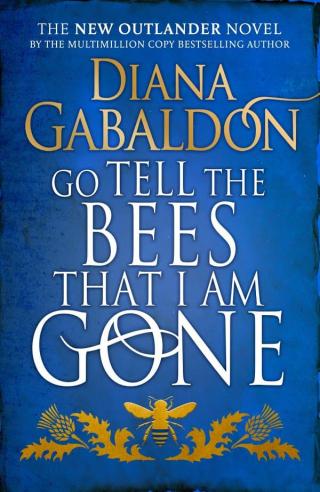
Go Tell the Bees That I Am Gone
- Автор: Гэблдон Диана
- Серия: Outlander #9
- Год: 2021
- Язык: английский
- Год: Delacorte Press
- ISBN: 978-1-473-51900-8
- Жанр: Исторические приключения

Электронная книга - «Go Tell the Bees That I Am Gone». Краткое содержание книги:
The past may seem the safest place to be . . . but it is the most dangerous time to be alive. . . .
Jamie Fraser and Claire Randall were torn apart by the Jacobite Rising in 1746, and it took them twenty years to find each other again. Now the American Revolution threatens to do the same. It is 1779 and Claire and Jamie are at last reunited with their daughter, Brianna, her husband, Roger, and their children on Fraser’s Ridge. Having the family together is a dream the Frasers had thought impossible. Yet even in the North Carolina backcountry, the effects of war are being felt. Tensions in the Colonies are great and local feelings run hot enough to boil Hell’s teakettle. Jamie knows loyalties among his tenants are split and it won’t be long until the war is on his doorstep. Brianna and Roger have their own worry: that the dangers that provoked their escape from the twentieth century might catch up to them. Sometimes they question whether risking the perils of the 1700s—among them disease, starvation, and an impending war—was indeed the safer choice for their family. Not so far away, young William Ransom is still coming to terms with the discovery of his true father’s identity—and thus his own—and Lord John Grey has reconciliations to make, and dangers to meet . . . on his son’s behalf, and his own. Meanwhile, the Revolutionary War creeps ever closer to Fraser’s Ridge. And with the family finally together, Jamie and Claire have more at stake than ever before.
“Would you care to rephrase that?” I said politely.
One of the benefits of long marriage is that you can see quite clearly where some conversations are likely to lead—and occasionally you can sidestep the booby traps and choose another path by silent mutual assent. He pursed his lips a little, looking thoughtfully up at me. Then he took a deep breath and nodded.
“Dorothea will write to her father, if she hasna done it already,” he said reasonably. He tucked Judah’s letter into his sporran and stood up. “His Grace will do whatever can be done.”
“We don’t know that Dottie can write to her father. She may not be near Denzell—she may not even know that he’s in prison! For that matter, we don’t know where Hal—er, I mean the duke—is, either,” I added. Bloody hell, I shouldn’t have called Hal by his first name … “But he and John can both be found, at least. The British army certainly knows where they are.”
“By the time I sent a message to Savannah or New York, Denzell will likely have been released, or paroled. Or moved.”
“Or died.” I unfolded my arms. “For heaven’s sake, Jamie. If anybody knows what the conditions are like inside a British prison, it’s you!”
He’d turned to go, but at this, his head whipped round like a snake’s.
“Aye, I do.”
Aye, he did. Prison is where he met John …
“Besides,” I said, trying to scramble back onto safer ground, “I said I’d write to him. Denzell’s more my friend than yours. You needn’t be involved at all.”
The blood was rising up the column of his neck, never a good sign.
“I dinna mean to be ‘involved,’” he said, handling the word as though it had fleas. “And I dinna mean you to be ‘involved’ with John Grey. At all,” he added as an emphatic footnote, and snatched up the shovel with which he’d been digging the new well for the garden, in a manner suggesting that he would have liked nothing better than to crown John Grey with it—or, failing that, me.
“I’m not suggesting any sort of involvement,” I said, with a fair assumption of calm.
“It’s a wee bit late for that,” he said, with a nasty emphasis that sent the blood up into my own cheeks.
“For God’s sake! You know what happened. And how. You know I—”
“Aye, I ken what happened. He laid ye down in his bed, spread your thighs, and swived ye. Ye think I’m ever going to hear the man’s name and not think of that?” He said something very rude in Gaelic featuring John’s testicles, drove the blade of his shovel into the ground, then pulled it up again.
I breathed slowly through my nose, lips pressed firmly together.
“I thought,” I said after a moment, “that we’d done with that.”
I had rather thought that. Apparently that had been wishful thinking on my part. And quite suddenly, I remembered what he’d said—well, one of the things he’d said—when he’d come to find me in Bartram’s Garden, he risen from the dead and smelling of cabbages, me mud-stained and shattered with joy.
“I have loved ye since I saw you, Sassenach. I will love ye forever. It doesna matter if ye sleep with the whole English army—well, no,” he had corrected himself, “it would matter, but it wouldna stop me loving you.”
I drew a slightly calmer breath, though my mind went right ahead and presented me with something else he’d said, later in that conversation:
“I don’t say that I dinna mind this, because I do. And I don’t say that I’ll no make a fuss about it later, because I likely will.”
He moved close to me and looked down into my face, blue eyes dark with intent.
“Did I tell ye once that I am a jealous man?”
“You did, but …”
“And did I tell ye that I grudged every hour ye’d spent in another man’s bed?”
I took a deep breath to squash down the hasty words I could feel boiling up.
“You did,” I said, through only slightly clenched teeth.
He glared at me for a long moment.
“I meant it,” he said. “I still mean it. Ye’ll do what ye damn please—God knows, ye always do—but don’t pretend ye dinna ken what I feel about it!”
He turned on his heel and stalked off, shovel over his shoulder like a rifle.
My fists were clenched so hard I could feel my nails cutting into my palms. I would have thrown a rock at him, but he was already out of range and moving fast, shoulders bunched with anger.
“What about William?” I bellowed after him. “If he’s ‘involved’ with John, so are you, you pigheaded Scot!”
The shoulders bunched harder, but he didn’t turn round. His shout floated back to me, though.
“Damn William!”
A SMALL COUGH from behind me distracted me from the mental list of synonyms for “bloody Scot!” I was compiling. I turned round to find Fanny standing there, her apron bulging with dirt-covered turnips and her sweet face fixed in a troubled frown, this directed at Jamie, who was vanishing into the trees by the creek.
“What has Will-iam done, Mrs. Fraser?” she asked, glancing up at me from under her cap. I smiled, in spite of the recent upheaval. Her speech was very fluent now, save when she was upset or talking fast, but she often still had that slight hesitation between the syllables of William’s name.
“William hasn’t done anything amiss,” I assured her. “Not that I know of. We haven’t seen him since … er …” I broke off an instant too late.
“Jane’s funeral,” she said soberly, and looked down into the purple-and-white mass of turnips. “I thought … maybe Mr. Fraser had had a letter. From William. Or maybe about him,” she added, the frown returning. She nodded toward the trees. “He’s angry.”
“He’s Scottish,” I amended, with a sigh. “Which means stubborn. Also unreasonable, intolerant, contumelious, froward, pigheaded, and a few other objectionable things. But don’t worry; it really isn’t anything to do with William. Here, let’s put the turnips in the tub there and cover them with water. That will keep the tops from wilting. I’m making bashed neeps for supper, but I want to cook the tops with bacon grease and serve them alongside. If anything will make Highlanders eat a leafy green vegetable, bacon grease ought to do it.”
She nodded as though this made sense and let down her apron slowly, so the turnips rolled out into the tub in a tumbling cascade, dark-green tops waving like pom-poms.
“You probably shouldn’t have told him.” Fanny spoke with an almost clinical detachment.
“Told who what?” I said, picking up a water bucket and sloshing it over the muddy turnips. “Get another bucket, will you?”
She did, heaved the water into the tub, then set down the bucket, looked up at me, and said seriously, “I know what ‘swived’ means.”
I felt as though she’d just kicked me sharply in the shin.
“Do you, indeed?” I managed, picking up my working knife. “I, um … suppose you would.” She’d spent half her short life in a brothel in Philadelphia; she probably knew a lot of other words not in the vocabulary of the average twelve-year-old.
“It’s too bad,” she said, turning to fetch another bucket; the boys had filled all of them this morning; there were six left. “I like his lordship a lot. He wath—was so good to me and—and Jane. I like Mr. Fraser, too,” she added, though with a certain reserve.
“I’m sure he appreciates your good opinion,” I said gravely, wondering, What the hell? “And yes, his lordship is a very fine man. He’s always been a good friend to us.” I put a bit of emphasis on the “us,” and saw that register.