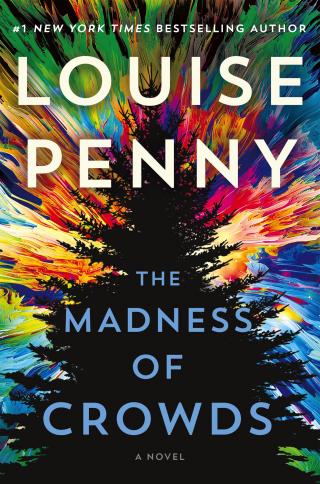
The Madness of Crowds
- Автор: Пенни Луиза
- Серия: Chief Inspector Gamache #17
- Год: 2021
- Язык: английский
- Год: St. Martin's Publishing Group
- ISBN: 9781250145284
- Жанр: Другие детективы

Электронная книга - «The Madness of Crowds». Краткое содержание книги:
You're a coward.
Time and again, as the New Year approaches, that charge is leveled against Armand Gamache.
It starts innocently enough.
While the residents of the Québec village of Three Pines take advantage of the deep snow to ski and toboggan, to drink hot chocolate in the bistro and share meals together, the Chief Inspector finds his holiday with his family interrupted by a simple request.
He's asked to provide security for what promises to be a non-event. A visiting professor of statistics will be giving a lecture at the nearby university.
While he is perplexed as to why the head of homicide for the Sûreté du Québec would be assigned this task, it sounds easy enough. That is, until Gamache starts looking into Professor Abigail Robinson and discovers an agenda so repulsive he begs the university to cancel the lecture.
They refuse, citing academic freedom, and accuse Gamache of censorship and intellectual cowardice. Before long, Professor Robinson's views start seeping into conversations. Spreading and infecting. So that truth and fact, reality and delusion, are so confused it's near impossible to tell them apart.
Discussions become debates, debates become arguments, which turn into fights. As sides are declared, a madness takes hold.
Abigail Robinson promises that if they follow her, ça va bien aller. All will be well. But not, Gamache and his team know, for everyone.
When a murder is committed, it falls to Armand Gamache, his second-in-command Jean-Guy Beauvoir, and their team to investigate the crime as well as this extraordinary popular delusion.
And the madness of crowds.
“How could it matter? What more was there?”
“A great deal more,” said Gamache, his voice calm. Calming. “I think she found the copy of the letter among your father’s things when she was helping you clear them out. It was probably in his agenda along with this.” He nodded to Lacoste, who placed the old photograph on the table, then backed away.
Abigail glanced at it. “How can any of this matter? Gilbert killed Debbie to get back the letter that he wrote Dad. He did it to protect himself. This has nothing to do with what Dad did. With what happened to Maria.”
“It has everything to do with it,” said Gamache. “When Debbie read the suicide note your father left, she realized it wasn’t quite the same as you’d said. Inspector Lacoste saw it too. She pointed out that Paul Robinson never actually confesses to killing Maria.”
“He does,” said Abigail. “He says it. He did it for me. So I wouldn’t have to look after Maria for the rest of my life. So that I could go away to university, do my research. He did it for her too. To free her too. And then he killed himself, to free himself of the guilt. And yes, whether he meant to or not, he put that guilt on me. Do you know what that did to me?”
“It made you write a report on the pandemic that suggested euthanizing the frail and vulnerable,” said Gamache. “It made what happened to your sister no longer murder, but a mercy killing.”
“That’s a lie.” Her voice rose higher, strained, her breathing heavier now, more rapid.
Chest, head. Chest, head.
If Gamache had come to the cabin looking for emotion, he’d found it.
“But suppose your father didn’t kill Maria,” he said.
“What do you mean?” asked Abigail.
“Why would he confess to a murder, to killing his own daughter, for God’s sake,” said Haniya, “if it wasn’t true?”
“Ahhhh,” said Gamache. “And that’s where we come to it. You might be here for your own reasons, but that’s why we’re here. To answer that question.”
“Answer it if you want, if you can. But it’s too late,” said Abigail. “Too much damage done. The only truth that matters is that he”—she shoved the rifle toward Gilbert—“helped Cameron kill my mother, my sister, my father. And now he’s killed Debbie. It stops here. Now. Nothing else matters.”
She hiked the rifle up.
Gilbert took a step back and stumbled on the chair behind him, while Beauvoir warned Abigail. “Don’t!”
“Your father’s letter wasn’t written out of guilt,” said Gamache, taking a small step forward. His voice was soft, almost mesmerizing. “It was love.”
He could see her hesitating.
“It was love,” Gamache repeated, his voice dropping, forcing her to listen. “He didn’t kill Maria. The letter was to you, always to you. He didn’t want you to be alone, to be afraid, when you read it. That’s why he sent it to someone he knew he could trust. With his life and with yours.”
Gamache glanced at Colette, who gave a small nod of acknowledgment.
“When your father got home from the conference that day,” he continued, “Maria was already dead, wasn’t she? He could see she’d been smothered. He knew it could only have been you or Debbie. I think he had to assume the worst.”
“The worst?” asked Haniya. She looked at Abigail. “You? You killed your sister?”
Colette shook her head. “No, she didn’t. But Paul had to assume she had, in case it was true. So he covered it up. And took the blame.”
Jean-Guy tried to keep his focus on Abigail. Tried to erase an image that would never completely go away. Of Paul Robinson hurriedly making the peanut butter sandwich, while one daughter called for help and the other lay dead. And then, picking up the sandwich, he …
“No,” said Abigail, adamant. “My father would never think that of me. He’d know I couldn’t do such a thing. I loved my sister.”
And yet, Gamache considered, Paul Robinson had thought exactly that.
“Your father lost his mind,” said Colette. “He was overcome with a sort of fugue, a temporary insanity. All he could think of was protecting you.”
“But I didn’t—”
Once again Gamache held up his hand. “He was a careful man. He’d close all holes, make absolutely sure there could never be any doubt. He wrote that letter, then took his life as his final act of love, to make absolutely sure you’d never be accused of the crime. But his confession was worded in such a strange way.”
He brought the letter out of his breast pocket. It was warm from sitting against his rapidly beating heart.
“He writes”—Gamache found the place—“It wasn’t deliberate. I know that.” He looked up. “He’s writing to you. To tell you that he knows you didn’t really mean to do it. He wants you to know that he forgives you, and that you’re free now, to live your life. To continue your studies at Oxford. To fulfill your potential. He wanted you to know that you’re safe.”
“That’s why he sent it to me,” said Colette. “He wanted me to know the truth. And to watch over you. To carry on his work of protecting you. I did it from far away, but I was always there. Always watching.”
“That was his eternal gratitude,” said Beauvoir.
“Yes.”
“No, that’s not the truth, I didn’t kill Maria,” said Abigail, exasperated. “And how can this have anything to do with what happened to Debbie?”
“That was the question,” said Isabelle Lacoste. “If your father didn’t kill Maria, and you didn’t, then who did?”
A silence descended on the cabin, broken only by the shrieking birds outside.
“Debbie?” suggested Gilbert, tentatively. “She did it?”
“Debbie?” demanded Abigail. “Why would she hurt Maria?”
The rifle was getting heavy, the tip dipping, then lifting.
Chest, abdomen. Chest, abdomen.
“Jealousy,” said Lacoste. “That picture says it all.” She nodded toward the photograph on the table. “Debbie locked it away in her desk because she didn’t want to see it. She didn’t want to see the little girl she’d killed, and she sure didn’t want to see how much you loved her. Look at it.” They did. “Look at Debbie’s expression. Look at how she’s tugging your arm. She’s practically ripping you away from your sister. You must’ve known.”
“I knew she was possessive, yes. That’s part of the reason I wanted to cool the friendship. She was smothering me.”
If Abigail realized the word she’d just used, she didn’t show it.
“There’s another reason Debbie might’ve killed Maria,” said Gamache. “The same one your father wrote in his letter. To free you of a burden.”
“No, Maria was never a burden.”
“I’m telling you what Debbie might have thought. Is that what she told you, when she confessed?” he asked. “That she did it for love?”
“Confessed? What’re you saying?”
“What are you saying, Armand?” demanded Colette.
“You know what I’m saying.” He hadn’t taken his eyes off Abigail. “She confessed, and you killed her.”
“No!”
“Yes.” His voice was grave. Sad. There was no triumph.
“Armand.” Colette reached for him, but Lacoste stepped between them.
“When Debbie found and finally read your father’s suicide note,” said Gamache, taking another step forward. He saw Abigail grip the rifle, steady the rifle. He saw, in his peripheral vision, Beauvoir brace himself, to take the shot. “She realized your father blamed you for what happened. She decided to tell you the truth.”
“No!”
“That night, New Year’s Eve.” He had her full attention now. “When Colette left Debbie and returned to the Inn, you went out to look for her, to tell her you were leaving. You found her on the trail. She told you then. That your father hadn’t killed Maria, she had. I think she had both letters with her. The one from Gilbert to your father. The one you wanted to threaten Gilbert with. But she had another. The one from your father.”